
Crunch Time for the CLARITY Act: What’s in Store for Crypto?


The CLARITY Act, the most closely watched piece of crypto legislation in the U.S. history, has entered its final sprint.
Over the past few months, questions such as who should receive stablecoin yields, how to allocate liability in DeFi, and whether traditional banks would suffer a “bloodletting” have repeatedly stalled the bill. It wasn’t until recently that the deadlock was truly broken. Senator Thom Tillis confirmed on Monday that he and Senator Alsobrooks have been in talks with various parties for months and have finally produced a proposal that is broadly acceptable to all sides.
So, what exactly does the long-delayed CLARITY Act entail? And if it passes, what changes will it bring to the crypto market? This article provides an in-depth breakdown.
CLARITY Act Overview: Establishing Compliance and Classification
The Digital Asset Market Clarity Act (CLARITY Act) is the most ambitious attempt at crypto industry regulation by the U.S. Congress to date.
The bill passed the House of Representatives in July 2025 but has been stalled for an extended period due to disputes in the Senate.
Simply put, the bill primarily covers three key areas:
- First, it clarifies the regulatory boundaries between the SEC and the CFTC. This is one of the most challenging issues facing those U.S. crypto companies. Currently, there is an overlap in the SEC and CFTC’s functions regarding the classification of digital assets, leaving companies facing long-standing uncertainty regarding their “regulatory status” from a compliance perspective.
- Second, establishing a regulatory framework for stablecoins. The bill imposes restrictions on stablecoin yields, but more crucially, it expands the scope of coverage—unlike the GENIUS Act signed in 2025, which targeted only issuers, the CLARITY Act extends to a broader range of entities, including trading platforms and wallet service providers, thereby filling a legislative gap.
- Third, strengthening investor protection and disclosure requirements. The bill strengthens the legal basis for holding parties accountable for fraudulent transactions, clarifies the criteria for determining market manipulation, and restricts insiders from abusing non-public information for illegal gains.
Additionally, federal regulators will issue a stablecoin disclosure framework and a list of compliance activities within one year of the bill’s passage, establishing a more predictable compliance roadmap for the industry’s development.
The Key Compromise: How Does the Stablecoin Yield Provision Balance the Interests of Both Sides?
It is clear that the biggest stumbling block preventing this bill from moving forward has been the issue of stablecoin yields—specifically, where the money comes from and whether it will siphon deposits away from banks—which has long been a major point of contention between the traditional banking sector and the crypto industry.
The key to breaking this deadlock lies in the compromise text on stablecoin yields reached by Senators Thom Tillis and Angela Alsobrooks. The provision explicitly prohibits crypto companies from paying “any form of interest or yield” (i.e., similar to bank deposits or interest-bearing products without cause) solely because customers hold stablecoins. However, it preserves room for rewards based on “real activity,” such as trading rebates, membership benefits, and on-chain interaction incentives.
Traditional banks have long feared that high-yield stablecoins would erode their deposit base, leading to massive capital outflows. This ban directly positions stablecoins as “payment tools” rather than “savings products,” effectively putting their minds at ease.
On the other hand, while crypto project teams cannot directly pay interest, they can still gain market share through product innovation, boosting user engagement, and expanding use cases.
In my view, this compromise may appear to be a mere semantic game on the surface, but it effectively amounts to a “redefinition of function”—stablecoins have shifted from their previous role as “savings-like assets” seeking risk-free returns back to that of “base money” for payments, settlements, and ecosystem incentives. However, the exact criteria for determining “real activity” remain vague, and this is likely to become a new battleground for all parties vying for regulatory interpretation in the future.
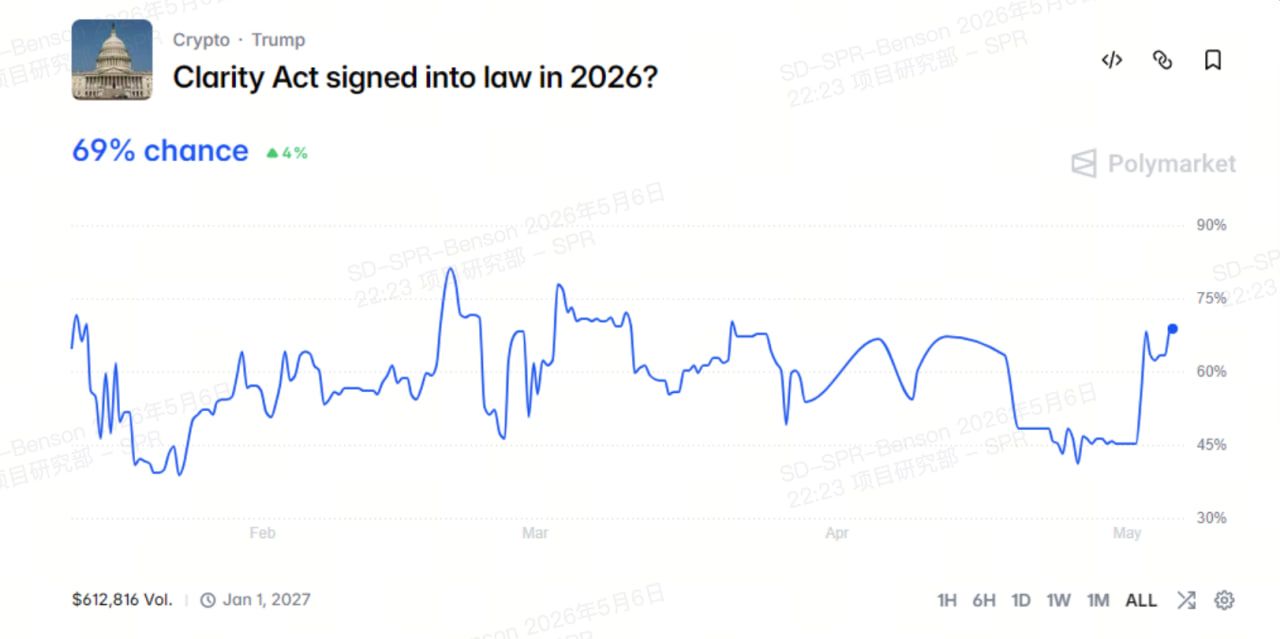
Following the key compromise, the probability of the bill being signed into law in 2026 surged to 70% on the prediction market Polymarket, setting a monthly high. https://polymarket.com/event/clarity-act-signed-into-law-in-2026
With the implementation of this compromise, the probability of the bill being signed into law in 2026 on the prediction market Polymarket briefly surged to 70%, setting a monthly record.
However, on the very day this article was written, U.S. banking trade groups still stated that the Senate’s stablecoin incentive compromise was “not sufficient”—they fear that the wording of the ban is not firm enough and that disguised economic incentives might emerge.
Clearly, this battle is far from over.
What Changes Will the Crypto Market See?
In fact, on every level, the CLARITY Act is more than just a simple update to regulatory terminology; it marks a landmark shift for the U.S. crypto market as it moves from a “pilot phase” to “institutionalization,” and the crypto market will benefit from this.
- Leading compliance players see a revaluation: As a leader in compliant stablecoins, Circle (CRCL) is one of the bill’s biggest beneficiaries, with its stock surging 20% on Monday alone. As interest income from reserve assets grows and USDC continues to expand its market share across multiple use cases, Circle’s profit outlook is expected to become increasingly clear, enabling its transformation from a “crypto cyclical stock” to a “Web3+AI infrastructure stock.”
- Stablecoin ecosystem stands to benefit directly: Stablecoins are explicitly defined as “payment tools” rather than “deposit-like products.” This represents a major boon for cross-border payments, the tokenization of RWA (real-world assets), and AI-driven business models, helping to revitalize sectors such as DeFi, PayFi, and RWA.
- Overall market sentiment is improving: As a “macro-level” development, the CLARITY Act will further boost risk appetite as btc-42">Bitcoin recently rebounded to the $80,000 mark.
The next two weeks will be a critical window for the CLARITY Act’s passage. The crypto industry has made clear concessions regarding the flexibility of financial products to alleviate the concerns of the traditional financial system. This concession is not a retreat, but a strategic trade-off.
Of course, this does not mean everything is settled—the banking sector continues to question the boundaries of “real-world activities,” and regulatory responsibilities for DeFi have not yet been fully clarified. But at the very least, for the entire crypto industry, a “clear bill” that can be implemented is more important than a “perfect bill.” And the active progress being made at this stage is itself a sign that crypto assets are moving toward a mature capital market.
You may also like

Tokenized Stocks 101: When the World's 7+3 Most Valuable Companies Become Crypto's Underlying Assets
Amid the boom in stablecoin investments, which stablecoins are worth keeping an eye on?
How the Three Most Valuable IPOs of 2026 Will Ignite a New RWA Narrative?
51% Attacks Explained: How Blockchains Get Rewritten
With the World Cup hype building, which tokens are worth keeping an eye on?
With OpenClaw taking the world by storm, what can the Agentic economy bring to Web3?
Conflict Escalates, Oil Prices Moon: How Will Crypto React?
Is Ethereum Still King in 2026? How Ethereum and Layer2 Are Reshaping the Crypto Ecosystem
US-Iran Tensions Boil Over: How War Rewires the Crypto Market
BTC Approaches $60K: Crypto Isn't Dead, It's Just Filtering the Noise
What Just Happened Referring to Decoding Crypto's Latest Plunge
WEEX Labs: Is the Much-Hyped “Supercycle” Finally Upon Us?
WEEX Labs: Gold & Silver Hit New Highs, Is Bitcoin's Safe-Haven Narrative Losing Its Luster?
WEEX Labs: Is the Chinese Meme Coin Craze Really Now?
How to Buy Cryptocurrency on WEEX Exchange 2026: Full Guide
Prediction Market Apps 2026: How Prediction Markets Work? Are They Safe and Legal?
Is Polymarket Legal in India in 2026? Key Legal Updates on Prediction Markets
14 Best Prediction Market Apps in 2026: The Ultimate Guide to Crypto-Native and Regulated Platforms
Tokenized Stocks 101: When the World's 7+3 Most Valuable Companies Become Crypto's Underlying Assets
Amid the boom in stablecoin investments, which stablecoins are worth keeping an eye on?
How the Three Most Valuable IPOs of 2026 Will Ignite a New RWA Narrative?
51% Attacks Explained: How Blockchains Get Rewritten
With the World Cup hype building, which tokens are worth keeping an eye on?
With OpenClaw taking the world by storm, what can the Agentic economy bring to Web3?
Contents
Popular coins


