
 Buy Crypto
- Markets
 Futures
- Spot
- Copy Trade
- Earn
- More
"2.5 Dip" Real Reason: Wall Street Deleveraging Induced Overreaction

Original Title: So what happened on 2/5?
Original Author: Jeff Park, Bitwise Advisor
Original Translation: Ding Dang, Odaily Planet Daily
Editor's Note: On February 5th, the crypto market once again experienced a sharp decline, with a 24-hour liquidation scale exceeding $26 billion, and Bitcoin briefly plummeting to $60,000. However, the market does not seem to have reached a clear consensus on the cause of this decline. Bitwise Advisor Jeff Park, from the perspective of options and hedging mechanisms, provided a new analysis framework.

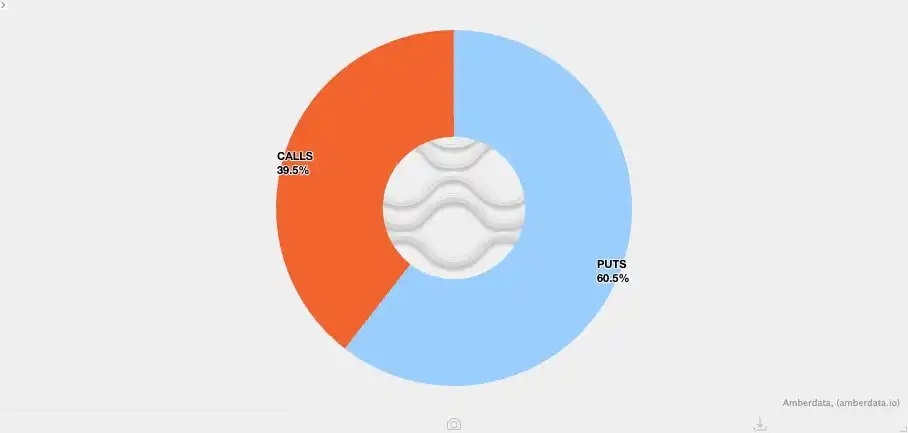
As time passed and more data continued to be disclosed, the situation became increasingly clear: this violent sell-off was likely related to a Bitcoin ETF, and the day itself was one of the most intense trading days in the capital market in recent years. We were able to make this judgment because IBIT's trading volume that day hit a historic high—trading volume exceeded $100 billion, doubling the previous record (truly an astonishing number). At the same time, the options trading volume also hit a record high (as shown in the chart below, the highest number of contracts since the ETF was launched). Somewhat unusually compared to the past, from the structure of the trading volume, this time the options trading was clearly dominated by put options, rather than call options (this point will be further elaborated later on).
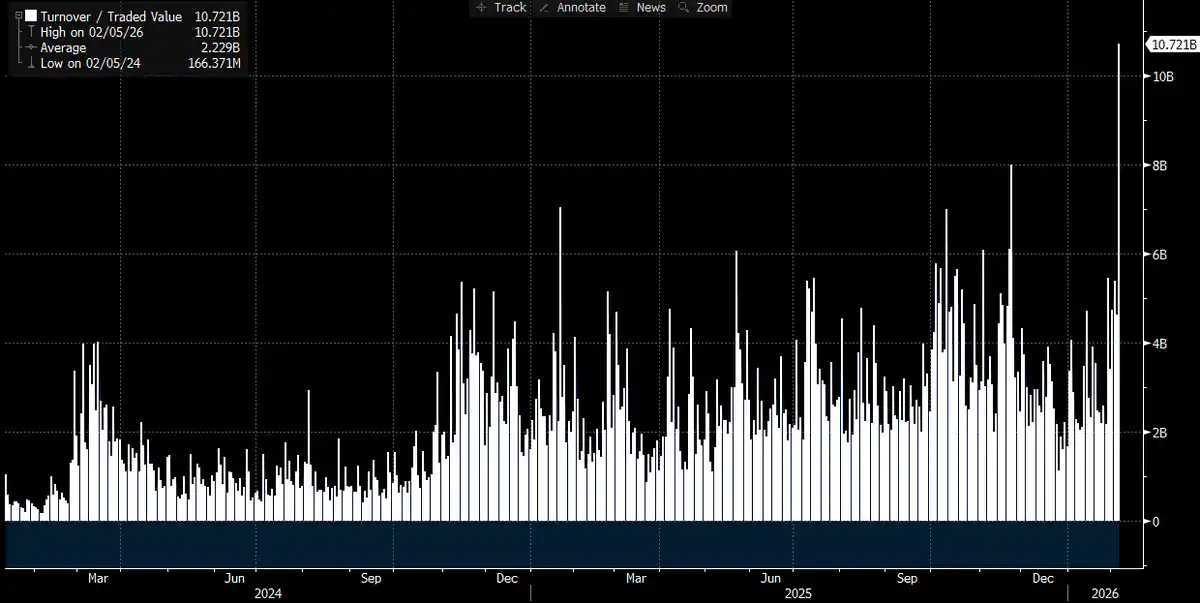
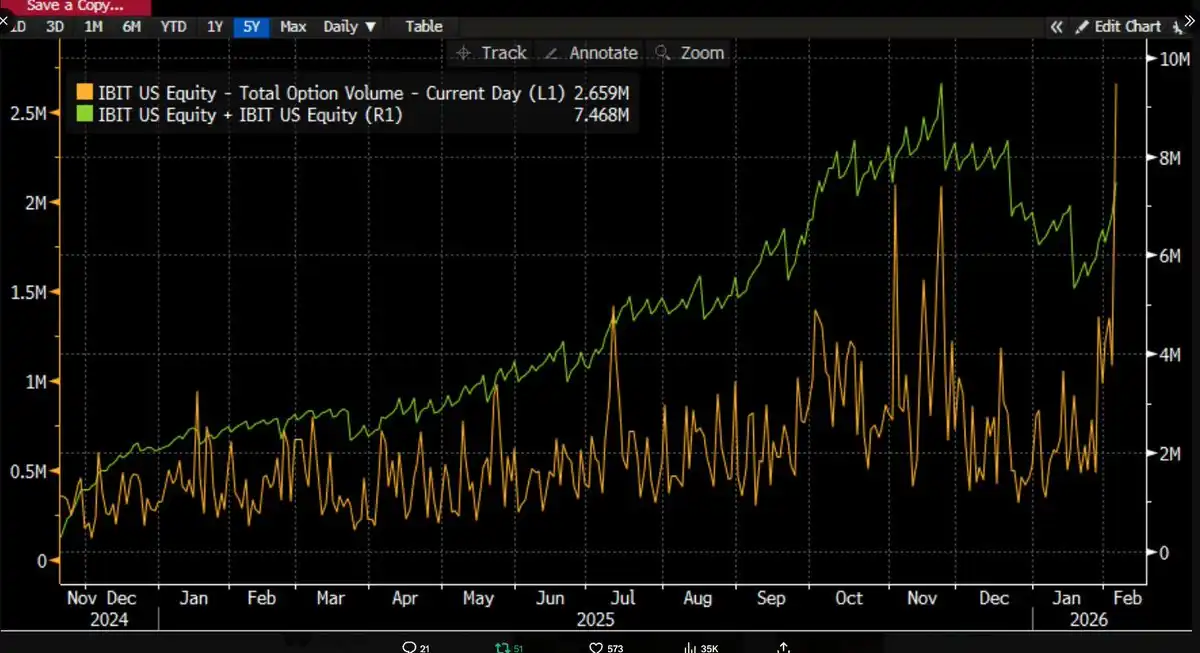
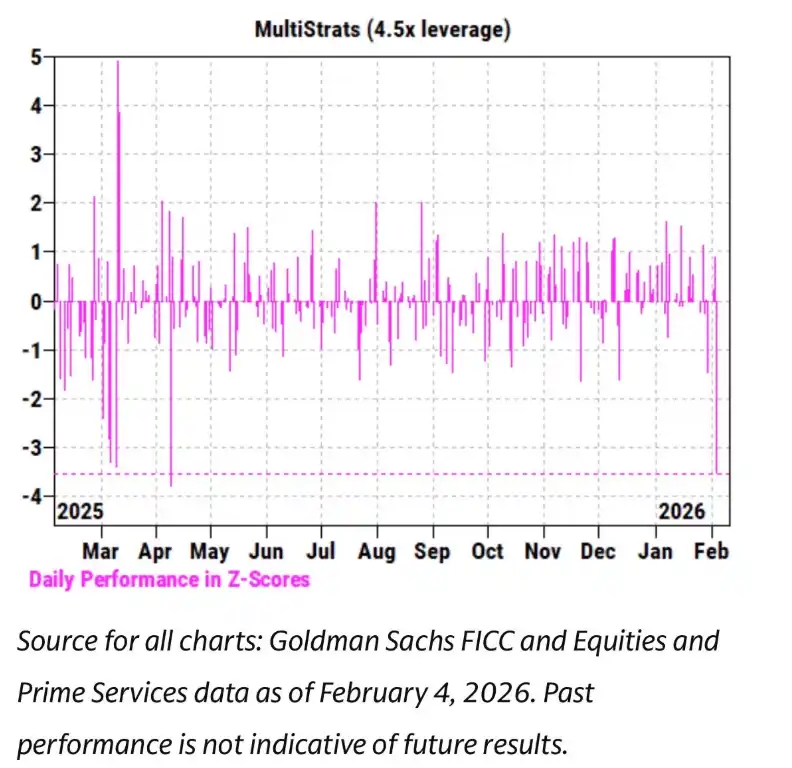
At the same time, over the past few weeks, we have observed an extremely close correlation between IBIT's price trend and software stocks and other risk assets. Goldman Sachs' Prime Brokerage (PB) team also released a report pointing out that February 4th was one of the worst-performing days on record for multi-strategy funds, with a Z-score of 3.5. This means it was an extreme event with a probability of only 0.05%, ten times rarer than a 3-sigma event (the classic "black swan" threshold, with a probability of about 0.27%). It can be said that this was a catastrophic shock. Typically, it is after such an event that multi-strategy funds (pod shop) risk managers would promptly intervene and require all trading teams to deleverage immediately, indiscriminately, and urgently. This explains why February 5th also turned into a bloodbath.
With so many records being broken and a clear downward price trend (a 13.2% single-day drop), we originally expected to see ETF net outflows. Referring to historical data, such an expectation is not far-fetched: for example, on January 30, following a 5.8% drop the previous trading day, IBIT saw a record $530 million redemption; or on February 4, with ongoing declines, IBIT had around a $370 million redemption. Therefore, in the market environment of February 5, an outflow of at least $500 million to $1 billion was entirely reasonable.
However, the reality was quite the opposite — what we saw was widespread net purchases. IBIT added approximately 6 million shares that day, corresponding to a growth of over $230 million in assets under management. At the same time, other Bitcoin ETFs also saw inflows, with the entire ETF system attracting over $300 million in net inflows.
This result is somewhat perplexing. In theory, one could argue that the strong price rebound on February 6 somewhat alleviated redemption pressure, but to shift directly from "potential reduced outflows" to "net inflows" is a whole different story. This implies that there were likely multiple factors at play simultaneously, but these factors do not form a single, linear narrative. Based on the information currently available to us, several reasonable assumptions can be made, and upon these assumptions, I will present my overall inference.
First, this round of Bitcoin sell-off likely touched upon some form of non-pure, crypto-native multi-asset investment portfolio or strategy. This could be the aforementioned multi-strategy hedge fund, or it could be a model portfolio business similar to BlackRock's, allocating between IBIT and IGV (software ETF) and being forced to auto-rebalance funds amid intense volatility.
Second, the acceleration of the Bitcoin sell-off is likely related to the options market, especially to options structures associated with the downside direction.
Third, this sell-off did not ultimately translate into outflows at the Bitcoin asset level, indicating that the primary driving force behind the rally came from the "paper money system," dominated by traders and market makers engaged in position adjustments overall in a hedged state.
Based on the above facts, my current core assumptions are as follows.
1. The direct catalyst for this sell-off was a broad deleveraging triggered by multi-asset funds and portfolios when the downside correlation of risk assets reached statistically anomalous levels.
2. This process then triggered an extremely intense deleveraging cycle, which also included Bitcoin risk exposure, but a considerable part of the risk was actually in a "Delta-Neutral" hedge position, such as basis trading, relative value trading (such as Bitcoin relative to crypto equities), and other structures usually used by trading firms to "box in" the remaining Delta risk.
3. This deleveraging cycle then triggered a short Gamma effect, further amplifying the downward pressure, forcing trading firms to sell IBIT. However, due to the excessive selling pressure, market makers had to engage in net short selling of Bitcoin without considering their own inventory. This process actually created new ETF inventory, reducing the market's original expectation of large-scale fund outflows.
Subsequently, on February 6th, we observed positive fund inflows into IBIT, with some IBIT buyers (the question remains which category these buyers belong to) choosing to buy on dips after the decline, further offsetting the potential minor net outflows.
Firstly, I personally tend to believe that the initial catalyst of this event came from the sell-off of software stocks, especially considering the high correlation between Bitcoin and software stocks, even higher than its correlation with gold. Please refer to the two charts below.
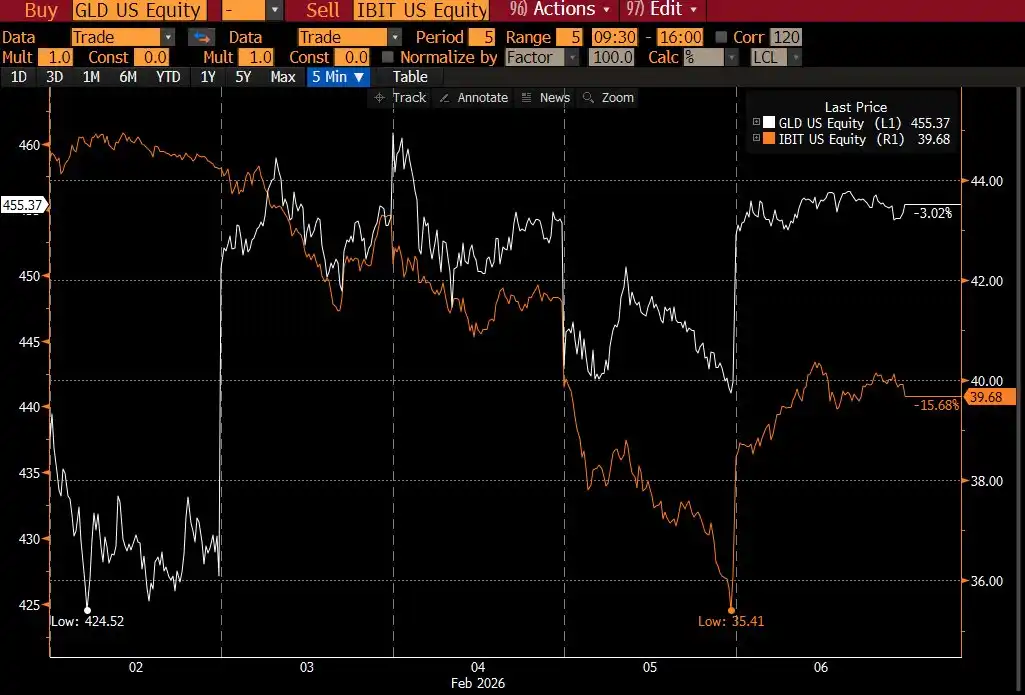
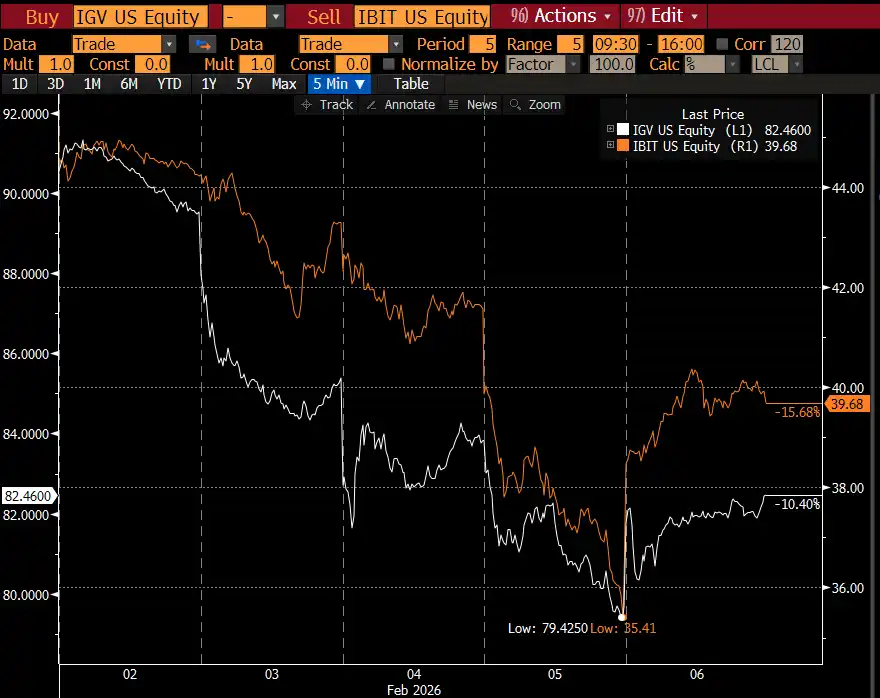
This logically makes sense because gold is usually not an asset held in large quantities by multi-strategy funds engaged in leveraged trading, although it may appear in RIA model portfolios (a set of pre-designed asset allocation schemes). Therefore, in my view, this further confirms a judgment: the center of this round of turmoil is more likely within the multi-strategy fund system.
And therefore, the second judgment seems more reasonable, namely, this intense deleveraging process indeed included Bitcoin risk in a hedged state. Taking the CME Bitcoin basis trading as an example, this has been one of the most preferred trading strategies for multi-strategy funds for a long time.

Looking at the complete data from January 26th to yesterday, covering CME Bitcoin basis trends for 30, 60, 90, 120 days (thanks to top industry researcher @dlawant for providing the data), it is clear to see that the near-month basis surged from 3.3% to as high as 9% on February 5th. This is one of the largest magnitude surges we have personally observed in the market since the ETF launch, almost conclusively pointing to one conclusion: basis trading was massively liquidated by order flow.
Consider for a moment institutions like Millennium and Citadel, forced to unwound basis trading positions (selling spot, buying futures). Given their footprint in the Bitcoin ETF ecosystem, it’s not hard to understand why this action would cause a severe impact on the overall market structure. I have previously written my own musings on this.
Editor's note: The current indiscriminate selling pressure, likely originating from the U.S., is probably from multi-strategy hedge funds. These funds often employ delta hedging strategies or run some sort of relative value (RV) or factor-neutral trades, which are currently widening spreads, potentially accompanied by growth stock equity beta spillover.
A rough estimate: about 1/3 of the Bitcoin ETF is institutionally held, with approximately 50% (possibly more) considered hedge fund holdings. This is a significant chunk of hot money flow, and once financing costs or margin requirements increase in the current high-volatility environment, risk managers intervene, these funds are quick to capitulate, especially when the basis returns no longer justify the risk premium. Worth noting, today MSTR's USD trading volume is one of the highest in its history.
This is why the biggest factor that makes hedge funds most vulnerable to collapse is the infamous "common holder risk": multiple seemingly independent funds holding highly similar exposures, when the market goes down, all rushing to the same narrow exit, causing all downside correlations to tend to 1. Selling in such poor liquidity as we see today is typical "fire sale" behavior, which we are witnessing today. Ultimately, this will be reflected in the ETF fund flow data. If this assumption holds, once all this unwinds, I suspect prices will reprice rapidly, but then rebuilding confidence will take some time.
This brings us to the third clue. Now that we understand why IBIT is being sold off in a widespread deleveraging context, the question becomes: what is accelerating the downturn? One possible "accelerant" is structured products. While I don't believe the size of the structured products market is enough to single-handedly trigger this selloff, when all factors align in a way that is extraordinarily and perfectly out of line with any Value at Risk (VaR) model's expectations, they can absolutely become a catalytic event triggering a chain liquidation event.
This immediately reminds me of my experience working at Morgan Stanley. There, structured products with knock-in put barriers (options that only "activate" as valid put options when the underlying asset price hits/crosses a specific barrier level) often had extremely destructive consequences. In certain cases, the change in option Delta could even exceed 1, a phenomenon that the Black-Scholes model didn't even consider—because in the standard Black-Scholes framework, for regular vanilla options (the most basic European call/put options), option delta can never exceed 1.
Using a note priced by JPMorgan in November of last year as an example, we can see that its barrier knock-in level was set exactly at 43.6. If these notes continue to be issued in December, and the Bitcoin price drops by another 10%, we can imagine a large accumulation of knock-in barriers in the 38–39 range, which is precisely the so-called "eye of the storm".
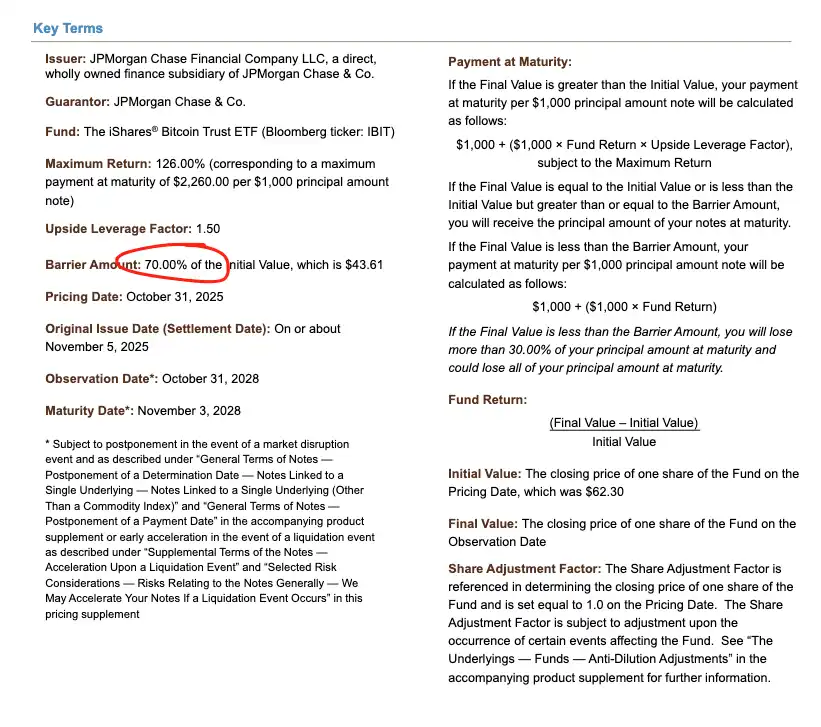
In the event that these barriers are breached, if traders have hedged the knock-in risk by selling put options, the speed of Gamma's change under negative Vanna dynamics will be extremely rapid. At this point, as a trader, the only feasible response is to aggressively sell the underlying asset in a weakening market. This is exactly what we observe: implied volatility (IV) collapsing to near its historical low of 90%, almost reaching a catastrophic level of squeezing. In this scenario, traders have to increase their IBIT short position to ultimately create new net ETF shares. This part indeed requires a certain amount of speculative space and is difficult to confirm without more detailed spread data, but considering the record-breaking volume of the day and the deep involvement of Authorized Participants (AP), this situation is entirely plausible.
Combining this negative Vanna dynamic with another fact makes the logic clearer. Due to a period of overall low volatility, clients in the crypto-native market have been generally inclined to buy put options in recent weeks. This means that crypto traders themselves are in a natural short Gamma state and have underestimated the potential for future high volatility in pricing. When a truly significant market move occurs, this structural imbalance further amplifies downward pressure. The position distribution chart below clearly illustrates this, showing that in the $64K to $71K range, traders are primarily concentrated in short Gamma positions in put options.
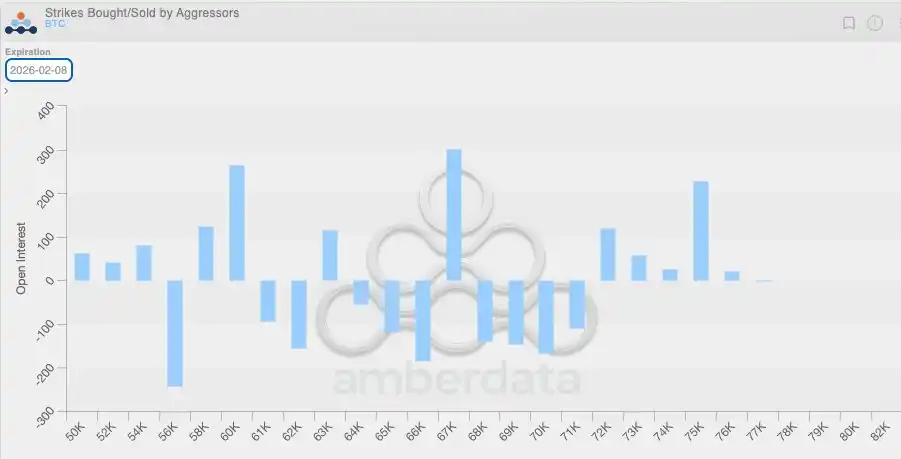
This brings us back to February 6th, when Bitcoin saw a more than 10% powerful rebound. An interesting observation on that day was that the CME's open interest (OI) expanded at a significantly faster rate than Binance's (also thanks to @dlawant for aligning hourly data to EST 4 pm). From February 4th to 5th, the distinct collapse of CME OI is evident, once again confirming the large-scale unwinding of basis trades on February 5th; and on February 6th, these positions may have been rebuilt to take advantage of higher basis levels, offsetting the outflow of funds.
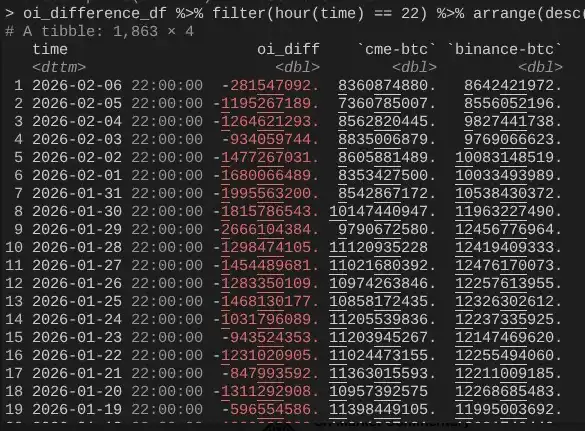
The entire logic chain has now closed loop: IBIT remains roughly flat at the subscription and redemption level, as CME basis trading has resumed; however, the price remains low because Binance's Open Interest has significantly collapsed, indicating that a considerable amount of deleveraging pressure is coming from the crypto-native market's short Gamma positions and liquidation behavior.
So here is my best explanation of the market performance on February 5 and subsequent to February 6. This deduction is based on several assumptions and is not entirely satisfactory because it does not have a clear "culprit" to blame (like the FTX incident). But the core conclusion is this: The trigger for this round of sell-off came from traditional financial derisking behavior outside of crypto, which conveniently pushed the Bitcoin price into a range where downward acceleration due to short Gamma hedging behavior would occur. This decline was not driven by directional bearish views but by hedging demand, and eventually swiftly reversed on February 6 (unfortunately, this reversal primarily benefited market-neutral funds in traditional finance rather than directional strategies in crypto-native). Although this conclusion may not be exciting, at least it can be somewhat reassuring that the previous day's sell-off most likely had nothing to do with the 10/10 event.
Yes, I do not believe that last week's events were a continuation of the 10/10 deleveraging process. I read an article suggesting that the turmoil may have originated from a non-U.S.-based fund headquartered in Hong Kong, which was involved in yen basis trading and ultimately failed. However, this theory has two obvious flaws. First, I do not believe there would be a non-crypto prime broker willing to provide services for such a complex multi-asset trade while offering a 90-day margin cushion and not already collapsing into insolvency when the risk framework tightened. Second, if the basis trading funds were trying to "escape" by buying IBIT options, then a Bitcoin price drop itself would not accelerate the risk release—the options would simply go out of the money, with their Greeks rapidly approaching zero. This means that the trade itself must involve real downside risk. If someone is long the USD/JPY basis while selling IBIT put options, then such a prime broker, frankly speaking, does not deserve to continue to exist.
The next few days will be crucial as we will have more data to determine if investors are taking advantage of this dip to build new demand, which would be a very bullish signal. At the moment, I am quite excited about the potential inflow of ETF funds. I still believe that true RIA-style ETF buyers (not relative value-oriented hedge funds) are insightful investors, and at the institutional level, we are seeing a lot of genuine and profound progress, a fact that is evident throughout the industry's advancement and among my friends at Bitwise. Therefore, I am focusing on those net inflows that have not been accompanied by basis trading expansion.
Lastly, all of this once again demonstrates that Bitcoin has integrated into the global financial capital market in an extremely complex and mature way. This also means that when the market is positioned for a short squeeze in the future, the uptrend will be steeper than ever before.
The fragility of traditional financial margin rules is exactly Bitcoin's antifragility. Once the price rebounds—inevitable in my view, especially after Nasdaq raised the options' open interest ceiling—it will be a spectacular rally.
You may also like

A plunge of over 97% continues to unlock, yet WLD has completed $65 million in over-the-counter financing: who is still footing the bill?

Potential Bitcoin Crash Below $60K May Delay Recovery to 2027
Key Takeaways: Bitcoin’s deep drawdown phase may extend recovery to the second quarter of 2027. Historical data shows…

BTC USD Price Drops Below $67K Amid Rising Treasury Yields
Key Takeaways: BTC USD slumped to $66,300, its first drop below $67K since March 9, driven by macroeconomic…

Second Bill Targets Insider Trading in Prediction Markets
Key Takeaways: The Public Integrity in Financial Prediction Markets Act of 2026 prohibits government officials from using insider…

India Apprehends Key Figure in Myanmar Crypto Fraud Complex
Key Takeaways: India’s Central Bureau of Investigation (CBI) arrested a key player in a scam that trafficked Indian…

Bitcoin and Profit Metrics: Will History Repeat Itself?
Key Takeaways: Historical patterns reveal that when Bitcoin’s supply in profit falls below 50%, significant price rallies ensue.…

Bitcoin ‘Compression’ Outcome Could Propel BTC Towards $80K: An Analyst’s Perspective
Key Takeaways: Bitcoin’s price is testing a critical $71,500 level, hinting at a possible rally to $80,000. Traders…
Data Points to Accelerating Ether Supply Crunch: Will ETH Price Follow?
Key Takeaways: As of now, 33.1% of Ethereum’s circulating supply is staked, resulting in a tighter liquid supply.…

XRP Risk-Reward Improves as Whale Accumulation Surges: Will the Price Mirror This Trend?
Key Takeaways: XRP’s Sharpe Ratio turned positive on March 26, 2026, indicating a potential for returns outweighing associated…

Cryptocurrency Price Predictions for March 27: BTC, ETH, BNB, XRP, SOL, DOGE, HYPE, ADA, BCH, and LINK
Key Takeaways: Bitcoin is struggling to maintain its position above the $66,000 threshold, amplifying concerns of a further…
Bitcoin ETFs Face Capital Outflow as Market Treads with Caution
Key Takeaways: Bitcoin ETFs experienced a $296 million outflow, ending a four-week inflow run. Total net assets for…

Crypto Market Predictions: BTC, ETH, BNB, XRP, SOL, DOGE, HYPE, ADA, BCH, LINK
Key Takeaways: Bitcoin struggles at the $72,000 level as bulls aim for $80,000, while resistance remains strong. Ethereum…

Bitcoin Returns to $71K as Oil Prices Plummet with Trump Halting Iran Strikes
Key Takeaways: Bitcoin rallies 5% to surpass $71,000 following Trump’s delay of US military action against Iran. Liquidations…

Ether Taker Volume Reaches Three-Year Peak: Can ETH Sidestep a 19% Price Drop?
Key Takeaways: An Ether on-chain indicator has surged to its highest in over three years, signaling potential stabilization…

Bitcoin Spot Volumes Reach 2023 Lows While BTC Rallies Stay News-Driven
Key Takeaways: Bitcoin’s price surged to $71,600 during a US market open, but the rise lacked consistent spot…
Unifying Ethereum: Tackling Fragmentation and Embracing Onchain Trading
Key Takeaways: Ethereum developers propose a groundbreaking ‘Economic Zone’ to address fragmentation in layer-2 networks. Onchain commodity trading…
Lummis Affirms CLARITY Act as DeFi’s Strongest Shield Yet
Key Takeaways: The CLARITY Act is touted by Senator Cynthia Lummis as providing unparalleled protections for DeFi developers.…
US Probes Bitmain over Security Concerns Amidst Crypto Mining Dominance
Key Takeaways: US authorities have initiated “Operation Red Sunset” to investigate potential security threats posed by Bitmain’s Chinese-manufactured…
A plunge of over 97% continues to unlock, yet WLD has completed $65 million in over-the-counter financing: who is still footing the bill?
Potential Bitcoin Crash Below $60K May Delay Recovery to 2027
Key Takeaways: Bitcoin’s deep drawdown phase may extend recovery to the second quarter of 2027. Historical data shows…
BTC USD Price Drops Below $67K Amid Rising Treasury Yields
Key Takeaways: BTC USD slumped to $66,300, its first drop below $67K since March 9, driven by macroeconomic…
Second Bill Targets Insider Trading in Prediction Markets
Key Takeaways: The Public Integrity in Financial Prediction Markets Act of 2026 prohibits government officials from using insider…
India Apprehends Key Figure in Myanmar Crypto Fraud Complex
Key Takeaways: India’s Central Bureau of Investigation (CBI) arrested a key player in a scam that trafficked Indian…
Bitcoin and Profit Metrics: Will History Repeat Itself?
Key Takeaways: Historical patterns reveal that when Bitcoin’s supply in profit falls below 50%, significant price rallies ensue.…


 App
App