
Circle Stock Analysis: Business Model and Valuation in 2026

Circle is easy to misunderstand. On the surface, it looks like the company behind USDC, one of the world’s largest stablecoins. But for investors, that description is too narrow. A proper Circle stock analysis has to answer a harder question: is Circle just a regulated wrapper around short-term Treasury yield, or is it becoming the core financial infrastructure layer for stablecoins, payments, and onchain settlement?
That distinction is what makes Circle interesting in 2026. As of market data on April 8, 2026, CRCL traded at $94.44, well above its June 2025 IPO price of $31. That price move tells you the market is not valuing Circle like a plain financial utility. It is assigning a premium to a business that sits at the center of digital dollars, compliance, and cross-border settlement.
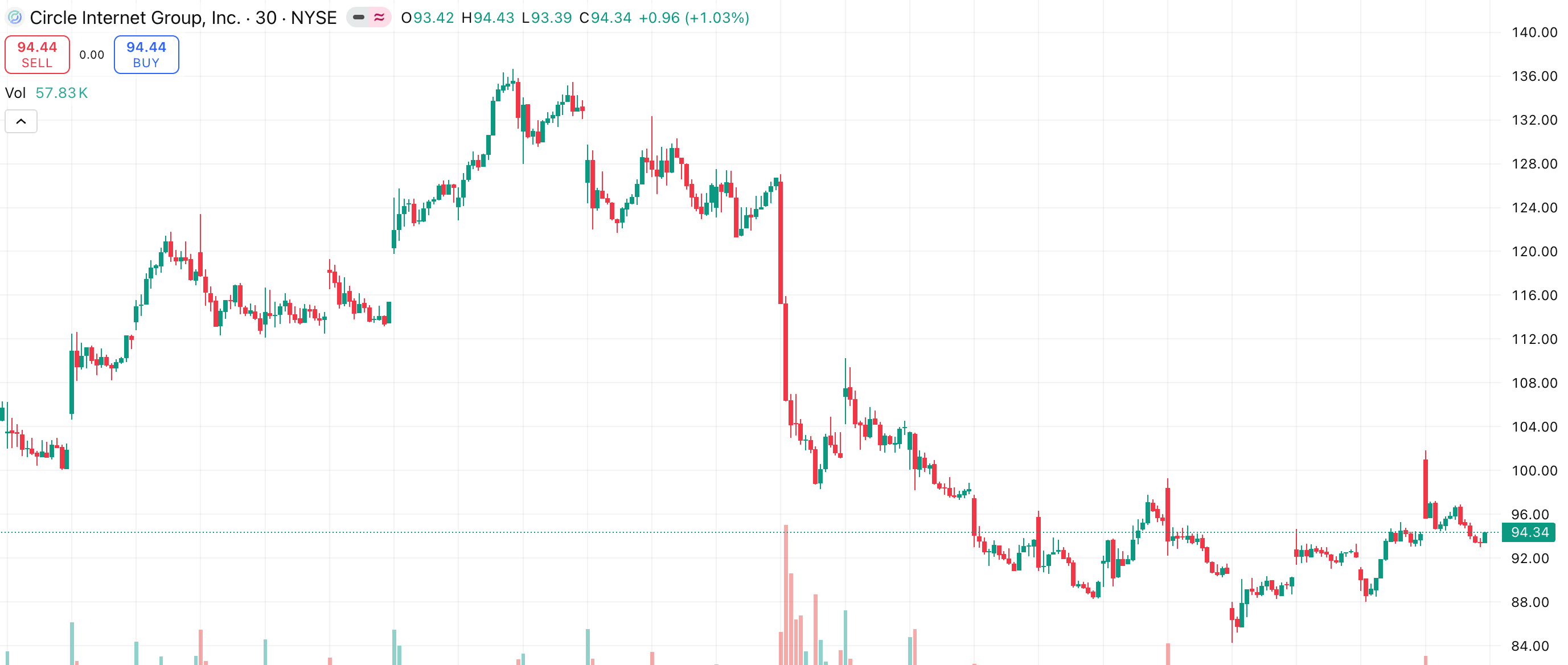
The bull case is clear. Circle owns a trusted, regulated stablecoin brand in USDC, it benefits from interest income on reserves, and it is expanding into payments and chain infrastructure through products like Arc and Circle Payments Network. The bear case is just as clear. Circle still depends heavily on reserve income, it is exposed to lower rates, and it faces real competition from Tether, tokenized deposits, and future public-sector alternatives.
What Circle Actually Does
Circle is best known as the issuer of USDC, but its business is broader than simply minting a token. Circle is building a full stack around internet money: issuance, reserve management, cross-chain movement, payments, and developer rails.
That matters because the company is trying to move up the value chain. If Circle remained only a stablecoin issuer, investors would mostly care about reserve balances and interest rates. But if Circle becomes the infrastructure layer for compliant digital dollars, then the valuation story starts to look more like a network business.
Circle’s own February 25, 2026 results show the direction of travel. The company reported:
FY2025 total revenue and reserve income of $2.7 billion, up 64% year over year
FY2025 adjusted EBITDA of $582 million, up 104%
USDC in circulation of $75.3 billion at year-end 2025, up 72%
USDC onchain transaction volume of $11.9 trillion in Q4 2025, up 247%
Arc testnet with 100+ participants and near 100% uptime
Circle Payments Network with 55 enrolled financial institutions and 74 more under review
Those numbers come from Circle’s official FY2025 results and are central to any serious view on CRCL.
How Circle Makes Money
The core of the Circle business model is still reserve income.
A simple way to think about it is:
Reserve income ≈ Average reserve assets × short-term yield - distribution and management costs
When users mint USDC, Circle holds the backing assets in cash and highly liquid government instruments. The spread between what those reserves earn and what Circle pays out or shares with partners is the engine of today’s profitability.
This is why Circle is both attractive and vulnerable. It is attractive because the model has huge operating leverage. Once reserve balances scale, incremental revenue can fall through to profit quickly. It is vulnerable because the model is highly sensitive to interest rates. If the Fed cuts aggressively, Circle’s most important income stream gets pressured immediately.
That is why 2026 matters. Circle is trying to diversify away from being seen as “just a rate-sensitive stablecoin issuer.” Arc, CCTP, Circle Payments Network, and enterprise settlement products are not side projects. They are the company’s attempt to reduce dependence on reserve yield over time.
Financial Snapshot: 2023-2025
The clearest way to see Circle’s operating leverage is to look at the last three years side by side.
| Fiscal Year | Total Revenue and Reserve Income | YoY Growth | Adjusted EBITDA | Net Income / Loss |
|---|---|---|---|---|
| 2023 | $1.45B | 87.9% | / | $(1.3)M |
| 2024 | $1.68B | 15.6% | $285M | $156M |
| 2025 | $2.75B | 63.9% | $582M | $(70)M |
The 2025 net loss needs context. Circle said the result was significantly affected by $424 million of stock-based compensation tied to its IPO, which means the headline loss does not fully reflect the underlying earnings power of the business.
This is one of the most important points in a Circle valuation discussion. If you read the 2025 bottom line literally, the company looks far less profitable than it really was. If you focus on adjusted EBITDA and reserve-income growth, the picture is much stronger.
Why Circle Deserves a Premium Valuation
The premium case for CRCL rests on four pillars.
First, Circle has regulatory credibility. In stablecoins, that matters more than in many other crypto categories. Circle’s structure, disclosure culture, and official engagement with regulators give it a trust advantage with institutions that cannot treat USDC and offshore stablecoins as interchangeable.
Second, USDC has high strategic relevance even where it is not the largest token by market cap. In many institutional and onchain settlement use cases, USDC’s compliance profile matters as much as raw size. That makes Circle more valuable than a simple “market share” comparison might suggest.
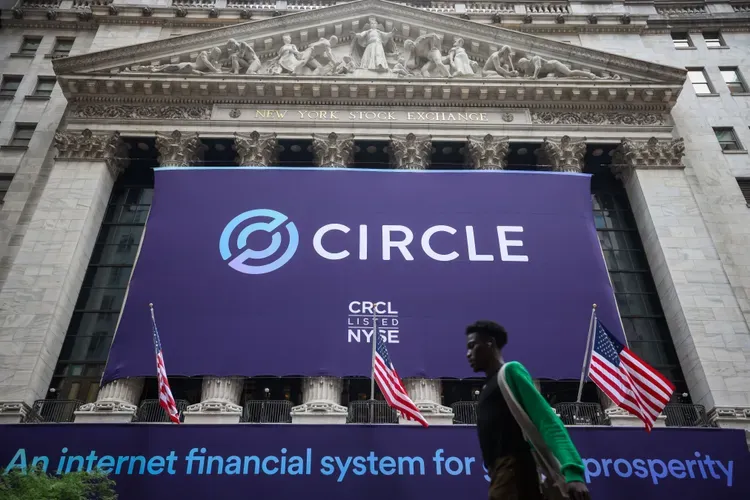
Third, Circle is building new rails around USDC, not just defending the token itself. Arc and Circle Payments Network matter because they create the possibility that Circle earns recurring revenue from infrastructure usage, not only from reserve yield.
Fourth, Circle benefits from operating leverage. If USDC grows from roughly $75 billion toward $100 billion-plus while non-interest revenue expands, margins could widen quickly.
This is an inference from the financial model and company strategy, not a direct quote from management.
What Could Go Wrong
The biggest risk is still rates. If short-term yields fall faster than USDC circulation grows, Circle’s earnings power weakens.
The second risk is competition. Tether remains dominant in overall stablecoin size, and newer forms of tokenized money could challenge Circle at the institutional end of the market.
The third risk is valuation compression. At nearly three times its IPO price in less than a year, CRCL is no longer priced for modest execution. Investors are already paying for continued USDC adoption, regulatory tailwinds, and successful product expansion.
The fourth risk is regulation cutting both ways. Circle benefits from clearer rules, but strict implementation could also limit monetization models or increase capital and compliance costs. That matters under frameworks like the GENIUS Act and future bank-style oversight.
Is Circle Stock Worth Watching in 2026?
Yes, but investors need to be honest about what they are buying.
If you buy CRCL, you are not buying a boring cash-equivalent issuer. You are buying a leveraged bet on three things happening at once:
USDC continues to scale as a trusted digital dollar
stablecoin regulation favors compliant issuers
Circle successfully expands from reserve income into infrastructure revenue
If those three things hold, Circle can justify a premium multiple. If they do not, the stock can re-rate sharply lower.
That is why the best way to approach Circle stock analysis in 2026 is not to ask whether the company is “cheap” in a conventional sense. The better question is whether Circle is becoming the Visa-like infrastructure layer of compliant internet money. If you believe the answer is yes, the valuation premium looks more reasonable. If you think Circle remains mainly a rate-sensitive spread business, the stock looks much harder to defend.
Conclusion
Circle is one of the few public companies that gives investors direct exposure to the rise of regulated stablecoins. That alone makes it strategically important. But the stronger investment case depends on whether Circle can evolve from a reserve-income business into a broader settlement and financial infrastructure platform.
Right now, the market is paying for that possibility. The company’s FY2025 growth, USDC expansion, Arc rollout, and payments push all support the story. At the same time, the risks are real: lower rates, fierce competition, and valuation pressure can all hit the stock hard.
For 2026, the right conclusion is not that CRCL is obviously cheap or obviously overhyped. It is that Circle sits at the intersection of regulation, digital dollars, and internet-scale payments. That makes it one of the most important stocks to watch in crypto-linked public markets.
FAQ
What does Circle do?
Circle is the issuer of USDC and a financial infrastructure company focused on stablecoins, payments, and onchain settlement tools.
Why is CRCL stock interesting in 2026?
Because it offers public-market exposure to USDC growth, stablecoin regulation, and Circle’s push into payment and infrastructure services.
How does Circle make money?
Mostly through reserve income earned on assets backing USDC, plus a smaller but growing contribution from transaction and platform services.
What is the biggest risk to Circle’s valuation?
Lower interest rates. If reserve yields fall faster than USDC and platform revenue grow, earnings could come under pressure.
Is Circle just a bet on USDC?
Not entirely. USDC is still the core, but the broader investment case depends on Circle becoming a larger infrastructure layer for digital dollars and payments.
You may also like

The Regulatory Storm Hitting Crypto Casinos: Licensing, AML, and Enforcement
Understanding CeDeFi: How It Blends CeFi Security with DeFi Innovation
Meme Coin Guide: Opportunities, Risks, and Strategy in 2026
Decentralized Exchange (DEX): Benefits, Risks, and How It Works in 2026
WEEX Trade to Earn Phase 2: Trade More but Pay Less in Futures Trading Markets
What is Canton Network: Pioneering Institutional Crypto with Canton Coin (CC) and Privacy-Preserving Blockchain Innovation
Introduction to Canton Network: A New Era for Institutional-Grade Digital Assets
What Is Recall Coin Crypto? A Deep Dive Into RECALL Token & the Recall Network
One-Click Margin Mode Setup for All Futures Pairs
Get Up To 100% APR On WEEX Auto Earn USDT
Crypto Trading vs.Traditional Investment, What's the Difference?
Why Celebrity Memecoins Often End in scandal and What Traders Can Learn?
The Regulatory Storm Hitting Crypto Casinos: Licensing, AML, and Enforcement
Understanding CeDeFi: How It Blends CeFi Security with DeFi Innovation
Meme Coin Guide: Opportunities, Risks, and Strategy in 2026
Decentralized Exchange (DEX): Benefits, Risks, and How It Works in 2026
WEEX Trade to Earn Phase 2: Trade More but Pay Less in Futures Trading Markets
What is Canton Network: Pioneering Institutional Crypto with Canton Coin (CC) and Privacy-Preserving Blockchain Innovation
Contents
Popular coins


