
What Is UTFS Crypto? A Guide to United Trust Fund System Coin


KEY TAKEAWAYS
UTFS stands for United Trust Fund System and appears as an SPL token on Solana.
The project uses wealth-building, trust-fund, staking, and community governance language.
UTFS should not be treated as a regulated trust fund unless legal and custody documentation proves it.
Public token pages show inconsistent market snapshots, so users should verify live data before trading.
Key checks include token mint, liquidity, holder concentration, mint/freeze authority, and asset-backing claims.
What is UTFS crypto?
UTFS, or United Trust Fund System, is a Solana SPL token with the contract address shown on the project’s website as utfsaa2B8LNUkRZCNcYtAXnisDVXLPszDNj5cySZBGS. The project describes itself as a movement for accessible wealth creation, using language around financial inclusion, global access, staking rewards, transparent transactions, and community-driven governance.
That positioning gives UTFS a broader financial theme than a typical meme coin. Still, the token should be evaluated through evidence, not branding. A project can use terms like “trust fund,” “wealth creation,” or “backed assets” without being a legally regulated fund or giving holders enforceable claims on real-world assets.
This guide explains what UTFS crypto is, how its market structure looks, and what WEEX users should check before treating it as more than a speculative Solana token. Users researching new assets can also start crypto trading on WEEX while applying a cautious verification framework.
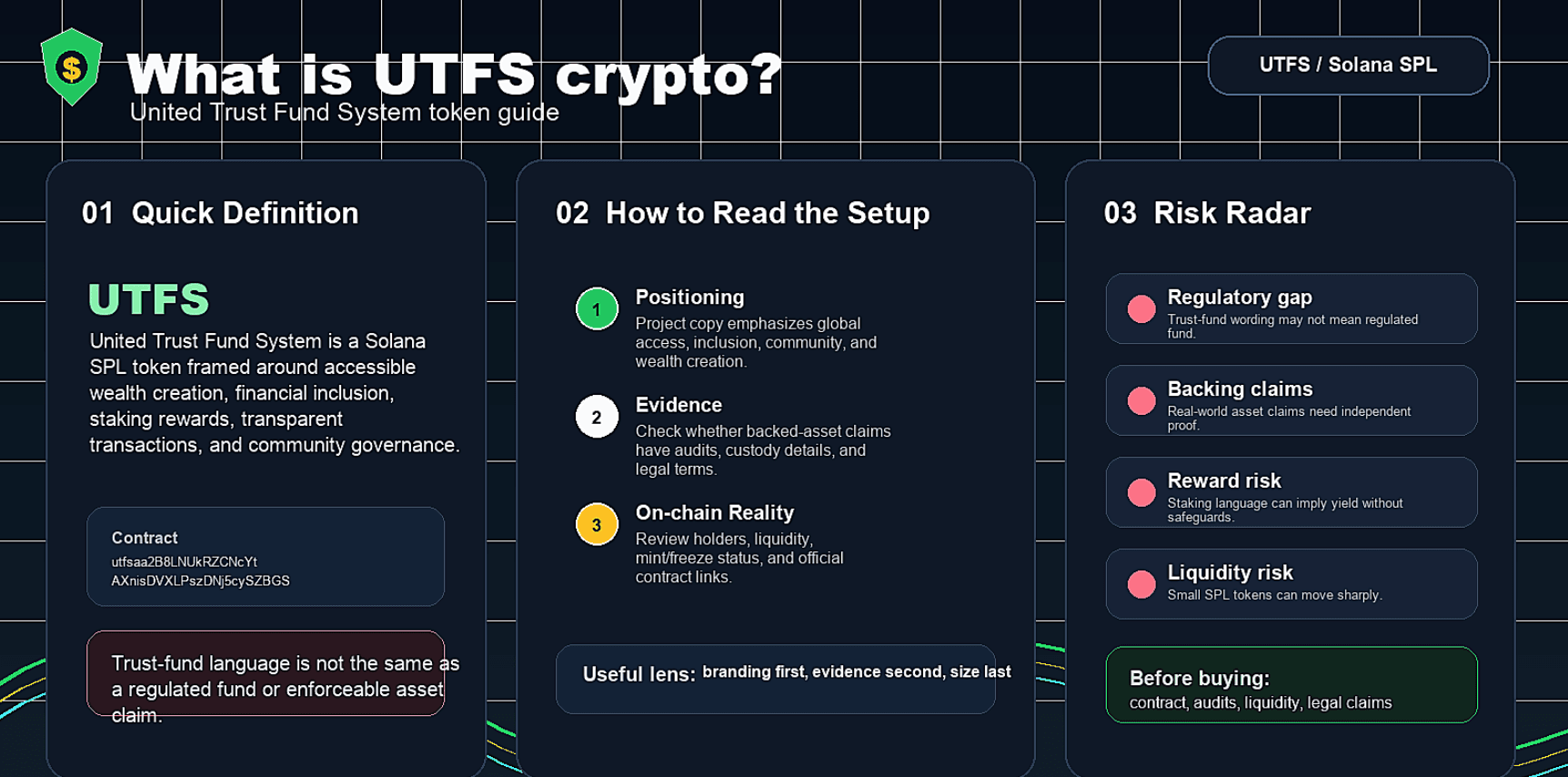
How United Trust Fund System presents its model
The UTFS website describes a model involving tax-related financial systems, tariff revenue structures, inflation recovery, staking rewards, ecosystem development, and strategic partnerships. It also claims a focus on blockchain transparency and global community participation.
For beginners, those claims should raise follow-up questions. What assets back the system? Who manages allocations? Are there audits? What rights do token holders have? Are revenue structures legally documented? Without clear answers, UTFS is better viewed as a speculative token with a financial narrative rather than a confirmed investment product.
UTFS token data and market snapshot
Public market data for UTFS appears inconsistent across sources. The project website displays a dashboard with a token price of $0.0842, market cap of $5.2 million, total supply of 1 billion, circulating supply of 420 million, and liquidity of $1.8 million. A separate Solana token page recently showed UTFS at $0.000016, with about $13,550 in 24-hour volume, $6,540 in liquidity, and a market cap near $15,970.
That gap is important. When market data varies widely, WEEX users should not rely on one screenshot or dashboard. The safer approach is to verify the token mint, check the active trading pair, and review live liquidity through on-chain tools before making any decision.
Is UTFS a real trust fund?
UTFS should not be treated as a traditional trust fund unless the project provides legal documentation that proves the structure. A real trust or fund product usually has a legal entity, trustee or manager, custody rules, investor rights, compliance documents, and clear disclosures.
The UTFS website uses trust-fund and wealth-access language, but that alone does not establish a regulated structure. From a WEEX research perspective, this is the main point: the token may be tradable, but tradability is not the same as legal fund status.
Why UTFS is getting attention
UTFS is getting attention because it combines several themes retail crypto traders understand quickly: Solana tokens, wealth-building language, staking, community ownership, and financial access. These themes can help a token spread across social channels, especially when traders are looking for new low-cap narratives.
The risk is that the story may move faster than verification. In early-stage token markets, a strong website, a clean ticker, and ambitious language can attract attention before liquidity, audits, or legal clarity are strong enough to support the narrative.
Main risks of UTFS crypto
The first risk is liquidity. One public on-chain page showed UTFS liquidity at only a few thousand dollars, which means even modest trades may create heavy slippage. Another risk scan described UTFS as high risk because liquidity was small compared with its reported market capitalization.
The second risk is claim verification. Phrases such as “secure,” “backed,” or “wealth creation” need proof. The third risk is holder concentration and contract control. If a few wallets hold a large share of supply, or if mint/freeze authority remains active, market risk increases. The fourth risk is data inconsistency, which can make valuation harder for beginners.
How WEEX users can evaluate UTFS
Start with the token mint. Confirm that any trading interface shows the same Solana address as the project’s published contract. Then check the active pair, liquidity, spread, slippage, and recent volume.
After that, review the project claims. If UTFS claims backing from real-world investments or revenue structures, look for audits, custody records, legal terms, and redemption rules. If those materials are missing, treat the token as speculative. This does not mean UTFS cannot rise. It means the risk profile is closer to an early Solana narrative token than a regulated wealth product.
Final thoughts
UTFS crypto is interesting because it uses trust-fund language in a market where many users want easier access to wealth-building tools. The concept is easy to understand, but the evidence still matters more than the name.
For WEEX users, the practical view is simple: verify the token first, then judge the market. Check the mint, liquidity, holders, permissions, and documentation. Until stronger proof appears, United Trust Fund System Coin should be treated as a high-risk speculative token, not a guaranteed path to wealth creation.
FAQ
1. What is UTFS crypto?
UTFS crypto, or United Trust Fund System Coin, is a Solana SPL token using wealth-access, trust-fund, and community finance branding. It should be evaluated as a speculative token unless stronger legal and asset-backing proof is available.
2. What blockchain is UTFS on?
UTFS appears to be built on Solana as an SPL token. Users should verify the exact token mint before trading because similar tickers or fake contracts may appear.
3. Is UTFS a real trust fund?
Users should not assume UTFS is a regulated trust fund unless the project provides legal documents, custody rules, fund structure, trustee details, and investor-rights disclosures.
4. Is UTFS backed by real assets?
The project uses “backed” and wealth-building language, but users should look for independent audits, asset records, custody details, and redemption terms before accepting any backing claim.
5. Why is UTFS risky?
UTFS is risky because of possible low liquidity, inconsistent market data, unclear legal structure, unverified backing claims, holder concentration risk, and standard Solana token contract risks.
6. What should beginners check before buying UTFS?
Beginners should check the token mint, trading pair, liquidity depth, slippage, top holders, mint/freeze authority, and whether project claims are supported by documents.
7. Can UTFS rise even if it is risky?
Yes. Speculative tokens can rise when attention, liquidity, and social momentum increase. That does not make them safer. Fast rallies can reverse quickly if volume fades or large holders sell.
8. What else can WEEX users review?
Users researching the WEEX ecosystem can also review WEEX Token (WXT), the platform token of WEEX. New users may also check the WEEX welcome bonus, which can include trading bonuses, coupons, or task-based rewards tied to account setup, deposits, or trading activity.
DISCLAIMER: WEEX and affiliates provide digital asset exchange services, including derivatives and margin trading, onlywhere legal and for eligible users. All content is general information, not financial advice-seek independentadvice before trading. Cryptocurrency trading is high risk and may result in total loss. By using WEEX services you accept all related risks and terms. Never invest more than you can afford to lose. See our Terms of Use and Risk Disclosure for details.
You may also like

BlockDAG Mining Explained: How to Mine BDAG and Is It Worth It in 2026?
This guide breaks down how BlockDAG mining works, the gear options (CPU/GPU or official rigs), expected rewards, and…
BlockDAG Tokenomics Explained: Supply, Distribution and What It Means for Price
This guide breaks down BlockDAG (BDAG) tokenomics—total supply, distribution, halving-style emissions, and vesting—so you can judge potential price…
BDAG Price Analysis: What Is Driving BlockDAG Price Right Now
BlockDAG is a Layer-1 built on DAG architecture, and its BDAG token is trading in a tight band…
How to Use DEXTools to Avoid Crypto Scams and Fake Tokens
DEXTools can dramatically cut your risk on decentralized exchanges by surfacing contract red flags, liquidity health, and trading…
DEXTools Pair Explorer Explained: How to Read On-Chain Data Like a Pro
This guide shows you how to use DEXTools Pair Explorer to read on-chain data with confidence. You’ll learn…
How to Use DEXTools to Research a Token Before You Buy
DEXTools helps you evaluate any DEX token before committing capital. This guide shows how to find the right…
What Is DEXTools? The Beginner’s Guide to On-Chain Token Analysis
DEXTools is a real-time analytics platform for decentralized exchanges (DEXs). It helps you research new tokens, track liquidity,…
How to Spot a Rug Pull on DexScreener: Red Flags Every Trader Should Know
Rug pulls thrive in fast-moving memecoin markets, but you can filter many of them in minutes using DexScreener.…
America250 Coin Price Analysis: Is the Hype Still Alive Days Before the July 4 Snapshot?
America250 Coin price analysis 2026: Will the July 4 snapshot trigger a rally or crash? Get the latest America250 Coin price, risks, and post-event outlook.
Mexico vs England Crypto Odds: Azteca Factor and the Divergence Between Traditional and Blockchain Prediction Markets
Mexico vs England crypto odds: Azteca factor narrows the gap. Get match analysis, score predictions, and crypto odds movement for this Round of 16 clash.
SNDK Stock Price Prediction 2026-2030: Can SNDK Stock Reach $3,000 on AI Storage Demand?
SNDK stock price prediction 2026: Can Sandisk reach $3,000? Get analyst targets, key drivers, and learn how to trade SNDK stock on WEEX TradFi 24/7.
DexScreener vs DEXTools: Which Token Screener Is Better for Crypto Traders?
DexScreener and DEXTools are the two most-used token screeners for onchain traders. This guide compares their data coverage,…
How to Use DexScreener to Find New Tokens Before They Pump
This guide shows you how to use DexScreener’s real-time tools—especially the New Pairs tab—to spot fresh listings with…
What Is DexScreener? The Beginner’s Guide to Reading DEX Data in 2026
DexScreener is a free, real‑time dashboard for decentralized exchange (DEX) pairs across dozens of blockchains. This guide shows…
What is Strategy(MSTR) Coin? Everything You Need to Know about MSTR/USDT Perpetual Futures on WEEX
This guide explains what Strategy (MSTR) Coin represents on WEEX, why the MSTR/USDT perpetual futures track equity momentum…
Can MSTR Reach $150 in 2026? MSTR Price Prediction
KEY TAKEAWAYS Current MSTR/USDT futures price: $103.49 at publication time. Required move to hit $150: about +45% from…
SNDK Stock Price Prediction 2030: Can Sandisk Reach $5,000?
Sandisk has become one of the most volatile AI memory and storage-linked stocks. This SNDK stock forecast looks at whether Sandisk can reach $5,000 by 2030, what needs to happen, and which risks traders should watch.
Sandisk Stock Forecast 2026: Can SNDK Recover From $1,843.99 and Reach $3,000?
Sandisk is trading around $1,843.99 after a 7.05% drop, putting the $3,000 target back in focus. This SNDK stock forecast explains the upside math, key support levels, catalysts, and risks for 2026.
BlockDAG Mining Explained: How to Mine BDAG and Is It Worth It in 2026?
This guide breaks down how BlockDAG mining works, the gear options (CPU/GPU or official rigs), expected rewards, and…
BlockDAG Tokenomics Explained: Supply, Distribution and What It Means for Price
This guide breaks down BlockDAG (BDAG) tokenomics—total supply, distribution, halving-style emissions, and vesting—so you can judge potential price…
BDAG Price Analysis: What Is Driving BlockDAG Price Right Now
BlockDAG is a Layer-1 built on DAG architecture, and its BDAG token is trading in a tight band…
How to Use DEXTools to Avoid Crypto Scams and Fake Tokens
DEXTools can dramatically cut your risk on decentralized exchanges by surfacing contract red flags, liquidity health, and trading…
DEXTools Pair Explorer Explained: How to Read On-Chain Data Like a Pro
This guide shows you how to use DEXTools Pair Explorer to read on-chain data with confidence. You’ll learn…
How to Use DEXTools to Research a Token Before You Buy
DEXTools helps you evaluate any DEX token before committing capital. This guide shows how to find the right…