
What Is POLYX Token? A Beginner’s Guide to Polymesh


KEY TAKEAWAYS
POLYX is the native token of Polymesh, a permissioned blockchain built for regulated asset tokenization.
POLYX is used for transaction fees, staking, network security, governance signaling, and block rewards.
Polymesh focuses on identity, compliance, confidentiality, settlement, and governance for security tokens and real-world assets.
POLYX supply can increase over time through block rewards, so traders should watch inflation and staking activity.
Beginners should evaluate POLYX by looking at network adoption, token utility, validator participation, liquidity, and regulatory-market demand.
What is Polymesh?
Polymesh is a public permissioned blockchain designed for regulated assets. That means it is not trying to be everything for everyone. Its main focus is tokenized securities and financial assets that need identity checks, compliance rules, and clearer settlement processes.
This is different from many public blockchains where anyone can create and transfer tokens freely. Regulated assets need more control. Issuers may need to know who holds an asset, whether a transfer is allowed, and how corporate actions or governance votes should work. Polymesh was built with those requirements in mind rather than adding them later as patches.
What is POLYX token?
POLYX is the native utility token of the Polymesh network. It is used to pay transaction and protocol fees, stake to help secure the chain, support governance signaling, and reward network participants.
A simple way to think about POLYX is that it is the fuel and incentive layer for Polymesh. If users create assets, transfer tokens, participate in governance, or help secure the network through staking, POLYX sits inside that process. The token’s role is tied to network activity, not just market speculation.
Why Polymesh focuses on regulated assets
Tokenization sounds simple: put financial assets on-chain. In practice, regulated assets are difficult. Securities, funds, and other financial products often need investor checks, transfer restrictions, issuer controls, reporting rules, and privacy around sensitive ownership data.
Polymesh is designed for that world. It uses identity-based interactions and compliance-aware asset rules so issuers can manage regulated tokens more directly. This is why Polymesh is often discussed in the real-world asset, or RWA, category. Its goal is not just faster transfers. It is making blockchain infrastructure more usable for regulated finance.
How POLYX is used on Polymesh
POLYX has several core uses. Users need POLYX to pay transaction fees on the network. Validators and nominators can stake POLYX to support network security under Polymesh’s nominated proof-of-stake model. Token holders can also signal on governance issues and support Polymesh Improvement Proposals.
Block rewards are another part of the system. New POLYX can be minted as rewards for operators and stakers who help secure the chain. This creates incentives for participation, but it also means supply can increase over time. For traders, that makes staking participation and inflation important metrics to watch.
POLYX tokenomics and supply
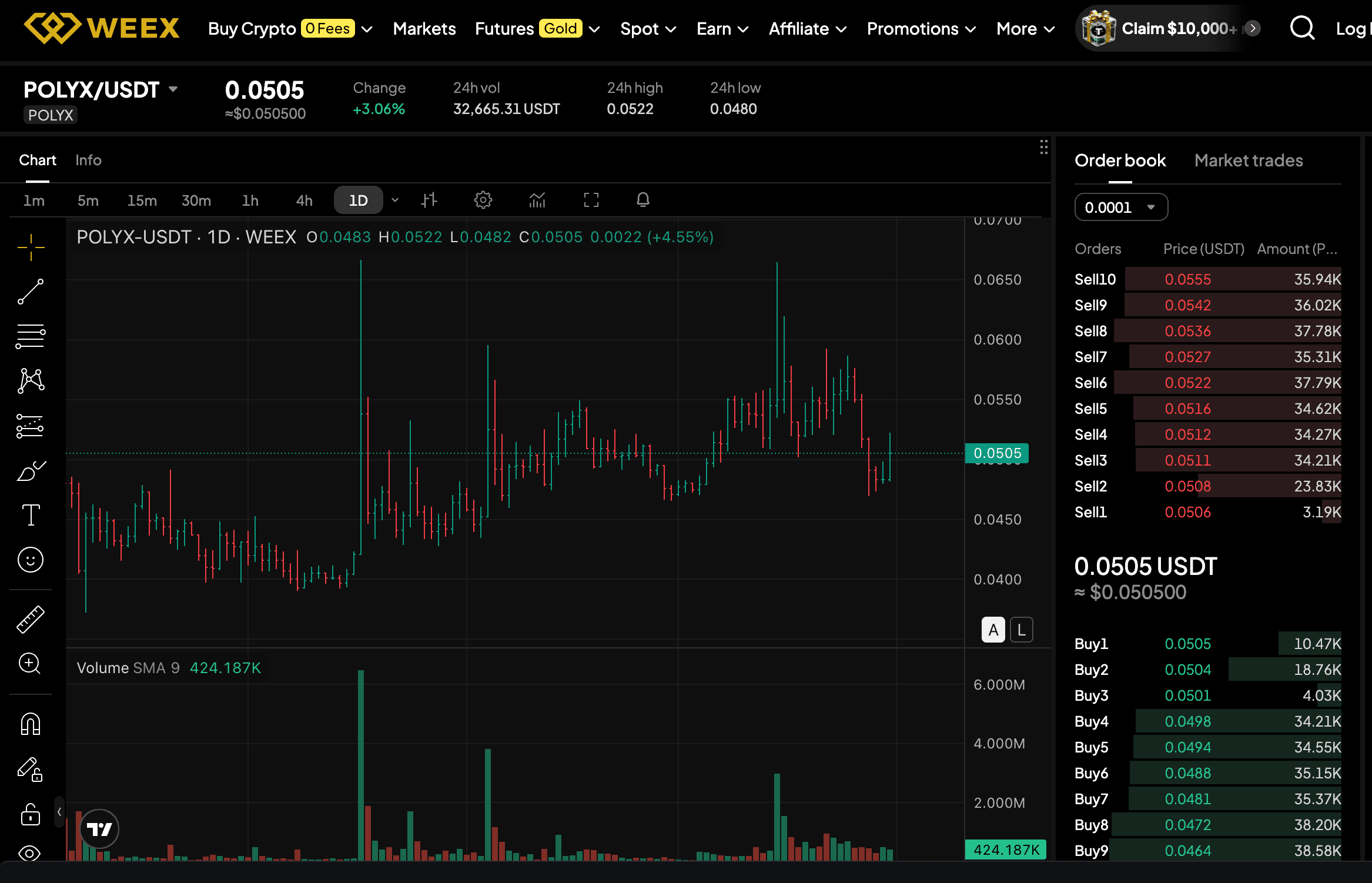
POLYX does not have a fixed maximum supply in the same way some capped tokens do. Public market trackers recently showed POLYX with roughly 1.04 billion circulating tokens and about 1.27 billion total supply, though live figures can change as new rewards are minted and market data updates.
The supply model matters because POLYX rewards help secure the network, but new issuance can dilute holders if demand does not grow. This is not automatically bad. Many proof-of-stake networks use rewards to pay validators. The question is whether network usage, staking demand, and token utility can keep pace with supply growth.
POLYX staking and network security
Polymesh uses nominated proof of stake. In plain English, token holders can back trusted node operators with POLYX, while operators help produce blocks and secure the chain. If operators perform well, stakers can receive rewards. If operators fail or misbehave, penalties can apply.
For beginners, staking sounds like passive income, but it has rules. Rewards are not risk-free, and users should understand bonding, nomination, validator performance, and unstaking terms before participating. The staking model is important because it links POLYX holders directly to network security.
Governance and compliance on Polymesh
Governance is a major part of Polymesh because regulated asset infrastructure needs predictable rules. POLYX holders can signal support on governance matters, while Polymesh Improvement Proposals help guide changes to the network.
Compliance is also built into the chain’s design. Polymesh uses identity and permissioning so regulated asset issuers can define who can hold or transfer certain assets. This approach may feel less open than typical DeFi, but it matches the needs of institutions that cannot ignore legal and reporting requirements.
Why POLYX matters in the RWA market
Real-world asset tokenization is one of crypto’s more practical narratives. The idea is to bring assets such as securities, funds, private credit, bonds, and other financial instruments onto blockchain rails.
POLYX matters because Polymesh was built specifically for this category. If regulated tokenization grows, infrastructure that handles identity, compliance, settlement, and governance may become more relevant. The risk is timing. RWA adoption can move slowly because institutions, regulators, and legal teams do not adopt new rails overnight.
Main risks of POLYX
The first risk is adoption risk. Polymesh needs issuers, developers, institutions, and users to bring meaningful activity to the network. Without that, POLYX utility may stay limited.
The second risk is supply inflation. New POLYX rewards support network security, but supply growth can pressure price if demand is weak. The third risk is market liquidity. POLYX may trade on multiple venues, but users should still check order depth, spread, and volume. Regulatory risk also matters because Polymesh sits close to securities and institutional finance.
How beginners can evaluate POLYX
Start with utility. Ask whether POLYX is being used for fees, staking, governance, and real network activity. Then check market structure. Look at price, volume, liquidity, circulating supply, and staking participation.
After that, evaluate the bigger RWA story. Are more assets being issued on Polymesh? Are institutions using the chain? Is governance active? These questions are more useful than asking whether POLYX is “cheap” based only on price. A low token price does not mean undervaluation if adoption is weak.
Final thoughts
POLYX is not just another exchange-traded token with a catchy ticker. It is the native token of a blockchain designed for regulated asset tokenization. That gives it a clearer purpose than many narrative coins, but it also means its long-term case depends on real adoption from issuers, institutions, developers, and stakers.
For beginners, POLYX is worth understanding if you are interested in real-world assets and compliant tokenization. The opportunity is the growth of regulated on-chain finance. The risk is that adoption may take longer than traders expect, while token supply, liquidity, and broader market sentiment still affect price.
FAQ
1. What is POLYX token?
POLYX is the native utility token of Polymesh. It is used for transaction fees, staking, network security, governance signaling, and block rewards inside the Polymesh blockchain.
2. What is Polymesh used for?
Polymesh is used for regulated asset tokenization. It is designed to support assets that need identity checks, compliance rules, transfer restrictions, governance, confidentiality, and clearer settlement.
3. Is POLYX the same as POLY?
No. POLY was the earlier ERC-20 token connected to Polymath, while POLYX is the native token of the Polymesh blockchain. Users should check current migration and exchange support details before handling either asset.
4. Can users stake POLYX?
Yes. POLYX can be staked in Polymesh’s nominated proof-of-stake system. Stakers support node operators and may earn rewards, but they should understand staking rules, validator risk, and unstaking conditions.
5. Does POLYX have a fixed supply?
POLYX does not have a fixed maximum supply. New POLYX can be minted as block rewards to support network security, so users should watch inflation, staking participation, and demand.
6. Why is POLYX linked to real-world assets?
Polymesh is built for tokenized regulated assets, including securities and other financial instruments. POLYX supports the network where those assets can be issued, transferred, and governed.
7. What are the main risks of POLYX?
Main risks include slow institutional adoption, token inflation, liquidity changes, regulatory uncertainty, validator or staking risk, and broader crypto-market volatility.
8. What else can WEEX users review?
Users researching the WEEX ecosystem can also review WEEX Token (WXT), the platform token of WEEX. New users may also check the WEEX welcome bonus, which can include trading bonuses, coupons, or task-based rewards tied to account setup, deposits, or trading activity.
DISCLAIMER: WEEX and affiliates provide digital asset exchange services, including derivatives and margin trading, onlywhere legal and for eligible users. All content is general information, not financial advice-seek independentadvice before trading. Cryptocurrency trading is high risk and may result in total loss. By using WEEX services you accept all related risks and terms. Never invest more than you can afford to lose. See our Terms of Use and Risk Disclosure for details.
You may also like
BlockDAG Mining Explained: How to Mine BDAG and Is It Worth It in 2026?
This guide breaks down how BlockDAG mining works, the gear options (CPU/GPU or official rigs), expected rewards, and…
BlockDAG Tokenomics Explained: Supply, Distribution and What It Means for Price
This guide breaks down BlockDAG (BDAG) tokenomics—total supply, distribution, halving-style emissions, and vesting—so you can judge potential price…
BDAG Price Analysis: What Is Driving BlockDAG Price Right Now
BlockDAG is a Layer-1 built on DAG architecture, and its BDAG token is trading in a tight band…
How to Use DEXTools to Avoid Crypto Scams and Fake Tokens
DEXTools can dramatically cut your risk on decentralized exchanges by surfacing contract red flags, liquidity health, and trading…
DEXTools Pair Explorer Explained: How to Read On-Chain Data Like a Pro
This guide shows you how to use DEXTools Pair Explorer to read on-chain data with confidence. You’ll learn…
How to Use DEXTools to Research a Token Before You Buy
DEXTools helps you evaluate any DEX token before committing capital. This guide shows how to find the right…
What Is DEXTools? The Beginner’s Guide to On-Chain Token Analysis
DEXTools is a real-time analytics platform for decentralized exchanges (DEXs). It helps you research new tokens, track liquidity,…
How to Spot a Rug Pull on DexScreener: Red Flags Every Trader Should Know
Rug pulls thrive in fast-moving memecoin markets, but you can filter many of them in minutes using DexScreener.…
America250 Coin Price Analysis: Is the Hype Still Alive Days Before the July 4 Snapshot?
America250 Coin price analysis 2026: Will the July 4 snapshot trigger a rally or crash? Get the latest America250 Coin price, risks, and post-event outlook.
Mexico vs England Crypto Odds: Azteca Factor and the Divergence Between Traditional and Blockchain Prediction Markets
Mexico vs England crypto odds: Azteca factor narrows the gap. Get match analysis, score predictions, and crypto odds movement for this Round of 16 clash.
SNDK Stock Price Prediction 2026-2030: Can SNDK Stock Reach $3,000 on AI Storage Demand?
SNDK stock price prediction 2026: Can Sandisk reach $3,000? Get analyst targets, key drivers, and learn how to trade SNDK stock on WEEX TradFi 24/7.
DexScreener vs DEXTools: Which Token Screener Is Better for Crypto Traders?
DexScreener and DEXTools are the two most-used token screeners for onchain traders. This guide compares their data coverage,…
How to Use DexScreener to Find New Tokens Before They Pump
This guide shows you how to use DexScreener’s real-time tools—especially the New Pairs tab—to spot fresh listings with…
What Is DexScreener? The Beginner’s Guide to Reading DEX Data in 2026
DexScreener is a free, real‑time dashboard for decentralized exchange (DEX) pairs across dozens of blockchains. This guide shows…
What is Strategy(MSTR) Coin? Everything You Need to Know about MSTR/USDT Perpetual Futures on WEEX
This guide explains what Strategy (MSTR) Coin represents on WEEX, why the MSTR/USDT perpetual futures track equity momentum…
Can MSTR Reach $150 in 2026? MSTR Price Prediction
KEY TAKEAWAYS Current MSTR/USDT futures price: $103.49 at publication time. Required move to hit $150: about +45% from…
SNDK Stock Price Prediction 2030: Can Sandisk Reach $5,000?
Sandisk has become one of the most volatile AI memory and storage-linked stocks. This SNDK stock forecast looks at whether Sandisk can reach $5,000 by 2030, what needs to happen, and which risks traders should watch.
Sandisk Stock Forecast 2026: Can SNDK Recover From $1,843.99 and Reach $3,000?
Sandisk is trading around $1,843.99 after a 7.05% drop, putting the $3,000 target back in focus. This SNDK stock forecast explains the upside math, key support levels, catalysts, and risks for 2026.
BlockDAG Mining Explained: How to Mine BDAG and Is It Worth It in 2026?
This guide breaks down how BlockDAG mining works, the gear options (CPU/GPU or official rigs), expected rewards, and…
BlockDAG Tokenomics Explained: Supply, Distribution and What It Means for Price
This guide breaks down BlockDAG (BDAG) tokenomics—total supply, distribution, halving-style emissions, and vesting—so you can judge potential price…
BDAG Price Analysis: What Is Driving BlockDAG Price Right Now
BlockDAG is a Layer-1 built on DAG architecture, and its BDAG token is trading in a tight band…
How to Use DEXTools to Avoid Crypto Scams and Fake Tokens
DEXTools can dramatically cut your risk on decentralized exchanges by surfacing contract red flags, liquidity health, and trading…
DEXTools Pair Explorer Explained: How to Read On-Chain Data Like a Pro
This guide shows you how to use DEXTools Pair Explorer to read on-chain data with confidence. You’ll learn…
How to Use DEXTools to Research a Token Before You Buy
DEXTools helps you evaluate any DEX token before committing capital. This guide shows how to find the right…