
What is ISOR? A guide to the Iran Strategic Oil Reserve token


KEY TAKEAWAYS
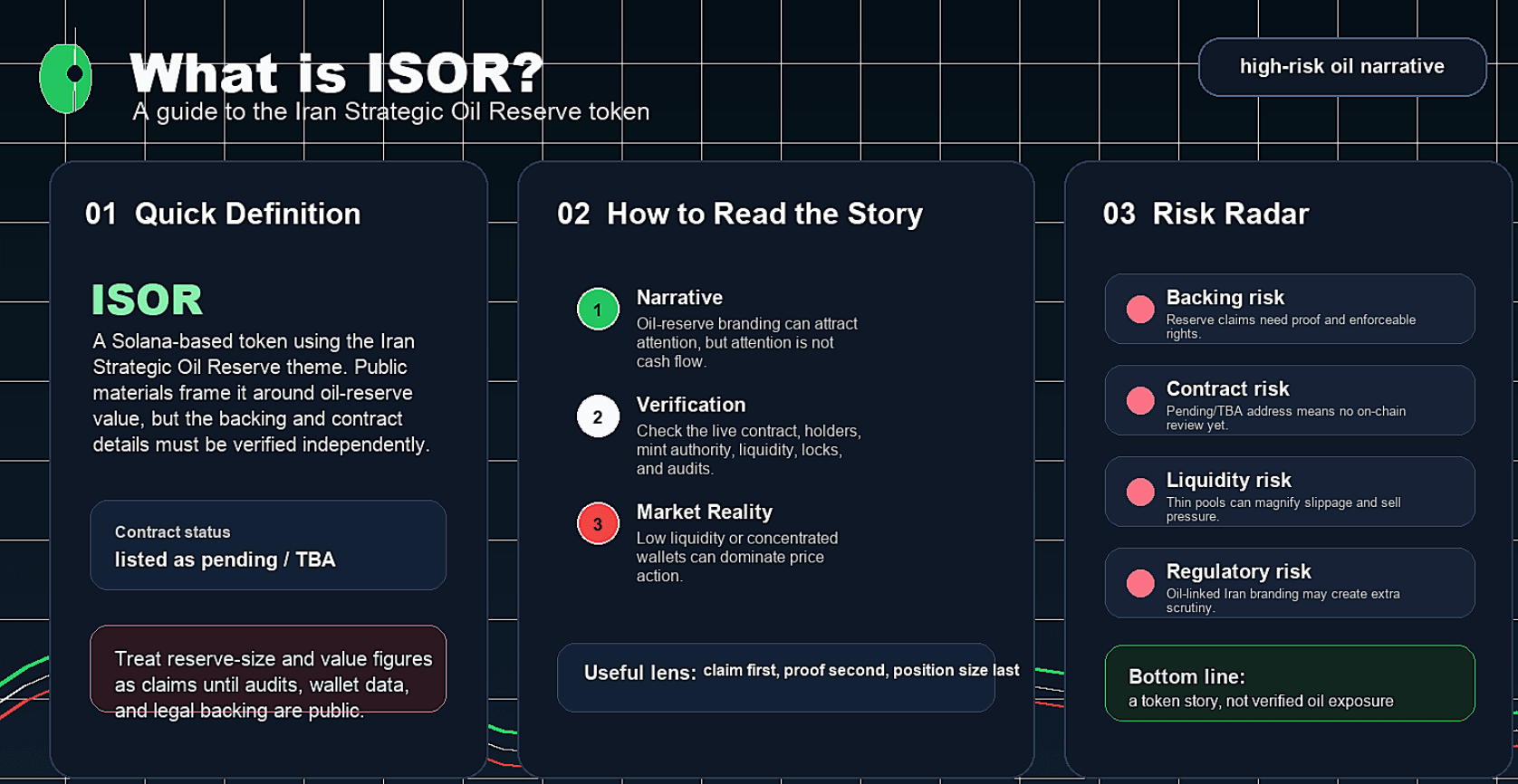
ISOR is an oil-themed Solana token with an Iran reserve narrative.
The project should not be treated as oil-backed unless it provides clear legal and reserve documents.
Traders should check the contract, liquidity, top wallets, and token permissions before trading.
The main risks are unclear backing, thin liquidity, whale activity, sanctions-sensitive branding, and weak utility.
ISOR is better viewed as a speculative narrative token until stronger proof appears.
What is ISOR?
ISOR stands for Iran Strategic Oil Reserve. It is presented as a crypto token linked to Iran’s oil reserve story and energy-market speculation. Traders researching new oil-themed tokens can start crypto trading on WEEX while using a basic checklist: confirm the contract, check liquidity, review top wallets, and avoid taking the token name as proof.
The idea is easy to understand. Oil is a major global commodity, Iran is often part of energy-market discussions, and crypto traders like simple narratives that can move fast. Still, a token can mention oil without giving holders ownership rights, revenue rights, or redemption rights.
Why traders are watching ISOR
ISOR fits into the recent wave of oil-themed Solana tokens. These projects borrow language from national reserves, energy security, and real world asset tokenization. That kind of story can get attention quickly because it feels more concrete than a normal meme coin.
That is also the trap. A token can trade actively because the name is timely, not because the project has a working commodity structure. For ISOR, the useful question is simple: what can be verified on-chain, and what is only branding?
ISOR and the real world asset story
Real world asset, or RWA, tokens try to connect crypto markets with off-chain assets such as treasuries, credit, property, commodities, or invoices. In theory, an oil-backed token would need a clear link between the token and oil inventory, revenue, or contractual rights.
ISOR uses oil reserve language, but beginners should be careful with that label. A real commodity-backed token usually shows reserve audits, custody details, legal structure, issuer information, and redemption rules. Without those documents, ISOR should be treated as an oil-themed crypto token, not direct exposure to Iranian oil.
How ISOR works as a Solana token
ISOR appears on Solana, a blockchain known for fast transactions and low fees. That helps small tokens trade quickly when attention spreads across crypto communities.
Speed is useful, but it cuts both ways. ISOR can move up quickly, and it can fall just as fast. Before trading, beginners should check whether the token has enough liquidity for normal buying and selling. A chart can look active while the actual exit price is much worse than expected.
ISOR token data beginners should check
For early tokens, price can change minute by minute. Market structure matters more. Beginners should review the contract address, liquidity pool, trading volume, top wallets, and token permissions.
Price tells you where the token traded. Structure tells you whether the market is healthy enough to trade.
Does ISOR represent real oil?
This is the first question beginners should ask. ISOR’s name suggests a link to Iran’s oil reserves, but that does not mean holders own oil, earn oil revenue, or can redeem tokens for barrels.
A real oil-backed crypto product would need more than a website and a ticker. It would need custody proof, legal agreements, reserve verification, redemption mechanics, and compliance disclosures. Without those, ISOR is better understood as a speculative token using an oil reserve narrative.
Main risks of ISOR
Brand confusion is the first risk. “Iran Strategic Oil Reserve” sounds official, but traders should not assume government backing, reserve access, or institutional approval without direct proof.
Liquidity is another issue. New Solana tokens can have shallow pools, which makes slippage painful. Holder concentration also matters. If a few wallets hold much of the supply, one large sell can move the market. The Iran oil angle may also bring sanctions-related sensitivity, especially if the project implies access to restricted markets. Finally, ISOR still needs clear utility beyond the name.
How beginners can research ISOR
Start with the contract address. Confirm it through project materials and compare it with the token shown on the trading page. Then check liquidity, top holders, transaction history, and token permissions.
After that, read the oil-related claims carefully. If ISOR suggests it is tied to reserves, look for hard evidence. Strong evidence means legal documents, audits, custody records, issuer details, and redemption terms. Weak evidence means broad claims, dramatic wording, or oil-market charts that do not explain how the token is connected to the asset.
ISOR trading framework
ISOR is easier to judge if you split the research into three parts: narrative, market structure, and verification.
The narrative is Iran, oil reserves, energy security, and RWA speculation. Market structure means liquidity, volume, wallet distribution, price action, and slippage. Verification means checking whether the oil-related claims are backed by documents or on-chain evidence. If the narrative is strong but verification is weak, the token may still move, but the risk stays high.
Final thoughts on ISOR
ISOR gets attention because it mixes crypto speculation with oil and geopolitics. That can be a powerful hook, especially when energy-market headlines are active.
For beginners, the cleaner approach is to treat ISOR as speculative until stronger documentation appears. Focus on the contract, liquidity, wallet concentration, token permissions, and proof behind the oil story. The name may get traders interested. The data should decide whether the setup is worth watching.
FAQ
1. What is ISOR?
ISOR stands for Iran Strategic Oil Reserve. It is a Solana-based crypto token using Iran oil reserve and energy-security branding. Beginners should treat it as speculative unless the project provides stronger proof of real oil backing.
2. Is ISOR backed by real oil?
Traders should not assume ISOR is backed by real oil unless the project provides legal documents, reserve audits, custody records, and redemption terms. Without those, ISOR is better viewed as an oil-themed crypto token.
3. Why is ISOR getting attention?
ISOR is getting attention because it combines oil, geopolitics, Solana trading, and the real world asset narrative. Those themes can attract traders quickly, but a strong story does not prove legitimacy.
4. What are the main risks of ISOR?
The main risks include unclear asset backing, thin liquidity, whale concentration, copycat tokens, sanctions-sensitive branding, and limited proof of real utility. Beginners should research these points before trading.
5. How should beginners check ISOR before trading?
Beginners should confirm the contract address, review liquidity depth, inspect top wallets, check token permissions, and look for proof behind oil-related claims. These steps reduce the chance of trading on branding alone.
6. Is ISOR a meme coin or an RWA token?
ISOR uses RWA-style oil reserve language, but it should not be treated as a verified RWA token unless asset backing is documented. Until then, it is safer to view ISOR as a speculative oil-themed Solana token.
7. Can ISOR rise even if it is risky?
Yes. High-risk tokens can rise when attention, liquidity, and trading volume increase. That does not make them safer. Fast rallies can reverse quickly if large holders sell or the narrative cools.
8. What else can WEEX users review?
Users researching the WEEX ecosystem can also review WEEX Token (WXT), the platform token of WEEX. New users may also check the WEEX welcome bonus, which can include trading bonuses, coupons, or task-based rewards tied to account setup, deposits, or trading activity.
DISCLAIMER: WEEX and affiliates provide digital asset exchange services, including derivatives and margin trading, onlywhere legal and for eligible users. All content is general information, not financial advice-seek independentadvice before trading. Cryptocurrency trading is high risk and may result in total loss. By using WEEX services you accept all related risks and terms. Never invest more than you can afford to lose. See our Terms of Use and Risk Disclosure for details.
You may also like
How to Use DEXTools to Avoid Crypto Scams and Fake Tokens
DEXTools can dramatically cut your risk on decentralized exchanges by surfacing contract red flags, liquidity health, and trading…
DEXTools Pair Explorer Explained: How to Read On-Chain Data Like a Pro
This guide shows you how to use DEXTools Pair Explorer to read on-chain data with confidence. You’ll learn…
BlockDAG Mining Explained: How to Mine BDAG and Is It Worth It in 2026?
This guide breaks down how BlockDAG mining works, the gear options (CPU/GPU or official rigs), expected rewards, and…
BlockDAG Tokenomics Explained: Supply, Distribution and What It Means for Price
This guide breaks down BlockDAG (BDAG) tokenomics—total supply, distribution, halving-style emissions, and vesting—so you can judge potential price…
BDAG Price Analysis: What Is Driving BlockDAG Price Right Now
BlockDAG is a Layer-1 built on DAG architecture, and its BDAG token is trading in a tight band…
How to Use DEXTools to Research a Token Before You Buy
DEXTools helps you evaluate any DEX token before committing capital. This guide shows how to find the right…
What Is DEXTools? The Beginner’s Guide to On-Chain Token Analysis
DEXTools is a real-time analytics platform for decentralized exchanges (DEXs). It helps you research new tokens, track liquidity,…
How to Spot a Rug Pull on DexScreener: Red Flags Every Trader Should Know
Rug pulls thrive in fast-moving memecoin markets, but you can filter many of them in minutes using DexScreener.…
America250 Coin Price Analysis: Is the Hype Still Alive Days Before the July 4 Snapshot?
America250 Coin price analysis 2026: Will the July 4 snapshot trigger a rally or crash? Get the latest America250 Coin price, risks, and post-event outlook.
Mexico vs England Crypto Odds: Azteca Factor and the Divergence Between Traditional and Blockchain Prediction Markets
Mexico vs England crypto odds: Azteca factor narrows the gap. Get match analysis, score predictions, and crypto odds movement for this Round of 16 clash.
SNDK Stock Price Prediction 2026-2030: Can SNDK Stock Reach $3,000 on AI Storage Demand?
SNDK stock price prediction 2026: Can Sandisk reach $3,000? Get analyst targets, key drivers, and learn how to trade SNDK stock on WEEX TradFi 24/7.
DexScreener vs DEXTools: Which Token Screener Is Better for Crypto Traders?
DexScreener and DEXTools are the two most-used token screeners for onchain traders. This guide compares their data coverage,…
How to Use DexScreener to Find New Tokens Before They Pump
This guide shows you how to use DexScreener’s real-time tools—especially the New Pairs tab—to spot fresh listings with…
What Is DexScreener? The Beginner’s Guide to Reading DEX Data in 2026
DexScreener is a free, real‑time dashboard for decentralized exchange (DEX) pairs across dozens of blockchains. This guide shows…
What is Strategy(MSTR) Coin? Everything You Need to Know about MSTR/USDT Perpetual Futures on WEEX
This guide explains what Strategy (MSTR) Coin represents on WEEX, why the MSTR/USDT perpetual futures track equity momentum…
Can MSTR Reach $150 in 2026? MSTR Price Prediction
KEY TAKEAWAYS Current MSTR/USDT futures price: $103.49 at publication time. Required move to hit $150: about +45% from…
SNDK Stock Price Prediction 2030: Can Sandisk Reach $5,000?
Sandisk has become one of the most volatile AI memory and storage-linked stocks. This SNDK stock forecast looks at whether Sandisk can reach $5,000 by 2030, what needs to happen, and which risks traders should watch.
Sandisk Stock Forecast 2026: Can SNDK Recover From $1,843.99 and Reach $3,000?
Sandisk is trading around $1,843.99 after a 7.05% drop, putting the $3,000 target back in focus. This SNDK stock forecast explains the upside math, key support levels, catalysts, and risks for 2026.
How to Use DEXTools to Avoid Crypto Scams and Fake Tokens
DEXTools can dramatically cut your risk on decentralized exchanges by surfacing contract red flags, liquidity health, and trading…
DEXTools Pair Explorer Explained: How to Read On-Chain Data Like a Pro
This guide shows you how to use DEXTools Pair Explorer to read on-chain data with confidence. You’ll learn…
BlockDAG Mining Explained: How to Mine BDAG and Is It Worth It in 2026?
This guide breaks down how BlockDAG mining works, the gear options (CPU/GPU or official rigs), expected rewards, and…
BlockDAG Tokenomics Explained: Supply, Distribution and What It Means for Price
This guide breaks down BlockDAG (BDAG) tokenomics—total supply, distribution, halving-style emissions, and vesting—so you can judge potential price…
BDAG Price Analysis: What Is Driving BlockDAG Price Right Now
BlockDAG is a Layer-1 built on DAG architecture, and its BDAG token is trading in a tight band…
How to Use DEXTools to Research a Token Before You Buy
DEXTools helps you evaluate any DEX token before committing capital. This guide shows how to find the right…