
WEEX x SYNBO Protocol X Space Recap: Redefining Investment with Decentralized Consensus

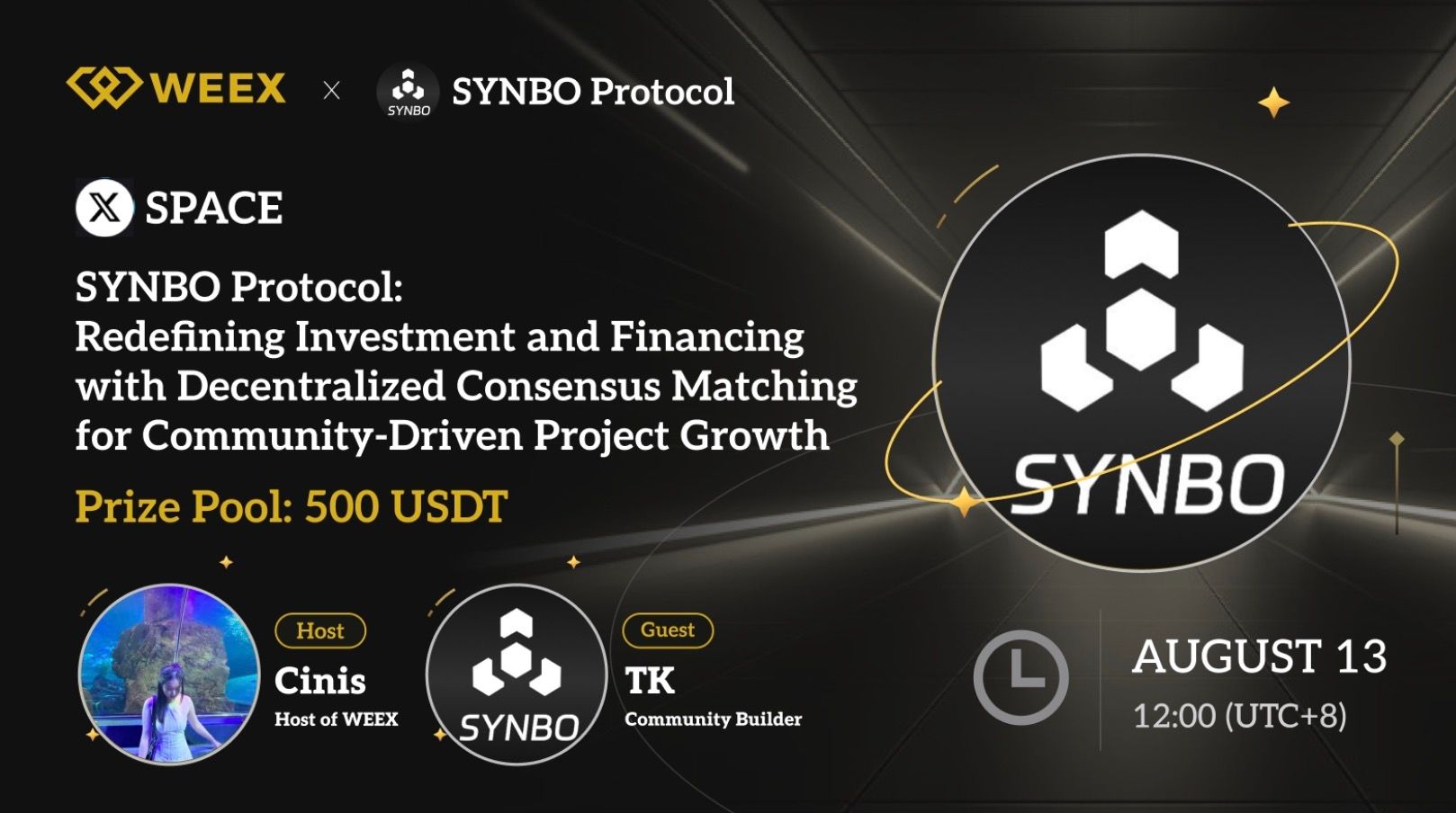
Key Insights from the WEEX x SYNBO Protocol X Space: Decentralized Consensus and CCO Explained
During WEEX x SYNBO Protocol X Space, TK addressed the fundamental principles of SYNBO Protocol and the advantages of its community-driven model. Participants learned how decentralized consensus matching connects projects with aligned communities, while the CCO model ensures that token issuance reflects community participation rather than unregulated distribution. TK explained the Proof of Position mechanism and how it validates actions in development. The X Space also highlighted the four user roles — Alpha Broker, Beta Miner, Investor, and Issuer — and how each contributes to the ecosystem. Key takeaways included how SYNBO balances investor and community interests, incentivizes participation through its token economy, supports suitable projects, and implements sustainable governance models. The roadmap discussion provided early insights into upcoming initiatives and opportunities for community involvement.
The Significance of WEEX x SYNBO Protocol X Space: Empowering Community-Driven Projects
For SYNBO Protocol, this X Space served as a platform to showcase its vision for community-driven financing and demonstrate how decentralized mechanisms can improve project success and governance. For WEEX, hosting the session reinforced its commitment to fostering innovative Web3 projects and promoting decentralized investment solutions. The collaboration emphasized the importance of community engagement in the blockchain ecosystem and highlighted how SYNBO’s model aligns with the growing trend toward transparent, participatory, and sustainable project funding. By connecting investors, project teams, and community members, the X Space strengthened awareness of SYNBO Protocol and showcased WEEX’s role in supporting next-generation decentralized finance initiatives.
Full recap is here:https://x.com/i/spaces/1mnxegNbEpRGX/peek
About SYNBO Protocol
SYNBO Protocol primarily aims to provide decentralized consensus matching and CCO services for blockchain consensus systems. CCO (Community Consensus Offering) refers to community consensus supply. Unlike the traditional ICO's unregulated issuance model, it is closer to a "POW/POS etc. for Consensus Offering" approach. CCO emphasizes the interactive participation and strategic decision-making by community members in the consensus process. The issuance of its tokens relies on a consensus mechanism — Proof of Position — to validate the objectives' legitimacy and ensure that actions taken during development are aligned with the collective interests of participants. It adheres to the growing trend towards decentralized and community-driven projects. By gaining broad support and aligning with community values, this method ensures the validity of demand and enhances the project's success rate.
Website : https://alpha.synbo.io/dashboard
Trade $ASM on WEEX: https://www.weex.com/spot/ASM-USDT
Follow WEEX on social media:
· X: @WEEX_Official
· Instagram: @WEEX Exchange
· Tiktok: @weex_global
· Youtube: @WEEX_Global
· Discord: WEEX Community
· Telegram: WeexGlobal Group
You may also like

SHA-256 vs Other Hashing Algorithms: What’s the Difference
This guide breaks down sha-256 alongside SHA-1, SHA-3, and MD5 in clear terms: what each hash does, where…
What Is SHA-256? How This Hashing Algorithm Works
SHA-256 is a cryptographic hashing algorithm that turns any input—short or long—into a fixed 256-bit output. Think of…
Leverage Trading Risks Every Beginner Should Know
Leverage can amplify gains and losses in crypto derivatives. This guide breaks down why leverage trading carries extra…
How to Calculate Leverage and Position Size?
Leverage lets you control a larger position with smaller capital. This guide shows how to calculate leverage and…
What Is Leverage in Trading? A Complete Guide
Leverage lets you control a larger position with a smaller amount of capital, but it also raises the…
What Is Initial Margin vs Maintenance Margin
Margin trading lets you control a larger crypto position with less capital, but it also introduces liquidation risk.…
What Is a Limit Order? A Beginner’s Guide
A limit order lets you set your own price. Your trade only executes if the market reaches that…
When Market Orders Can Cost You More Than Expected
A market order is simple: you click buy or sell, and the trade executes at the best available…
Market Order vs Limit Order: Which Should You Use
Choosing between a market order and a limit order comes down to one trade-off: speed versus price. This…
What Is a Market Order? A Beginner’s Guide
A market order is the simplest way to buy or sell: you tell the exchange to execute immediately…
Is SHA-256 Still Secure in 2026?
Updated: 2026-07-08 SHA-256 underpins Bitcoin mining, block integrity, and countless wallets and exchanges. This article explains whether SHA-256…
How SHA-256 Secures the Bitcoin Blockchain
SHA-256 is the cryptographic hash function that powers Bitcoin’s proof-of-work and the chain of blocks. This article explains…
What Happens When You Get Liquidated on Leveraged Trades?
Leverage lets you control a large position with a small margin, but it also narrows the price move…
How Margin Calls Work and How to Avoid Them
Margin trading lets you borrow against your collateral to amplify exposure, but it also introduces the risk of…
Margin Trading vs Spot Trading: What’s the Difference
Margin trading lets you borrow funds to amplify exposure, while spot trading uses only your own capital to…
What Is Margin Trading? A Beginner’s Guide
Margin trading lets you use your own funds as collateral to borrow extra capital, so you can take…
What is The White Bull (LEVI) Coin? Everything You Need to Know Before Trading LEVI/USDT
This article explains what The White Bull (LEVI) is, why it’s drawing attention on Solana, and how LEVI/USDT…
Should You Store Large Crypto Holdings in a Cold or Hot Wallet
Choosing between a cold wallet and a hot wallet is not just a preference—large crypto holders face a…
SHA-256 vs Other Hashing Algorithms: What’s the Difference
This guide breaks down sha-256 alongside SHA-1, SHA-3, and MD5 in clear terms: what each hash does, where…
What Is SHA-256? How This Hashing Algorithm Works
SHA-256 is a cryptographic hashing algorithm that turns any input—short or long—into a fixed 256-bit output. Think of…
Leverage Trading Risks Every Beginner Should Know
Leverage can amplify gains and losses in crypto derivatives. This guide breaks down why leverage trading carries extra…
How to Calculate Leverage and Position Size?
Leverage lets you control a larger position with smaller capital. This guide shows how to calculate leverage and…
What Is Leverage in Trading? A Complete Guide
Leverage lets you control a larger position with a smaller amount of capital, but it also raises the…
What Is Initial Margin vs Maintenance Margin
Margin trading lets you control a larger crypto position with less capital, but it also introduces liquidation risk.…