Privacy Tokens Guide 2026: Secure & Anonymous

Key Takeaways
- Privacy Tokens Guide 2026 is primarily a practical guide: privacy is created not just by coins, but through wallet setup, network privacy, and clean usage.
- Monero (XMR) is "privacy by default" through ring signatures, stealth addresses, and RingCT.
- Zcash (ZEC) relies on zero-knowledge proofs (zk-SNARKs) and can offer optional ("shielded") privacy, which is often considered more compliance-friendly.
- In the EU, regulatory pressure is rising, including discussions about a ban on anonymous crypto accounts and privacy coins starting in 2027.
- On-chain privacy is evolving in 2026 toward "practical, configurable privacy" rather than all-or-nothing.
Introduction
Privacy Tokens Guide 2026: Do you want to use crypto without everyone being able to publicly analyze your payments, amounts, and account balances?
Then you don't just need "a privacy coin," but a setup that reduces tracking at the blockchain and network levels.
This guide shows you in a beginner-friendly way which privacy tokens are relevant in 2026, how the technology works, and how to use them cleanly without getting lost in technical jargon.
What are Privacy Tokens?
Privacy tokens are cryptocurrencies (or protocols) that specifically obfuscate transaction details such as the sender, recipient, or amount.
The background: Many blockchains are transparent by default, which means payments remain analyzable and wallets can be de-anonymized.
A good starting point for categorizing "privacy coins" in the market is the "Top Privacy Tokens" category overview on CoinMarketCap.
Privacy Tokens vs. Privacy Coins (in brief)
"Privacy coin" often refers to a dedicated blockchain with privacy as its core feature (e.g., Monero or Zcash).
"Privacy token" is sometimes used more broadly on the web, including privacy layers on smart contract platforms.
For you as a reader, what matters in practice is: what data is hidden, how easy is it to use, and how high is the regulatory risk.
Why privacy with crypto is important at all
Transparency can make you vulnerable because transaction histories, wealth patterns, and payment partners can be inferred.
This affects not just "criminals," but also normal people who do not want a public financial biography.coindesk
Privacy is therefore a central topic in 2026 in the industry, also with a view to institutional use and "configurable" privacy.
Top Privacy Coins 2026 (Overview)
If you only have 5 minutes, start here and delve deeper afterward.
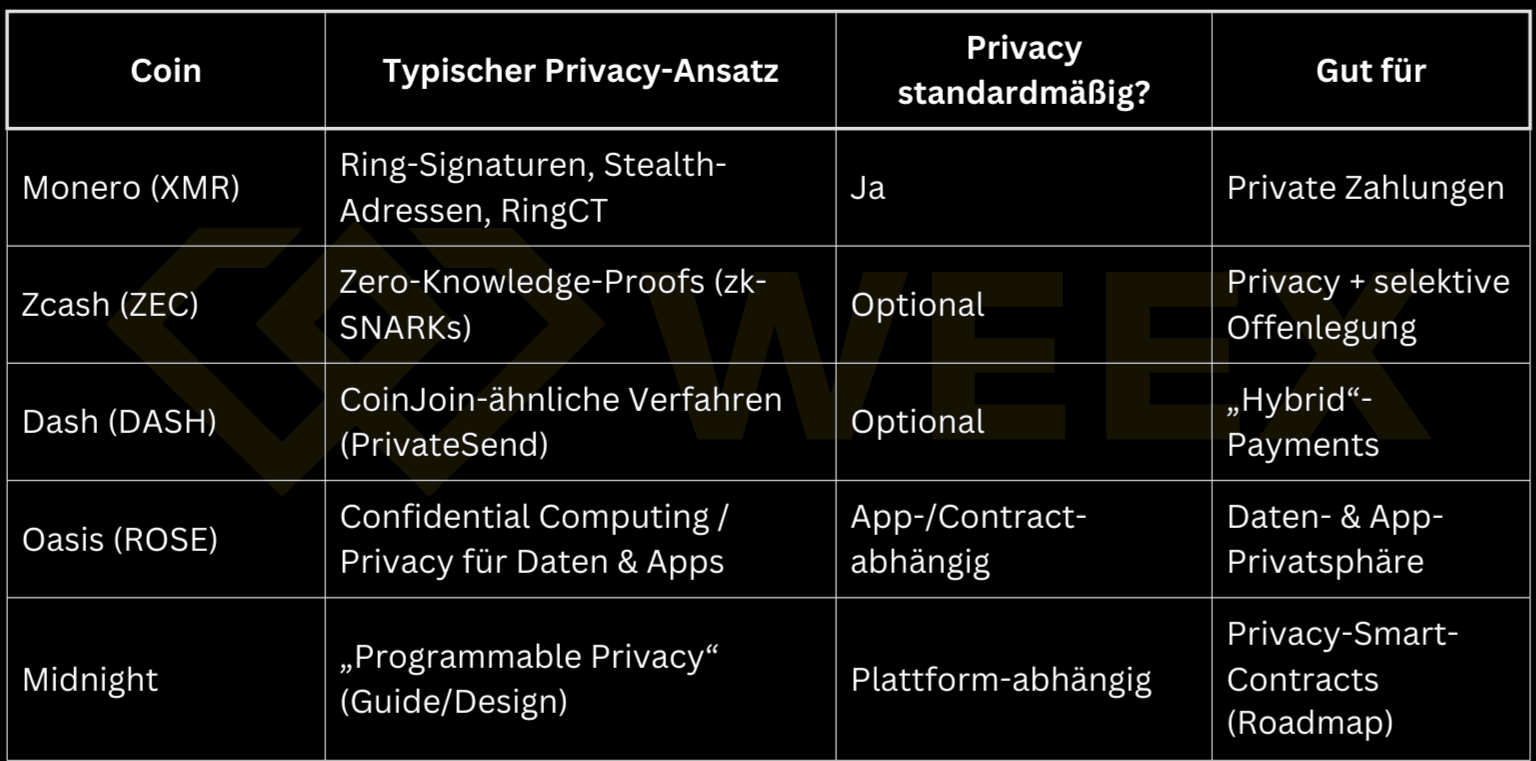
If you are looking for further candidates, use the market overview on CoinMarketCap as a continuously updated reference.
For "programmable privacy," the Midnight Network Guide from CoinGecko is a good overview.
Monero (XMR): Privacy by default
Monero uses ring signatures so that an exact sender is difficult to determine.
Monero additionally uses stealth addresses so that recipients cannot be easily linked via a fixed address.
And Monero uses RingCT to make amounts confidential.
If you really want to check technical details, the official documentation is the best starting point.
Zcash (ZEC): Privacy with zero-knowledge proofs
Zcash explains its privacy logic via zero-knowledge proofs, specifically zk-SNARKs.
The model supports "shielded" transactions (private) and can simultaneously be used transparently (depending on the wallet/mode).
If you want to understand the basic principle, the official explanation is a clean entry point.
How privacy technologies work (explained simply)
Here are the 3 most important building blocks that you should understand as a beginner.
Zero-Knowledge Proofs (ZKP)
A ZKP is a proof that a statement is true without disclosing the underlying data.z
In the context of privacy coins, this means: the blockchain can verify rules (e.g., "no double spend") without making all details public.
In 2026, privacy in many projects is thought of exactly this way: as a "practical, configurable" layer instead of absolute invisibility.
Ring Signatures & RingCT (Monero)
Ring signatures logically mix your signature with other possible signatures, making the actual sender difficult to identify.
RingCT complements this by obfuscating amounts.
The result is a very strong privacy default, but with trade-offs like more complexity and potential regulatory pressure.
Stealth Addresses (Recipient Privacy)
Stealth addresses ensure that recipients cannot be trivialized via a single, permanently reused address.
Technical articles like the overview from Chainstack provide a good, beginner-friendly explanation.
On Ethereum, there are approaches like EIP-5564, which aim to make stealth addresses usable for wallets. If you are working with Ethereum, this QuickNode guide helps as a practical introduction.
Practice: How to protect your privacy with crypto (step by step)
These steps are intentionally "boring" because they are the most effective in practice.
Step 1: Clean up your wallet setup
Use a non-custodial wallet where you control the seed yourself.
Write down the seed offline and do not save it as a photo or cloud note.
Activate device locks and secure backups before moving larger amounts.
Step 2: Take network privacy seriously
Blockchain privacy does not automatically protect your IP address or your device.
If you want privacy, combine wallet usage with network privacy (e.g., Tor/VPN) and good device hygiene.
A practical entry point is the section on crypto at PrivacyGuides.
Step 3: Understand Bitcoin privacy (even if you use privacy coins)
Many users move value via Bitcoin before switching to privacy coins, and they make tracking mistakes in the process.
CoinJoin is a well-known technique to make Bitcoin transaction flows harder to map.
If you want to understand the limits realistically, the MIT analysis on Whirlpool is a strong source.
Step 4: Avoid "privacy myths"
"Private coin = impossible to trace" is too simple, because your behavior (reusing addresses, KYC on-ramps, IP leaks) often ruins everything.
If you want to understand how crypto tracing basically works, the glossary entry from TRM Labs is helpful.
Regulation 2026: What you need to know in the EU
In the EU, MiCA sets a uniform legal framework for crypto assets and providers. A well-citable entry page is the MiCA overview from ESMA.
In parallel, there are reports that the EU wants to ban anonymous crypto accounts and privacy coins starting in July 2027 as part of anti-money laundering rules.
A German-language overview of this can be found at Trending Topics.
Practical consequence: Plan for the fact that "cash-out" and regulated interfaces could become more difficult, even if holding/using is not automatically illegal.
If you want to combine "privacy + compliance," orient yourself toward approaches like selective disclosure and "configurable privacy," which are described as a trend for 2026.
As a compact trend framework, you can use CoinDesk's "4 predictions for privacy in 2026".
Conclusion
Privacy tokens are no longer a niche topic in 2026, but an answer to public blockchains, analysis firms, and growing compliance.
For beginners, the best way is: first the basics (wallet + network), then choose the right coin (Monero for privacy-by-default, Zcash for ZKP-based, optional privacy).
If you are in the EU, factor in regulatory changes, especially toward 2027, and keep your strategy flexible.
FAQ - Frequently Asked Questions
Are privacy coins legal in Germany/EU?
MiCA creates EU-wide rules, and in parallel, restrictions for anonymous accounts/privacy coins are being discussed starting in 2027, so always check the current legal situation.
What is "better": Monero or Zcash?
Monero is privacy-by-default (ring signatures, RingCT, stealth addresses), while Zcash uses ZKPs and offers privacy optionally.
Are crypto transactions fundamentally traceable?
Many blockchains are easily analyzable, and tracing is a field of its own, which is why setup and behavior are decisive.
Is a privacy coin enough to be anonymous?
No, because IP leaks, KYC interfaces, and user errors often destroy privacy more than the choice of coin.
Where can I find a current list of relevant privacy tokens?
The continuously updated market overview on CoinMarketCap is a quick starting point.
WEEX | Rising star of crypto exchanges in the DACH region
WEEX combines security, innovation, and community with features for beginners and pros:
Security & Protection
- 1,000 BTC Protection Fund: Self-funded fund for quick loss protection in exceptional cases
Trading & Earning
- Auto Earn: Daily automatic USDT earnings without effort
- Copy Trading: Follow elite traders automatically or apply as an elite trader for additional benefits
- WE-Launch: Early access to new projects – exclusive for WEEX users
Benefits & Rewards
- Promotions & Rewards: Trading competitions and special bonuses for active users
- Affiliate Program: Lifetime commissions through new users – details here
- VIP Benefits: Lowest fees, market insights, and personal support for high-volume traders
- WXT Token: Fee discounts, airdrops, and exclusive platform benefits
Discover current trends on WEEX Spot and start now: Register now
Disclaimer – Legal notice from WEEX exchange
WEEX and its affiliates offer services for the exchange of digital assets, including derivatives and margin trading, only where they are legal and for eligible users. All content is general information, not financial advice - seek independent advice before trading. Trading cryptocurrencies is associated with high risk and can lead to a total loss. By using the services of WEEX, you accept all associated risks and conditions. Never invest more than you can afford to lose. Further information can be found in our Terms of Use and in the Risk Disclosure.