
Is Micron a Good Stock to Buy in 2026? MU Investment Analysis and WEEX Stock Futures Guide


KEY TAKEAWAYS
- Micron Technology is a cyclical semiconductor stock, so the investment case depends on memory pricing, AI server demand, HBM adoption, margins, and inventory conditions.
- MU can be attractive for investors who believe the AI memory cycle still has room to expand, but it can also sell off quickly if earnings expectations, chip demand, or guidance weaken.
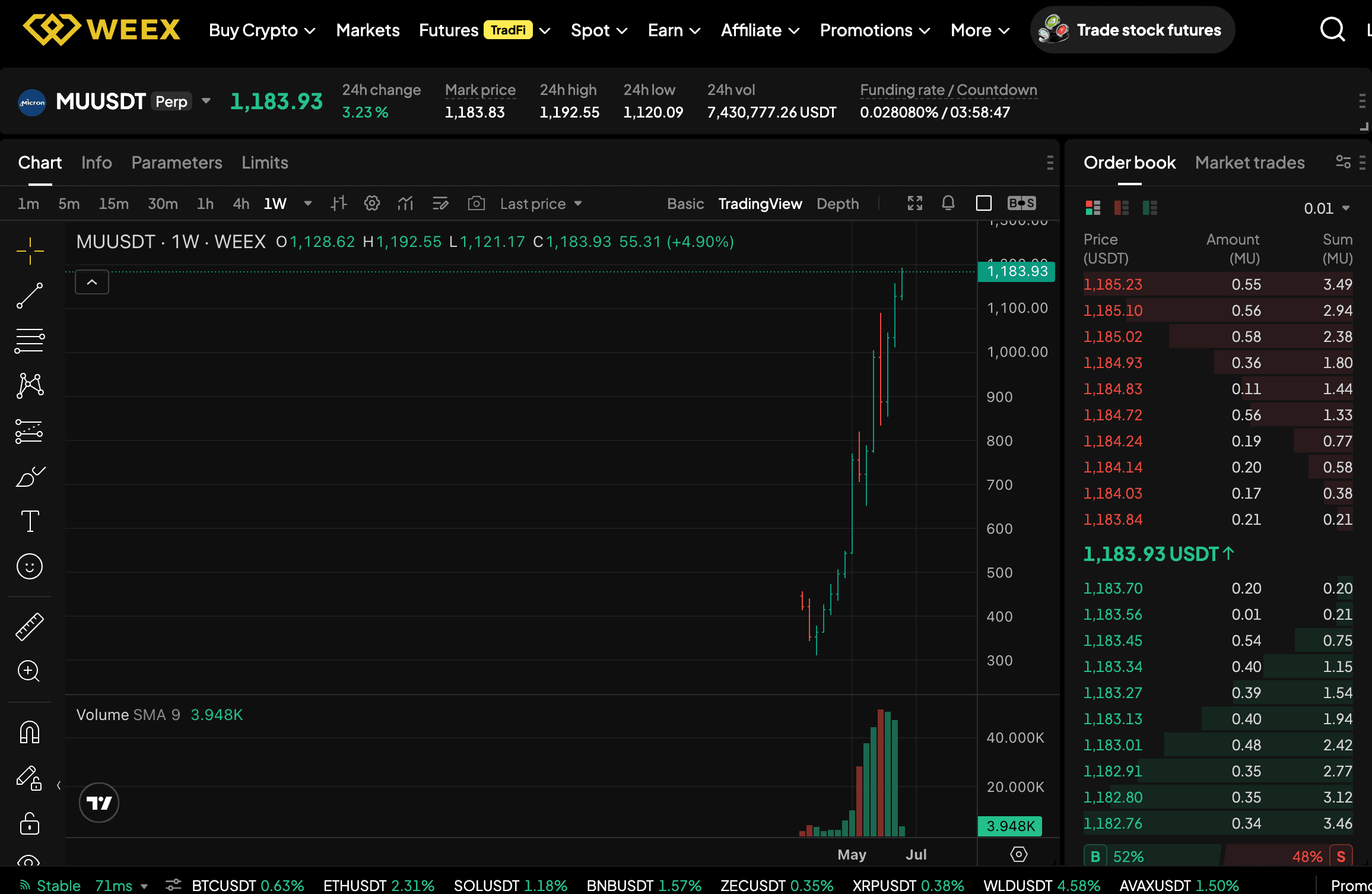
- The supplied WEEX MU-USDT futures page showed MUUSDT Perp around 1,183.93 USDT, highlighting strong short-term momentum, but futures quotes and stock prices can move quickly.
- For beginners, the better question is not only whether Micron is a good stock, but whether the current price already reflects a large part of the AI memory story.
- A practical MU strategy should compare valuation, earnings revisions, technical support, risk tolerance, and position size before buying or trading.
Why investors are watching Micron
Micron Technology is one of the best-known memory chip companies in the world. Its business is tied to DRAM, NAND, data center demand, AI infrastructure, PCs, smartphones, automotive electronics, and industrial devices. That makes MU different from software stocks: earnings can improve sharply during an upcycle, but profits can also fall when memory pricing weakens.
For users asking whether Micron is a good stock to buy, the main attraction is AI memory demand. High-bandwidth memory, data center upgrades, and AI server buildouts can support stronger revenue and margins if customers keep ordering at scale. Users who want trading access can review MU-USDT stock futures on WEEX, and new users may create a WEEX account before comparing markets, fees, and risk controls.
MU price analysis: what the chart is saying
The WEEX chart snapshot shows MUUSDT Perp near 1,183.93 USDT, with visible weekly momentum and a recent push into higher levels. That type of move can attract trend traders, but it also raises the risk of chasing after a fast rally. When a stock-linked futures market moves vertically, new buyers should watch for pullbacks, funding costs, and whether volume confirms the move.
From a trading perspective, Micron looks strongest when price holds above recent breakout areas and earnings expectations keep improving. It looks weaker if the price loses momentum, fails to hold support, or if broader semiconductor sentiment cools. For investors, the chart should support the thesis, not replace it.
Is Micron a good investment in 2026?
Micron can be a good investment for users who want exposure to AI memory and are comfortable with semiconductor volatility. The bullish case is built around HBM growth, better memory pricing, strong data center demand, and improving profitability. If those drivers continue, MU may have room to outperform broader indexes.
The cautious case is valuation and cyclicality. Memory stocks often look strongest near the middle or late part of an upcycle, when earnings estimates are being raised and investor sentiment is already optimistic. If demand slows, customers reduce orders, or margins peak, MU can fall even if the long-term AI story remains intact.
| Factor | Why it matters for MU | What investors should watch |
|---|---|---|
| AI memory demand | Supports revenue growth and higher-margin products | HBM orders, data center commentary, AI server spending |
| Memory pricing | Drives Micron margins and earnings power | DRAM and NAND pricing trends |
| Valuation | Shows whether optimism is already priced in | Forward earnings, sales multiples, peer comparison |
| Guidance | Can reset investor expectations quickly | Management outlook and analyst revisions |
| Market sentiment | Semiconductor stocks often move as a group | Nasdaq trend, AI chip leaders, risk appetite |
Should I buy Micron stock now?
Buying Micron now may make sense for long-term investors who believe memory demand is entering a durable AI-led cycle and who can tolerate sharp drawdowns. It may be less suitable for users who need stable cash flow, low volatility, or a short holding period.
A staged approach can reduce timing risk. Instead of buying a full position after a fast move, investors may consider scaling in around support levels, after earnings confirmation, or during broader semiconductor pullbacks. Traders using stock futures should also understand leverage, liquidation risk, funding, and stop-loss discipline.
Best time to buy MU
The best time to buy Micron is usually when the business cycle is improving but the market has not fully priced in that improvement. In practice, that can mean buying after a healthy pullback, after strong earnings with reasonable valuation, or when memory pricing data turns positive before the stock has fully repriced.
For momentum traders, the best setup is different: they may prefer breakouts with strong volume and clear risk levels. For long-term investors, patience matters more. A good MU entry should combine a strong thesis with a price that still leaves room for future returns.
MU 2026 outlook
| Scenario | 2026 outlook | What could drive it |
|---|---|---|
| Bullish case | MU continues higher and outperforms many chip peers | Strong HBM demand, rising memory prices, better margins, upbeat guidance |
| Base case | MU remains volatile but supported by AI memory demand | Good demand, mixed valuation, normal pullbacks, steady earnings revisions |
| Bearish case | MU gives back part of its rally | Weaker guidance, memory price pressure, AI spending concerns, broad tech selloff |
How to approach MU as an investment
Start with position size. Micron can move sharply around earnings, analyst updates, and semiconductor news, so a smaller position can be more practical than an oversized bet. Then separate investment exposure from trading exposure. Owning stock or stock-linked products for a multi-year thesis is different from using futures for shorter-term market movement.
Investors should also decide what would invalidate the thesis. Examples include weaker HBM demand, margin pressure, a sharp decline in memory pricing, or a valuation that becomes too expensive relative to expected growth. A strong investment plan includes both upside logic and exit rules.
Conclusion
Micron can be a compelling stock for 2026 if AI memory demand, HBM adoption, and memory pricing continue to improve. The company sits in an important part of the AI infrastructure supply chain, which gives MU a real investment story beyond short-term chart momentum.
Still, MU is not a simple low-risk buy. It is a cyclical semiconductor name with valuation, earnings, and market sentiment risk. For investors, the more balanced answer is that Micron may be worth buying on disciplined entries, especially after pullbacks or confirmed earnings strength, rather than chasing every breakout.
Before you go: users interested in stock futures may review the WEEX stock futures campaign, where eligible users can explore first-trade loss coverage, profit bonuses, consecutive trading rewards, and a limited-time reward pool through the WEEX stock futures promotion.
FAQ
1. Is Micron a good stock to buy in 2026?
Micron may be attractive for investors who believe AI memory demand and HBM growth will continue. However, MU is cyclical and can be volatile, so valuation and timing matter.
2. Should I buy MU stock now or wait?
Buying now depends on your risk tolerance and time horizon. A staged approach or waiting for pullbacks can reduce the risk of buying after a sharp rally.
3. What is the main bullish case for Micron?
The bullish case is stronger AI memory demand, HBM growth, improving margins, and better earnings guidance as data center customers continue investing in AI infrastructure.
4. What are the biggest risks for MU?
Main risks include memory price weakness, slower AI spending, high valuation, earnings disappointment, broader semiconductor selloffs, and futures trading risks for leveraged users.
5. Can I trade MU on WEEX?
Users can review MU-USDT stock futures on WEEX. Stock futures involve leverage and market risk, so users should understand product rules before trading.
6. What is the best time to buy Micron?
The best time is usually after a disciplined pullback, after earnings confirm the growth thesis, or when memory-cycle data improves before the market fully prices it in.
7. Is MU better for investing or trading?
MU can work for both, but the approach is different. Investors should focus on earnings and cycle strength, while traders should focus on chart levels, liquidity, leverage, and risk controls.
DISCLAIMER: WEEX and affiliates provide digital asset exchange and derivatives services, including stock futures where legal and for eligible users. All content is general information, not financial advice. Seek independent advice before trading or investing. Cryptocurrency, derivatives, and stock futures trading are high risk and may result in total loss. By using WEEX services you accept all related risks and terms. Never invest more than you can afford to lose. See the applicable Terms of Use and Risk Disclosure for details.
You may also like

Inside HBF: How SanDisk's High Bandwidth Flash Loads LLMs Straight Onto Hardware
What is HBF (High Bandwidth Flash)? Inside SanDisk and SK hynix's new AI memory technology that loads LLMs directly on hardware to cut inference lag, with timeline, specs, and how it differs from HBM.
Missed NVDA? Why SNDK's $1,500+ Surge Could Be the Start of the AI Storage Supercycle
Missed NVDA? See why SanDisk (SNDK) stock surged past $1,500 toward $2,000 in 2026, the AI storage supercycle driving NAND prices, analyst price targets, and key risks before you trade.
Elon Musk Reclaims Trillionaire Status: What It Means for Tesla and SpaceX Stock
Both Tesla and SpaceX stocks rallied in tandem on June 29, lifting Elon Musk back above the trillionaire…
SPCX Stock 52-Week Range: What $147 to $225 Tells You About Investor Sentiment
SPCX Stock shows a 52-week range from $147.11 (June 23) to $225.64 (June 16). That is a dramatic…
SPCX Stock and Government Contracts: How Much of SpaceX’s Revenue Actually Comes From NASA
SPCX stock is a popular search for investors hunting SpaceX exposure. While SpaceX remains private, understanding its revenue…
SPCX Stock Net Loss Explained: Why SpaceX Lost $4.28 Billion Last Quarter
SpaceX reportedly posted a $4.28 billion net loss last quarter, a sharp jump from a $0.528 billion loss…
Is Tesla Stock a Buy Before Q2 Delivery Numbers?
Tesla stock is heading into Q2 delivery numbers with a raised bar—and that’s the real story. Two major…
SPCX Stock Insider Lockup: What Happens When Early Investors Can Finally Sell
SPCX Stock is approaching a key phase: the insider lockup window. This article explains how lockup expiration can…
Should You Buy Amazon Stock Now? AI Boom and 2026 Forecast
Explore Amazon Stock (AMZN) outlook for 2026 and beyond, including AI growth, AWS expansion, retail performance, and key risks shaping future market expectations.
USWR Crypto Price Analysis 2026: Can USWR Memecoin Reach $1?
USWR crypto price analysis 2026: Can this AI-water narrative memecoin sustain momentum? Get USWR price targets, tokenomics, and key risks before investing.
$AI Airdrop on WEEX: Complete Guide to Gensyn and Claim Free $AI
Learn Gensyn tokenomics, machine-intelligence network utility, and how to claim free tokens in the WEEX 50,000 USDT AI airdrop before July 7, 2026.
What is NuScale Power(SMR) Coin: Comprehensive Guide to SMR/USDT Perpetual Futures and Investment Insights
This guide explains what NuScale Power (SMR) “coin” means in crypto markets, how SMR/USDT futures work, and practical…
What is NuScale Power(SMR) Coin: everything you need to know and how to trade SMR/USDT futures
This guide explains what NuScale Power (SMR) means for crypto market participants, how SMR/USDT derivatives work, and how…
What is Arista Networks(ANET) Coin: a comprehensive guide for USDT-settled stock futures traders
Arista Networks (ANET) on WEEX refers to a USDT-settled stock futures market that tracks the price of Arista…
SPCX Stock and the Cathie Wood Sell-Off: Why ARK Invest Is Cutting Its Position
SPCX stock drew fresh attention after ARK Invest trimmed its position as the price slid from around $225…
SPCX Stock vs AST SpaceMobile: Is There a Better Way to Play Satellite Connectivity?
SPCX Stock and AST SpaceMobile represent two very different paths to bet on satellite connectivity. SPCX Stock is…
SPCX Stock and the Charter Communications Deal: What a Mobile Partnership Would Mean
SPCX stock jumped after reports that SpaceX and Charter Communications discussed a mobile partnership. This piece explains what…
What is Hela Wood(HWOOD) Coin? Everything you need to know about the GameFi resource token and where to buy
Hela Wood (HWOOD) is the in-game resource token of World of Hela, newly listed on WEEX with HWOOD/USDT…
Inside HBF: How SanDisk's High Bandwidth Flash Loads LLMs Straight Onto Hardware
What is HBF (High Bandwidth Flash)? Inside SanDisk and SK hynix's new AI memory technology that loads LLMs directly on hardware to cut inference lag, with timeline, specs, and how it differs from HBM.
Missed NVDA? Why SNDK's $1,500+ Surge Could Be the Start of the AI Storage Supercycle
Missed NVDA? See why SanDisk (SNDK) stock surged past $1,500 toward $2,000 in 2026, the AI storage supercycle driving NAND prices, analyst price targets, and key risks before you trade.
Elon Musk Reclaims Trillionaire Status: What It Means for Tesla and SpaceX Stock
Both Tesla and SpaceX stocks rallied in tandem on June 29, lifting Elon Musk back above the trillionaire…
SPCX Stock 52-Week Range: What $147 to $225 Tells You About Investor Sentiment
SPCX Stock shows a 52-week range from $147.11 (June 23) to $225.64 (June 16). That is a dramatic…
SPCX Stock and Government Contracts: How Much of SpaceX’s Revenue Actually Comes From NASA
SPCX stock is a popular search for investors hunting SpaceX exposure. While SpaceX remains private, understanding its revenue…
SPCX Stock Net Loss Explained: Why SpaceX Lost $4.28 Billion Last Quarter
SpaceX reportedly posted a $4.28 billion net loss last quarter, a sharp jump from a $0.528 billion loss…