
Don’t Miss Out! How the U.S. 10-Year Treasury Yield Influences Bitcoin Price and Your Crypto Profits with WEEX

Introduction: Why the U.S. 10-Year Treasury Yield and Bitcoin Price Matter Now
The cryptocurrency market is a high-stakes arena, and few factors sway the Bitcoin price like the U.S. 10-year Treasury yield. As a key economic indicator, the yield reflects investor sentiment and monetary policy, directly impacting Bitcoin’s price swings. With Bitcoin’s role as a digital store of value, understanding how the U.S. 10-year Treasury yield influences Bitcoin price is crucial for traders aiming to maximize profits. WEEX, a top-10 global crypto exchange with over 5 million users, offers a secure platform with low fees to navigate these dynamics. This guide explores the relationship, its significance to the crypto industry, and how to trade on WEEX. Don’t miss out—Sign up on WEEX today!
The U.S. 10-Year Treasury Yield and Bitcoin Price: Historical Context and Mechanisms
What is the U.S. 10-Year Treasury Yield?
The U.S. 10-year Treasury yield is the annualized return on a 10-year U.S. Treasury note, a cornerstone of global financial markets. It signals investor confidence, inflation expectations, and Federal Reserve policies. From 2022 to 2025, yields have fluctuated between 3.5% and 4.9%, driven by inflation and Fed rate hikes. As of May 2025, yields hover around 4.0%, reflecting cautious optimism.
Historical Relationship
The U.S. 10-year Treasury yield and Bitcoin price often move inversely, as they compete for investor capital:
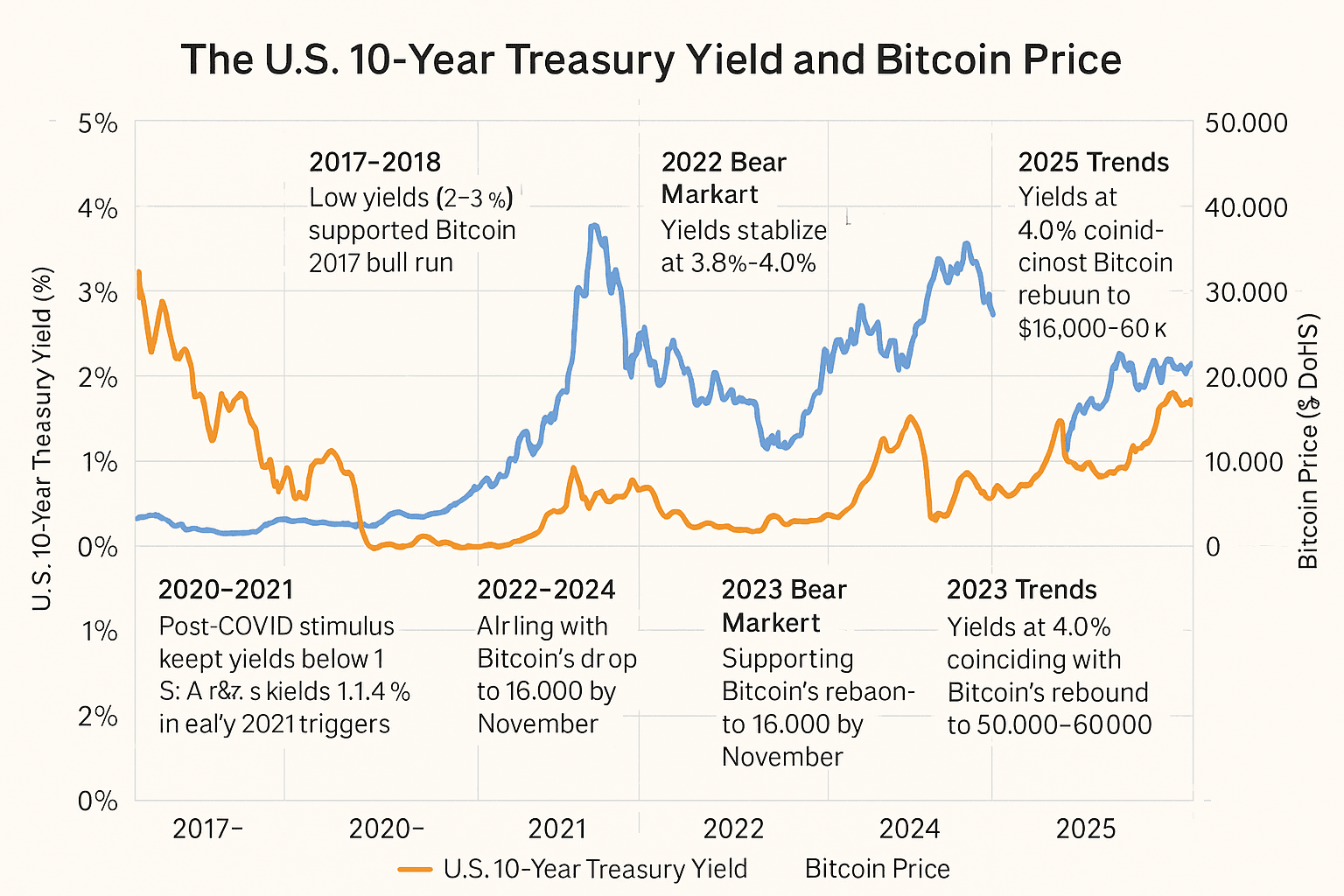
- 2017–2018: Low yields (2–3%) supported Bitcoin’s 2017 bull run to $20,000. Rising yields in 2018 contributed to a crash to $3,000.
- 2020–2021: Post-COVID stimulus kept yields below 1% in 2020, fueling Bitcoin’s surge from $5,000 to $69,000 by April 2021. A yield rise to 1.44% in early 2021 triggered corrections.
- 2022 Bear Market : Yields spiked to 4.2% amid Fed rate hikes, aligning with Bitcoin’s drop to $16,000 by November.
- 2023–2024 Recovery: Yields stabilized at 3.8%–4.0%, supporting Bitcoin’s rebound to $50,000–$60,000.
- 2025 Trends: Yields at 4.0% coincide with Bitcoin at ~$55,000, but Bitcoin’s reaction to yield surges has been subdued, suggesting a potential decoupling.
Data from 2022–2025 shows a negative correlation of ~0.6 between the U.S. 10-year Treasury yield and Bitcoin price, though crypto-specific factors like regulation can disrupt this.
Mechanisms of Influence
The U.S. 10-year Treasury yield influences Bitcoin price through:
- Risk Sentiment: Rising yields signal tighter monetary policy or inflation concerns, prompting investors to favor bonds over Bitcoin.
- Opportunity Cost: Higher yields make bonds more attractive, reducing capital flow to Bitcoin.
- Inflation Dynamics: Bitcoin is often seen as an inflation hedge, but sustained high yields can trigger sell-offs if bonds offer better returns.
- Liquidity Shifts: During uncertainty, investors flock to Treasurys, reducing Bitcoin demand.
WEEX provides real-time Bitcoin price data to align trades with yield trends.
Analysis: Will the U.S. 10-Year Treasury Yield Continue to Drive Bitcoin Price?
As experienced crypto analysts, we view the U.S. 10-year Treasury yield and Bitcoin price as a barometer of macroeconomic sentiment. Low yields, signaling loose policy or uncertainty, boost Bitcoin as a hedge against inflation or fiat devaluation. High yields, tied to Fed tightening or growth expectations, divert capital to bonds, pressuring Bitcoin’s price. However, 2025 data suggests Bitcoin’s reaction to yield surges is subdued, possibly due to:
- Institutional Adoption: Growing interest via ETFs or corporate treasuries prioritizes Bitcoin’s fundamentals.
- Decoupling Trend: Bitcoin may be evolving into a unique asset class, less tied to traditional markets.
For late 2025, we predict:
- Bullish Scenario: If yields stabilize at 3.5%–4.0%, Bitcoin could rally to $70,000, driven by adoption and innovations like BRC-20 tokens.
- Bearish Risk: A yield spike to 5%, due to inflation or geopolitical tensions, could push Bitcoin below $50,000, as in 2022.
Factors like regulatory clarity or global economic shifts could alter this dynamic.
Why This Matters to the Crypto Industry
The U.S. 10-year Treasury yield and Bitcoin price relationship shapes the crypto landscape:
- Market Sentiment: High yields signal risk-off sentiment, reducing crypto demand; low yields boost Bitcoin’s appeal.
- Trading Opportunities: Yield-driven volatility creates prospects for futures trading with up to 200x leverage on WEEX.
- Portfolio Strategy: Understanding this dynamic helps balance crypto and traditional assets.
- Institutional Impact: Stable yields could accelerate institutional adoption, boosting Bitcoin demand.
How to Trade Bitcoin on WEEX Amid Yield-Driven Volatility
To leverage how the U.S. 10-year Treasury yield influences Bitcoin price, follow these steps on WEEX:
- Register: Sign up on WEEX and complete KYC for full access.
- Deposit Funds: Add BTC or USDT via the platform’s deposit feature.
- Monitor Yields: Track yield updates (e.g., via Bloomberg) and Bitcoin prices on WEEX.
- Trade Futures: Access BTC/USDT pairs with up to 200x leverage. Practice risk-free with WEEX’s futures tools.
- Manage Risk: Set stop-loss orders to handle volatility. Enjoy low fees (0.02% maker) to maximize profits.
- Get Support: Visit the FAQ for trading guidance.

FAQs
- How does the U.S. 10-year Treasury yield influence Bitcoin price?
Rising yields often reduce Bitcoin’s price by favoring bonds; falling yields boost demand. Trade on WEEX to seize opportunities. - Is Bitcoin a good investment when yields rise?
It can hedge inflation initially, but high yields may trigger sell-offs. Test strategies on WEEX. - Why trade on WEEX?
WEEX offers low fees, high leverage, and robust security. - How can I track yield-driven Bitcoin price trends?
Use WEEX’s real-time data for market insights (see FAQ).
Conclusion
The U.S. 10-year Treasury yield influences Bitcoin price by shaping investor sentiment and capital flows, creating volatility and opportunity. While historically inverse, recent subdued reactions suggest Bitcoin may be decoupling. WEEX empowers traders with a secure platform and low fees to profit from these dynamics. Start today—Sign up on WEEX and unlock crypto profits!
You may also like

World Collective Oil Reserve (WCOR) Price Prediction 2026-2045: Expert Insights
WCOR (World Collective Oil Reserve) is a Solana-based cryptocurrency token that promotes an “oil reserve + real-world asset (RWA) narrative.” However, there is no public evidence that it is actually backed by physical oil assets. It is essentially a highly speculative, narrative-driven token. Its current market cap is around $14 million, with relatively low liquidity and high volatility, and its price is mainly driven by market sentiment and hype. Most analyses suggest limited short-term upside, with a possible gradual increase to around $0.02 by 2030. Overall, it is considered a high-risk crypto asset driven more by narrative speculation than fundamentals.
WEEX Gold & Silver 0% Fees Event: Trade Metals, Crude Oil and Stock Futures With Zero Fees
Join the WEEX 0-fee futures event from April 16 to May 31, 2026. Trade eligible gold, silver, crude oil, and stock futures with 0% fees.
Can PAC Coin Reach $1 Soon? Analyzing Public Asset Control
PAC is a Solana-based meme token with a government-themed narrative, but it is highly speculative.
At its current price (~$0.0009) and 1B supply, reaching $1 would require a $1B market cap, which is very unlikely.
Short-term moves to $0.001 or $0.01 are more realistic, but the token is highly volatile due to low liquidity and hype-driven trading.
Overall, $1 is not a realistic target, and PAC is better suited for short-term speculation than long-term investment.

What Is SAOS? Strategic American Oil Supply Token Explained
SAOS is a meme token on Solana with a 75,000 USD market cap and 22,000 USD locked liquidity, positioned around oil supply themes but lacking real asset backing
It thrives on pure narrative speculation, with no utility, website, or doxxed team, making it highly volatile and attention-dependent
Traders should distinguish SAOS from legitimate real-world asset projects, as its branding is speculative rather than substantive
Positive aspects include locked liquidity reducing rug pull risks, but low trading activity signals high uncertainty
NBIS Stock: What Nebius’ AI Cloud Surge Means Now
NBIS stock jumped as Nebius reported rapid AI cloud growth. See the key Q1 2026 numbers, catalysts, valuation risks, and what to watch next.

What Is Public Asset Control (PAC) Coin? Explained for Beginners
Public Asset Control (PAC) is a Solana-based token that uses a “government asset control” narrative involving oil and gold themes, but it has no verified ties to any real institutions or governments. It is mainly an entertainment-focused, speculative meme coin.
The project’s claims about links to entities like BlackRock or Palantir are unverified, and its own disclaimer states it is not a real financial or institutional asset. Like many new Solana tokens, PAC is highly volatile, with low liquidity and limited transparency, including no fully verified audit.
Overall, PAC is a high-risk speculative token driven by hype and storytelling rather than real utility. Beginners are advised to be cautious, verify contract details, and prioritize risk control before considering any trading.

Public Asset Control: What PAC Token Really Is
Public Asset Control PAC is a Solana token with bold asset-control branding. Learn what it is, what is verified, and the key trading risks.

Why Is Chinese Oil Asset Reserve (COAR Crypto) Trending Now?
Why is Chinese Oil Asset Reserve trending now? Learn the latest COAR crypto price action, trading volume, oil narrative, Solana pair data, and what is driving attention today.

How to Buy Chinese Oil Asset Reserve (COAR) Token in 2026: Latest Step-by-Step Guide, Contract Address, and Safe Buying Tips
How to buy Chinese Oil Asset Reserve (COAR) token step by step, including the official COAR contract address, Solana wallet setup, SOL funding, and latest market data.

COAR Coin: What Chinese Oil Asset Reserve Really Is
COAR coin is a new Solana oil-narrative token. Learn what Chinese Oil Asset Reserve claims, how to verify the contract, and key trading risks.

Did the CLARITY Act Pass Today? Latest Status and the History of the Crypto Bill
SEO meta description: Did the CLARITY Act pass today? Read the latest crypto bill update, the history of the CLARITY Act, House and Senate votes, and what happens next for U.S. crypto regulation.

What Is Chinese Oil Asset Reserve (COAR) Token? $COAR and Coar Stock Relationship Explained
Chinese Oil Asset Reserve (COAR) token explained, $COAR price, Solana details, and the relationship between COAR and Coar stock. Learn the latest facts.

Trade to Earn on WEEX: Join the Futures Trading Event and Earn Real-Time WXT Rewards Throughout May 2026
Join the WEEX Trade to Earn Series Five event from May 1–31, 2026 and earn real-time WXT rewards through futures trading. Boost your rebate level, complete missions, invite friends, and maximize your trade to earn rewards with USDT-M futures trading.

What Is World Cup Meme Coin? Football Meme Crypto Narrative Explained
World Cup meme coin $WCMEME is a Solana token that collapsed 96% in 24 hours. Learn how football meme narratives work and the risks involved.

Trade to Earn With Futures Trading on WEEX: How Smart Traders Are Turning Every Position Into WXT Rewards
Join the WEEX Trade to Earn Series Five campaign and earn real-time WXT rewards through futures trading from May 1–31, 2026. Upgrade mining levels, unlock higher rebate ratios, complete missions, and maximize your trade to earn rewards with USDT-M futures trading.

CBRS Stock: What to Know About Cerebras After Its IPO
CBRS stock surged after Cerebras priced its IPO at $185. Learn what the AI chipmaker does, why valuation matters, and what risks to watch.

SpaceX IPO Stock Market Impact: What Investors Should Watch
SpaceX’s IPO could reshape indexes, liquidity, space stocks, and crypto risk appetite. Here is what matters before the listing.

HMSTR Token Price: What Moves Hamster Kombat Now
Track HMSTR token price, supply, catalysts, and risks. Learn what drives Hamster Kombat price action and what traders should watch.
World Collective Oil Reserve (WCOR) Price Prediction 2026-2045: Expert Insights
WCOR (World Collective Oil Reserve) is a Solana-based cryptocurrency token that promotes an “oil reserve + real-world asset (RWA) narrative.” However, there is no public evidence that it is actually backed by physical oil assets. It is essentially a highly speculative, narrative-driven token. Its current market cap is around $14 million, with relatively low liquidity and high volatility, and its price is mainly driven by market sentiment and hype. Most analyses suggest limited short-term upside, with a possible gradual increase to around $0.02 by 2030. Overall, it is considered a high-risk crypto asset driven more by narrative speculation than fundamentals.
WEEX Gold & Silver 0% Fees Event: Trade Metals, Crude Oil and Stock Futures With Zero Fees
Join the WEEX 0-fee futures event from April 16 to May 31, 2026. Trade eligible gold, silver, crude oil, and stock futures with 0% fees.
Can PAC Coin Reach $1 Soon? Analyzing Public Asset Control
PAC is a Solana-based meme token with a government-themed narrative, but it is highly speculative.
At its current price (~$0.0009) and 1B supply, reaching $1 would require a $1B market cap, which is very unlikely.
Short-term moves to $0.001 or $0.01 are more realistic, but the token is highly volatile due to low liquidity and hype-driven trading.
Overall, $1 is not a realistic target, and PAC is better suited for short-term speculation than long-term investment.
What Is SAOS? Strategic American Oil Supply Token Explained
SAOS is a meme token on Solana with a 75,000 USD market cap and 22,000 USD locked liquidity, positioned around oil supply themes but lacking real asset backing
It thrives on pure narrative speculation, with no utility, website, or doxxed team, making it highly volatile and attention-dependent
Traders should distinguish SAOS from legitimate real-world asset projects, as its branding is speculative rather than substantive
Positive aspects include locked liquidity reducing rug pull risks, but low trading activity signals high uncertainty
NBIS Stock: What Nebius’ AI Cloud Surge Means Now
NBIS stock jumped as Nebius reported rapid AI cloud growth. See the key Q1 2026 numbers, catalysts, valuation risks, and what to watch next.
What Is Public Asset Control (PAC) Coin? Explained for Beginners
Public Asset Control (PAC) is a Solana-based token that uses a “government asset control” narrative involving oil and gold themes, but it has no verified ties to any real institutions or governments. It is mainly an entertainment-focused, speculative meme coin.
The project’s claims about links to entities like BlackRock or Palantir are unverified, and its own disclaimer states it is not a real financial or institutional asset. Like many new Solana tokens, PAC is highly volatile, with low liquidity and limited transparency, including no fully verified audit.
Overall, PAC is a high-risk speculative token driven by hype and storytelling rather than real utility. Beginners are advised to be cautious, verify contract details, and prioritize risk control before considering any trading.


