
- Buy Crypto
- Markets
 Futures
- Spot
- Copy Trade
- Earn
- More
Ethereum's RWA Dominance: How One Blockchain is Reshaping the Asset Market

The tokenization of real-world assets (RWAs) represents one of blockchain technology's most promising applications. While numerous chains compete in this space, Ethereum has emerged as the undisputed leader. This article examines why Ethereum has become the backbone of the RWA revolution and what it means for the future of finance.
Understanding RWAs: The Bridge Between TradFi and DeFi
Real World Assets in the blockchain context refer to the tokenization of physical and financial assets that exist in the traditional economy - from government bonds to real estate, commodities, and private credit. By representing these assets on-chain, RWAs combine traditional asset value with blockchain efficiency and programmability.
The market for tokenized assets has grown exponentially, with projections suggesting it could expand to $10 trillion by 2030. Currently, Ethereum hosts nearly 60% of all non-stablecoin RWAs, creating a commanding lead in this rapidly growing segment.
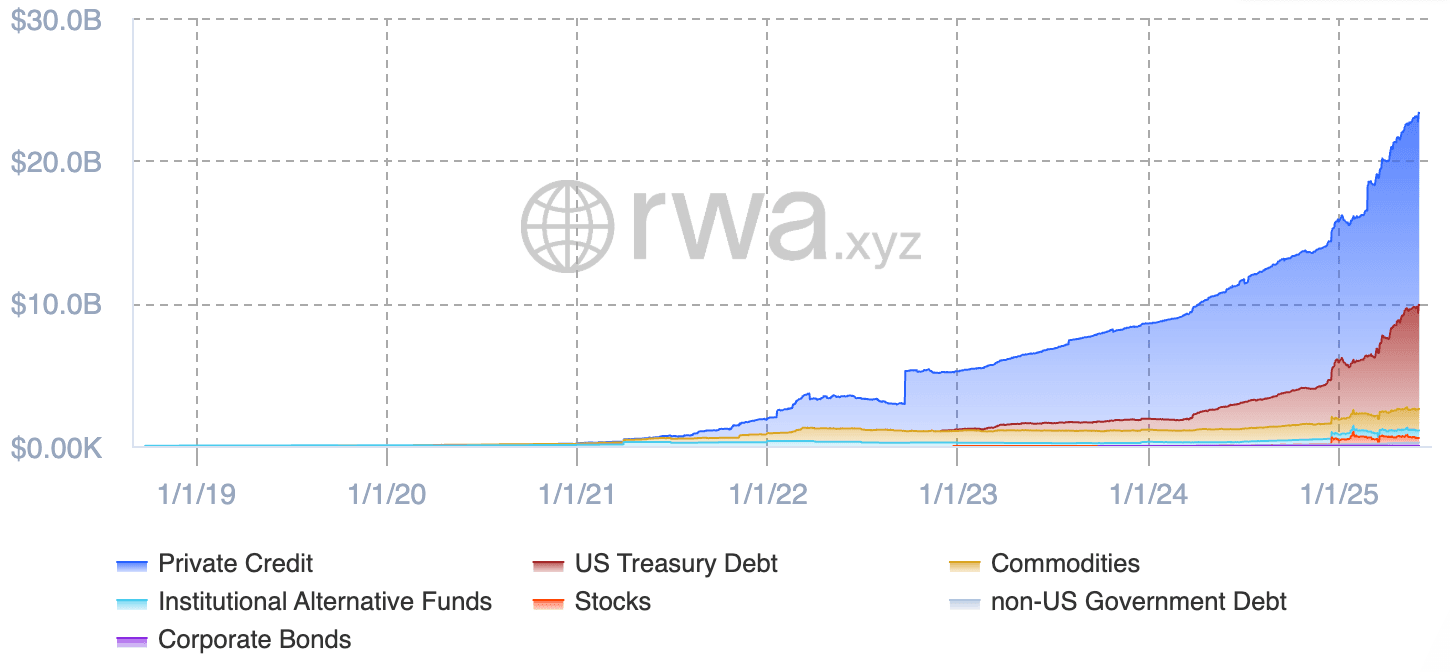
Ethereum's RWA Ecosystem: A Data-Driven Analysis
Ethereum's RWA ecosystem shows a distinct concentration in specific asset classes:
| Asset Class | Percentage of Ethereum RWA | Primary Projects |
|---|---|---|
| U.S. Treasury Products | 75.9% | BUIDL, OUSG, USDY |
| Commodities (Gold) | 20.3% | PAXG, XAUT |
| Private Credit | 2.1% | Centrifuge, Goldfinch |
| Real Estate | 1.0% | RealT, Propy |
| Other | 0.7% | Various |
BlackRock's BUIDL fund has become the single most influential project in this ecosystem, reaching $2.7 billion in assets under management with parabolic growth since March 2025. One year ago, it was comparable in size to gold-backed tokens like PAXG and XAUT; today, it significantly outpaces them.
Monthly growth data reveals that Ethereum's RWA expansion began in April 2024 with a 26.6% month-over-month increase. While growth moderated to around 5% monthly through late 2024, 2025 has seen a resurgence, with January posting a 33.2% increase followed by consistent double-digit growth.
Strategic Advantages Driving Ethereum's Leadership
First-Mover Advantage and Institutional Trust
Traditional financial institutions operate on different timelines than DeFi protocols. Regulatory scrutiny, pilot validations, and proof-of-concept demonstrations significantly extend deployment cycles. Ethereum's early establishment of relationships with top financial institutions before the RWA wave gained momentum has positioned it as the default blockchain for institutional deployment.
Ecosystem Maturity and Integration
Ethereum's RWA ecosystem benefits from:
Breadth: Diverse asset issuers and protocol architectures
Depth: Multiple billion-dollar projects creating meaningful scale
DeFi Integration: Direct access to established lending and trading protocols
Recent examples include Ethena using BUIDL as 90% of the reserves for its USDtb stablecoin and numerous DeFi protocols incorporating BUIDL into their collateral systems.

Security and Technical Resilience
Security is foundational for RWA adoption. The May 2025 Cetus protocol exploit on Sui blockchain, resulting in a $223 million loss, demonstrated the risks inherent in newer blockchain infrastructures.
Ethereum's advantages include its battle-tested infrastructure, decentralized architecture, and extensive developer ecosystem. These factors are crucial for institutional confidence in deploying high-value assets on-chain.
The Etherealize Initiative: Strategic Enabler
The Etherealize initiative has emerged as a key force driving Ethereum's RWA adoption. By addressing the gap between protocol development and institutional adoption, Etherealize systematically removes barriers to participation.
The organization's roadmap includes:
Institutional-grade SDKs with compliance workflows and gas optimization
Noir-based enterprise wallet solutions for privacy-preserving transactions
International partnerships with financial hubs in Singapore and Switzerland
Recently, Etherealize founder Vivek Raman testified before the House Financial Services Committee on "The Future of American Innovation and Digital Assets," further strengthening Ethereum's position in regulatory discussions.
Layer-2 Ecosystem: Complementary Growth Vectors
While Ethereum mainnet dominates the RWA landscape, Layer-2 networks provide additional growth avenues:
| Layer-2 Network | Total RWA Value | Top Project | Project Contribution |
|---|---|---|---|
| zkSync | $2.0B | Tradable | $2.0B (100%) |
| Arbitrum | $256M | BENJI | $111.9M (43.7%) |
| Polygon | $210M | Spiko | $73.5M (35.0%) |
| Optimism | $89M | USDe | $40M (44.9%) |
| Base | $45M | Various | Diversified |
Most L2 networks face ecosystem diversity challenges, with RWA values heavily dependent on 1-2 core projects. This concentration creates both opportunities and risks for investors looking at the L2 landscape.
Regulatory Developments: The GENIUS Act's Impact
The GENIUS Act, expected to be voted upon before June 9th, represents both an opportunity and a challenge for the RWA ecosystem. The legislation brings regulatory clarity while imposing significant constraints on stablecoin issuers.
By requiring stablecoin reserves to be anchored to U.S. sovereign credit, the Act effectively ties these assets to American treasuries. This regulatory framework will likely accelerate institutional adoption while potentially reshaping the competitive landscape for existing issuers.
Ethereum's stablecoin ecosystem demonstrates resilience through diversity. Since early 2025, numerous issuers have significantly increased their market capitalization, with new projects emerging and crossing the $50M threshold. This diversity provides natural risk isolation - even if some stablecoins adjust strategies for compliance, others will continue pushing innovation.
Top RWA Projects to Watch in 2025
| Project | Category | Key Features | AUM/TVL |
|---|---|---|---|
| BUIDL by BlackRock | U.S. Treasury | First major asset manager tokenized fund | $2.7B |
| Ondo Finance | U.S. Treasury | OUSG fund, multi-chain capability | $1.0B |
| Maple Finance | Private Credit | Institutional lending, BTC strategies | $300M |
| Propy | Real Estate | Property transactions, title registry | $75M |
| Plume Network | Infrastructure | RWA-focused Layer-1, compliance tools | N/A |
Strategic Implications for Investors
For investors and ecosystem participants, Ethereum's RWA leadership creates several strategic imperatives:
Prioritize Ethereum exposure for RWA investments: The network's dominance, security, and institutional trust make it the primary vehicle for RWA exposure.
Assess L2 opportunities selectively: While Layer-2 networks offer growth potential, evaluate each based on ecosystem diversity rather than headline numbers.
Monitor regulatory developments closely: Legislation like the GENIUS Act will reshape the competitive landscape, creating opportunities for compliant entities.
Consider stablecoin market dynamics: As BIS research indicates, stablecoin issuers have become significant treasury market players, potentially affecting monetary policy transmission.
Conclusion: Ethereum's Pivotal Role in the RWA Revolution
Ethereum's RWA ecosystem has experienced explosive growth in 2025, driven by BUIDL's remarkable expansion and increasing integration between DeFi and traditional finance. This growth demonstrates Ethereum's strategic advantages: first-mover position, security infrastructure, ecosystem depth, and regulatory engagement.
The GENIUS Act is accelerating U.S. credit onboarding into the on-chain world, bringing larger capital volumes and creating new yield opportunities. However, this integration also introduces the fundamental question of Ethereum's positioning - whether to embrace deeper integration with the dollar system or maintain some independence.
As this transformation continues, understanding Ethereum's central role isn't just academic—it's essential for navigating what may become the most significant financial infrastructure shift of the decade. For investors, developers, and financial institutions, Ethereum's leadership in RWA tokenization represents both a strategic opportunity and a glimpse into the future of global finance.
You may also like

Block's 40% Workforce Reduction Due to 'AI Cost Reduction,' Anthropic Denies US Department of Defense Request, What Are Global Cryptocurrency Communities Talking About Today?

Why is Wall Street **Shorting** Crypto's **Poster Child** Strategy?

Beyond the Financials, Nvidia's True Risk and Opportunity

Citrini Lingering Echo

Wintermute: Cryptocurrency Volatility Plummets as Retail Investors Flock Madly to US Stocks

Bloomberg: Romania Presidential Election Meddled by Crypto Traders

WEEX P2P merchant referral program | Invite and earn up to 100 USDT each!
WEEX P2P is launching the "Merchant Referral Program" to build a stronger P2P merchant community and boost market liquidity. Refer potential merchants to join WEEX P2P and both of you can earn rewards.

Key Market Information Discrepancy on February 27th - A Must-See! | Alpha Morning Report

The Circle Beautiful Money Report: Is the True Winner of Stablecoins Not the Issuer?

Opinion: Bitcoin's 10-point Plunge Wasn't All Jane Street's Fault

Milestone AI-driven Layoff, a 50% Reduction in Force, Resulting in Unquestionable Capital Market Approval

WEEX P2P upgrade: Ad posting now available for regular users
To further improve liquidity and user participation in the P2P market and create a more open and efficient trading environment, WEEX now allows regular users to post ads on P2P. This update allows non-merchant users to post ads, opening up greater participation in the P2P marketplace.

Dovey Wan: The Great Liquidity Schism, Bitcoin May Never Keep Up with ARKK

Market Key Insights for February 26th, How Much Did You Miss?

L1 Value Capture Shrinks Significantly, ETH, SOL, HYPE Struggle to Return to All-Time High

Exploring the ‘Super Cycle’ in Artificial Intelligence: Insights from Brad Gerstner
Key Takeaways The concept of a ‘super cycle’ in AI technology is gaining traction, spearheaded by industry experts.…

Children and Trump’s Investment Program: Billionaires’ Contributions to “Trump Accounts”
Key Takeaways: President Donald Trump has introduced the “Trump Accounts” program, massively funded by billionaires to provide financial…

Could Stablecoins Resolve U.S. Debt? Standard Chartered Predicts $1 Trillion in Treasury Demand
Key Takeaways Projected Growth: The stablecoin market could see its capitalization soar to $2 trillion by 2028, significantly…


 App
App