
- Buy Crypto
- Markets
 Futures
- Spot
- Copy Trade
- Earn
- More
Sui Network's Phoenix Moment: Technical Resilience and Ecosystem Recovery After the Security Crisis

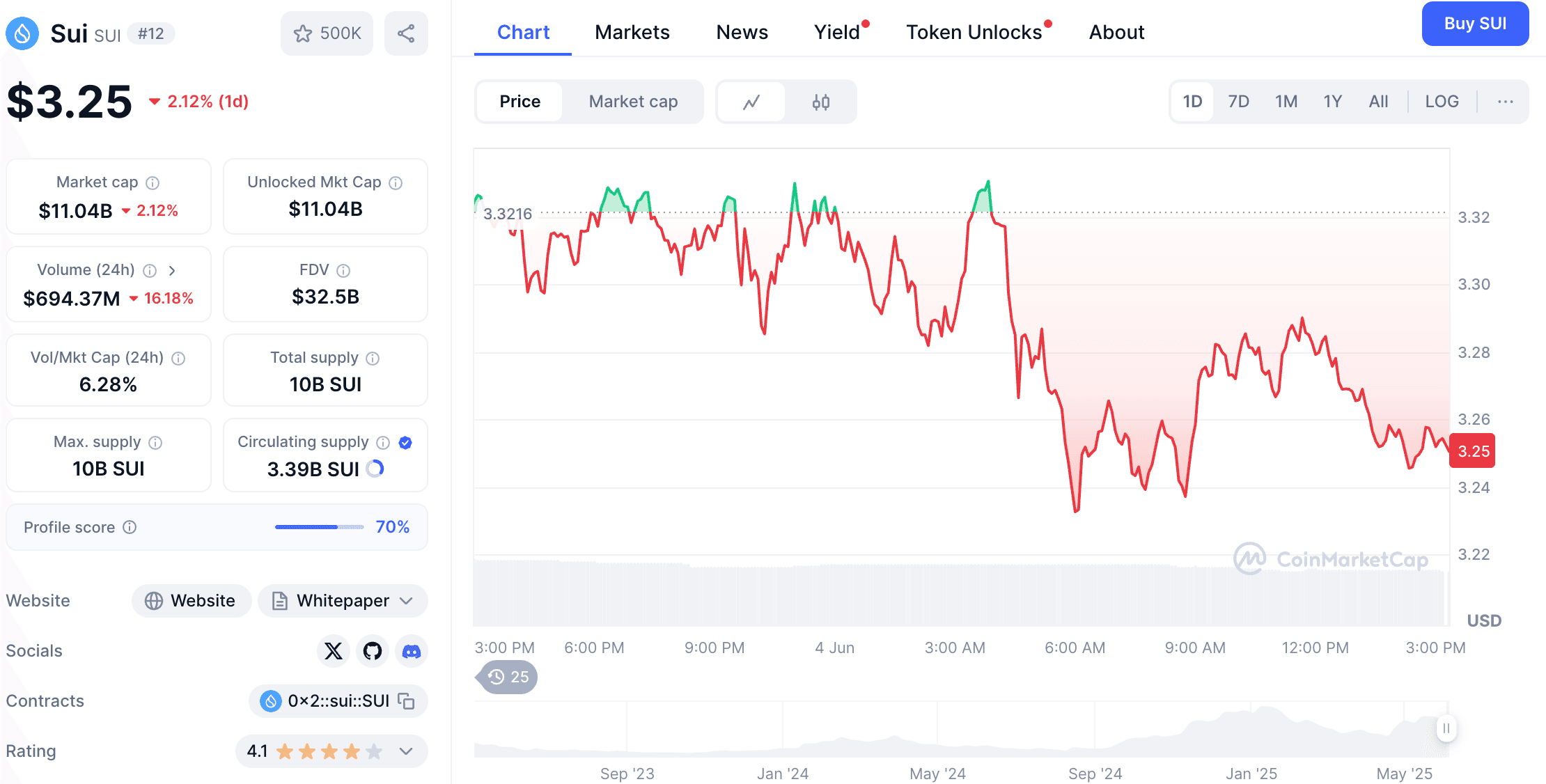
On May 22, 2025, the Sui Network faced a significant test when Cetus, a flagship AMM protocol in its ecosystem, suffered an exploit resulting in over $200 million in losses. Yet less than two weeks later, Sui shows remarkable recovery signs, with its token stabilizing around $3.25 and community sentiment strongly bullish at 84%.
This analysis examines the Cetus exploit, Sui's response mechanisms, and evaluates whether Sui still possesses the foundation for long-term growth despite this setback.
Understanding the Cetus Attack
What Happened?
The attack leveraged a mathematical vulnerability in Cetus's contract implementation - specifically an arithmetic overflow issue involving masking and bit shift operations. The attacker initiated a flash loan of 10 billion haSUI tokens, manipulated prices within an extremely narrow range, and exploited the vulnerability to extract approximately:
12.9 million SUI (~$54 million)
60 million USDC
4.9 million Haedal Staked SUI (~$19.5 million)
Other ecosystem tokens worth ~$66.5 million
Not a Fundamental Sui or Move Vulnerability
Security firms confirmed that the vulnerability existed specifically in Cetus's implementation of mathematical functions, not in Sui's underlying architecture or the Move programming language. The bug was:
Implementation-specific: Located in Cetus's math library, which wasn't included in previous audits
Easily fixable: Required only a two-line code change to implement proper boundary checking
Highly concealed: Remained undetected for nearly two years, as it required specific conditions to trigger
Sui's Emergency Response
Sui's handling of this crisis demonstrated the network's ability to rapidly coordinate a defensive response:
Address freezing: Validators synchronized the attacker's addresses to a deny list, freezing over $160 million in stolen funds
Recovery strategy: The Sui Foundation worked directly with Cetus on a compensation plan for affected users
Security reinforcement: A $10 million security audit fund was announced to strengthen ecosystem projects
This response highlighted the TransactionDenyConfig mechanism, which enables validators to block transactions involving flagged addresses during critical security events.
Technical Advantages That Protected the Ecosystem
Move Language Security Architecture
Sui's ability to contain damage stems from its Move programming language, which implements a resource-oriented programming model:
Ownership clarity: Assets are "resources" with single, explicit owners, unlike account-based models
Natural permission isolation: Resources can only be accessed by owners or through explicit authorization
Resource lifecycle tracking: Move's linear type system prevents common vulnerabilities like reentrancy attacks
The Cetus exploit occurred in an area using manual checks rather than relying on Move's native safety features, highlighting how deviations from the language's safety patterns can introduce vulnerabilities.
Efficient Consensus Structure
Sui implements a Delegated Proof of Stake (DPoS) mechanism with approximately 106 active validators. While critics point to this as evidence of centralization compared to Ethereum's validators, this structure enabled rapid coordination during the crisis without resorting to controversial measures like hard forks.
Ecosystem Recovery Signs
Despite the incident's impact, Sui's ecosystem shows remarkable resilience:
Market Performance
Current data shows Sui trading at $3.25, with a market cap of $11.04 billion and 84% bullish sentiment according to CoinMarketCap.
DeFi Ecosystem Strength
TVL Resilience: Total Value Locked remains around $1.6 billion, maintaining Sui's position as the 8th largest blockchain by TVL globally according to DeFiLlama
Stablecoin Growth: Circulation has surpassed $1 billion
Transaction Activity: Sui ranks 5th globally and 3rd among non-EVM networks
Key Projects Driving Recovery
| Project | Category | Key Features | TVL/Volume |
|---|---|---|---|
| DeFi Infrastructure | Multi-asset lending, leveraged vaults | $400M+ TVL | |
| Stablecoin | $BUCK stablecoin with multi-asset collateral | $110M+ TVL | |
| Trading | Perpetual contracts with 20x leverage | $50B+ volume | |
| Liquid Staking | Native SUI liquid staking | Rank 4 by TVL |
These diverse projects have provided stability and continued functionality even as Cetus recovered from the incident.
Security Improvements Following the Crisis
The Cetus incident catalyzed significant security enhancements:
Enhanced audit standards: New requirements for mathematical auditing, boundary verification, and formal verification
Real-time monitoring systems: Collaboration on tools to detect unusual price movements and suspicious flash loan activity
Collaborative security framework: Coordinated emergency communications between projects, validators, and the Foundation
How Sui Compares to Other Layer-1s After Security Incidents
When evaluating security response and recovery against other major blockchains, Sui showed strength:
| Network | Notable Security Incident | Response Time | Fund Recovery |
|---|---|---|---|
| Sui | Cetus Exploit (2025) | Hours | ~80% (projected) |
| Solana | Mango Markets Hack (2022) | Days | ~90% |
| Ethereum | The DAO Hack (2016) | Weeks | ~100% via hard fork |
Sui's response combined the speed of more centralized networks with a more measured approach than Ethereum's contentious hard fork.
Investment Perspective: Risks and Opportunities
Positive Indicators
Technical foundation remains sound: The incident highlighted implementation issues, not protocol weaknesses
Ecosystem diversity: Multiple strong projects across different sectors provide stability
Institutional support: Major exchanges including WEEX continue supporting Sui ecosystem projects
Risk Considerations
Market perception: Some participants may conflate project-level vulnerabilities with network risks
DeFi maturity: Sui's DeFi ecosystem, while growing rapidly, is still younger than Ethereum's
Competitive pressure: Established networks continue aggressive scaling efforts
Conclusion: Why Sui Maintains Long-Term Growth Potential
The Cetus exploit represents a significant but contained challenge in Sui's journey. Rather than revealing fundamental flaws, the incident demonstrated several strengths:
Technical robustness: The Move language continues to provide strong security guarantees, with the vulnerability stemming from implementation-specific issues
Governance effectiveness: Sui's validator structure enabled rapid coordination during crisis
Ecosystem diversity: Multiple strong projects ensured the incident didn't destabilize the entire ecosystem
Recovery mechanisms: Multi-layered approach combining validator-level security features, Foundation support, and compensation plans
Despite being less than two years since mainnet launch, Sui has established itself as a top-10 blockchain by TVL and a top-5 network by transaction activity. Its response to the Cetus incident demonstrates that in blockchain ecosystems, periods of stress often separate truly resilient systems from merely successful ones.
For those seeking a blockchain with technical advantages, governance responsiveness, and ecosystem vitality, Sui remains a compelling option in the competitive layer-1 landscape.
Disclaimer: This analysis is for informational purposes only and should not be considered investment advice. Always conduct your own research before making investment decisions.
You may also like

Block's 40% Workforce Reduction Due to 'AI Cost Reduction,' Anthropic Denies US Department of Defense Request, What Are Global Cryptocurrency Communities Talking About Today?

Why is Wall Street **Shorting** Crypto's **Poster Child** Strategy?

Beyond the Financials, Nvidia's True Risk and Opportunity

Citrini Lingering Echo

Wintermute: Cryptocurrency Volatility Plummets as Retail Investors Flock Madly to US Stocks

Bloomberg: Romania Presidential Election Meddled by Crypto Traders

WEEX P2P merchant referral program | Invite and earn up to 100 USDT each!
WEEX P2P is launching the "Merchant Referral Program" to build a stronger P2P merchant community and boost market liquidity. Refer potential merchants to join WEEX P2P and both of you can earn rewards.

Key Market Information Discrepancy on February 27th - A Must-See! | Alpha Morning Report

The Circle Beautiful Money Report: Is the True Winner of Stablecoins Not the Issuer?

Opinion: Bitcoin's 10-point Plunge Wasn't All Jane Street's Fault

Milestone AI-driven Layoff, a 50% Reduction in Force, Resulting in Unquestionable Capital Market Approval

WEEX P2P upgrade: Ad posting now available for regular users
To further improve liquidity and user participation in the P2P market and create a more open and efficient trading environment, WEEX now allows regular users to post ads on P2P. This update allows non-merchant users to post ads, opening up greater participation in the P2P marketplace.

Dovey Wan: The Great Liquidity Schism, Bitcoin May Never Keep Up with ARKK

Market Key Insights for February 26th, How Much Did You Miss?

L1 Value Capture Shrinks Significantly, ETH, SOL, HYPE Struggle to Return to All-Time High

Exploring the ‘Super Cycle’ in Artificial Intelligence: Insights from Brad Gerstner
Key Takeaways The concept of a ‘super cycle’ in AI technology is gaining traction, spearheaded by industry experts.…

Children and Trump’s Investment Program: Billionaires’ Contributions to “Trump Accounts”
Key Takeaways: President Donald Trump has introduced the “Trump Accounts” program, massively funded by billionaires to provide financial…

Could Stablecoins Resolve U.S. Debt? Standard Chartered Predicts $1 Trillion in Treasury Demand
Key Takeaways Projected Growth: The stablecoin market could see its capitalization soar to $2 trillion by 2028, significantly…


 App
App