
 Buy Crypto
- Markets
 Futures
- Spot
- Copy Trade
- Earn
- More
Tokenomics New Paradigm? When Backpack Starts Enabling VCs to "Deferred Gratification"

Original Article Title: "Long-Termism: Backpack's IPO Gamble"
Original Article Author: KarenZ, Foresight News
In the cryptocurrency "Wild West," "founder cash-out exits" and "rug pulls by project teams" have degenerated into blatant interest plundering, becoming a longstanding ailment hindering Web3 development. Therefore, "tokenomics" is often seen as both an accelerator of team wealth and a touchstone of user confidence.
However, when we turn our attention to Backpack, what we see is a starkly different design: Backpack has chosen a path that directly addresses an industry pain point—during the TGE, all liquidity tokens were given to users, and the team's and investors' rewards are entirely tied to the company's IPO process.
Backpack's move has forsaken the "VC accumulation, retail footing the bill" grassroots design. Regardless of the ultimate success or failure, this is a respect-worthy attempt in the history of cryptocurrency.
Deferred Gratification: The Long-Termism Game Between Team and Capital
In Backpack's tokenomics, the most intriguing aspect is the strict constraint on team and investor rewards—no founder, executive, employee, or venture capitalist can directly receive token allocations.
In the words of Backpack's founder and CEO Armani Ferrante, the "escape velocity" pursued by Backpack has never been about market cap breakthroughs or reaching a certain user count milestone in the short term; instead, it is about the company successfully completing an IPO in the United States.
All tokens originally intended for "team incentives" and "investor returns" (37.5% of the total supply) have been deposited into the company's "treasury," which is on Backpack's balance sheet. Even after a successful IPO, this portion of tokens has been subjected to a minimum one-year full lock-up period, further eliminating the possibility of "listing-to-cash-out."
This "deferred gratification" design is the best protection of the project's long-term value. In the crypto industry, the collapse of too many projects stems from the "get-rich-quick" mentality of teams and investors—premature token sell-offs leading to price crashes, loss of user trust, and eventual demise. Backpack's approach completely cuts off the path to "short-term cash-outs" by insiders, forcing the team and investors to be fully committed to the project's success.
Of course, IPO is not a smooth road. The founder of Backpack admits that going public could be just around the corner or a distant dream, or even ultimately unattainable. But regardless of the outcome, they will give it their all. This "break or make" determination makes Backpack stand out among a myriad of quick-profit crypto projects, earning the trust of users who truly value long-term benefits.
User-Centric Token Distribution: Igniting Growth with Incentives
In the Backpack tokenomics, all liquidity tokens are distributed entirely to users. In Backpack's view, users are the core driving force behind project growth, so tokens should serve as the fuel to incentivize user participation and drive product development.
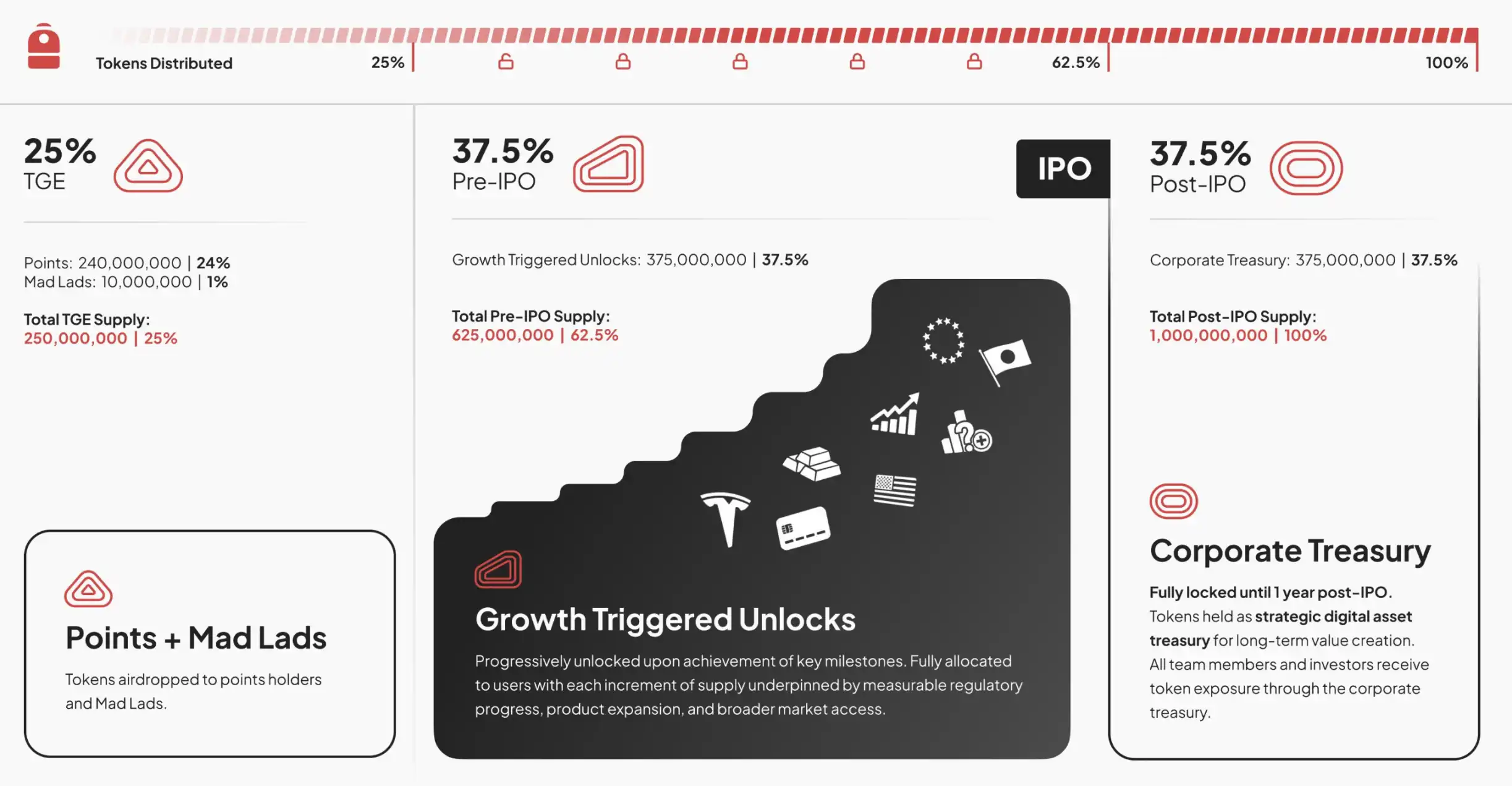
· Total token supply of 1 billion, with 25% directly released to the community in the TGE: Of this, points holders account for 24%, and Mad Lads holders account for 1%.
· Unlocking triggered by key product milestones before IPO (37.5%): Every market expansion and each new product launch before the IPO is an opportunity to incentivize users with tokens, triggering the corresponding token unlock. This design, through a predictable token unlock pattern, consistently attracts new users to join and expands the community.
More importantly, as described by Armani Ferrante, Backpack has set strict constraints for token unlocking: the additional ecological value brought by token unlocking must always outweigh its dilution effect on token price.
This design not only safeguards the core interests of users but also ensures that the long-term value of the project will not be diluted by short-term unlock actions, truly making token incentives a catalyst to drive platform growth, achieving a three-way win of "user benefit, ecological value appreciation, and project growth."
Compliance First: Slow is Fast
In addition to innovative token distribution, another unique aspect of Backpack is its pursuit of compliance. This stands in stark contrast to the industry's common logic of "expand first, comply later" and "emphasize scale, downplay compliance."
According to Armani Ferrante, "Backpack currently serves only about 48% of the global regions. This seemingly slow expansion is driven by our compliance focus."
This strategic choice may seem to miss out on market opportunities in the short term, but from a long-term development perspective, it is a key to building a trust barrier.
Currently, Backpack's positioning is as a compliant cryptocurrency trading platform, providing cryptocurrency spot, derivatives, and lending services. However, it aims to be more than just a cryptocurrency trading platform and is dedicated to building a compliant platform that integrates crypto assets with Traditional Finance (TradFi) services. To achieve this goal, the team is establishing banking rails globally and plans to gradually introduce diversified services such as security products in the future. In January, Backpack also launched a unified prediction investment portfolio product that adopts cross-margin and cross-collateralization.
Market Perspective: How to View Backpack FDV?
The market's attitude toward Backpack also indirectly reflects the controversy and potential of its model.
According to Axios citing sources familiar with the matter, Backpack is currently negotiating new financing terms, and its pre-money valuation has reached $1 billion.
On the prediction market Polymarket, market expectations for the Backpack token have shown significant fluctuations: the market is betting that the FDV of Backpack's token within one day of launch exceeding $1 billion has a 21% probability, while in November 2025, this probability once exceeded 80%. Of course, this volatility is largely due to the inherent uncertainty of the crypto market and reflects the market's cautious attitude toward the "IPO-bound revenue" model.
Summary
When tokens become a tool for project teams to cash out and users become mere targets for harvesting, the crypto industry loses its original ideals. However, Backpack's token distribution effectively physically segregates Web2's equity incentives from Web3's token utility.
· For the team: The only way out is to strengthen the product, ensure compliance, and work towards an IPO. If the company fails midway or cannot go public, the team's equity will be worthless, with no possibility of cashing out.
· For the community: They are no longer a liquidity exit for VCs. The token is purely a user reward and ecosystem tool, not a team's cash machine.
Backpack's choice is to redefine the value logic of crypto projects with compliance, transparency, and long-term thinking, showing us another possibility for the Web3 industry.
As Armani Ferrante said: "We either go big, or we go home." This statement is not only a declaration of the Backpack team but also a mandatory question for the entire Web3 industry: Do we continue to revel in speculative bubbles, overdrawing industry trust and future, or do we, like Backpack, choose the tougher, slower, but more hopeful path to reconstruct the industry ecosystem with long-term thinking?
Of course, an IPO is no easy feat, with a long and winding road, especially in the crypto industry, facing multiple challenges such as regulation, market, competition, and unexpected risks and uncertainties at every turn.
You may also like

AI Crypto Trading Bot Explained: Aurora's Multi-Factor Strategy in WEEX Hackathon
Aurora demonstrates how structured, multi-agent AI Trading systems can deliver more adaptive and resilient performance in the WEEX AI Trading Hackathon.

Cyber Taoist Fortune Teller: Fake Taoist, AI Fortune Telling, and Northeastern Metaphysics History

Bloomberg: Stablecoin Payments Emerge as Crypto VC's Newest Favorite Thing
BeatSwap is evolving towards a full-stack Web3 infrastructure, covering the entire lifecycle of IP rights.
BeatSwap, a global Web3 Intellectual Property (IP) infrastructure project, is attempting to overcome the current fragmentation limitations of the Web3 ecosystem, building a full-stack system that covers the entire lifecycle of IP rights.
Currently, most Web3 projects are still in the stage of functional fragmentation, often focusing only on a single aspect, such as IP asset tokenization, transaction functionality, or a simple incentive model. This structural dispersion has become a key bottleneck hindering the industry's scale application.
BeatSwap's approach is more integrated, integrating multiple core modules into the same system, including:
· IP authentication and on-chain registration
· Authorization-based revenue sharing mechanism
· User-engagement-driven incentive system
· Transaction and liquidity infrastructure
Through the above integration, the platform builds an end-to-end closed-loop path, allowing IP rights to complete a full cycle of "creation, use, and monetization" within the same ecosystem.
BeatSwap is not limited to existing crypto users but is attempting to take the global music industry as a starting point, actively creating new market demand. Its core strategies include:
Exploring and incubating music creators (Artist discovery)
Building a fan community
Igniting IP-centric content consumption demand
The current global music industry is valued at around $260 billion, with over 2 billion digital music users. This means that the potential market corresponding to the tokenization and financialization of IP far exceeds the traditional crypto user base.
In this context, BeatSwap positions itself at the intersection of "real-world content demand" and "on-chain infrastructure," attempting to bridge the structural gap between content production and financial flow.
BeatSwap's upcoming core product "Space" is scheduled to launch in the second quarter of 2026. This product is defined as the SocialFi layer in the ecosystem, aiming to directly connect creators with users and achieve deep integration with other platform modules.
Key designs include:
A fan-centric interactive mechanism
Exposure and distribution logic based on $BTX staking
User paths connected to DeFi and liquidity structures
Thus, a complete user behavior loop is formed within the platform: Discovery → Participation → Consumption → Rewards → Trading
$BTX is designed to be a core utility asset within the ecosystem, rather than just a simple incentive token, with its value directly tied to platform activity and IP use cases.
Main features include:
· Yield distribution based on on-chain authorized actions
· Value reflection based on IP usage and user engagement dynamics
· Support for staking and DeFi participation mechanisms
· Value growth driven by ecosystem expansion
With the increased frequency of IP use, the utility and value support of $BTX will enhance simultaneously, helping alleviate the "disconnect between value and utility" issue present in traditional Web3 token models to some extent.
Currently, $BTX has been listed on several mainstream exchanges, including:
Binance Alpha
Gate
MEXC
OKX Boost
As the launch of "Space" approaches, BeatSwap is actively pursuing more exchange listings to further enhance liquidity and global accessibility, laying a foundation for future market expansion.
BeatSwap's goal is no longer limited to the traditional Web3 narrative but aims to target over 2 billion digital music users and a trillion KRW-scale content market.
By integrating content creators, users, capital, and liquidity into a blockchain framework centered around IP rights, BeatSwap is striving to build a next-generation infrastructure focused on "IP tokenization."
BeatSwap integrates IP authentication, authorization distribution, incentive mechanism, transaction system, and market construction to establish a unified structure that bridges the full lifecycle path of IP rights.
With the launch of the Q2 2026 "Space," the project is expected to become a key infrastructure connecting content and finance in the IP-RWA (Real World Assets) track.

Mag 7 Evaporates $2 Trillion | Rewire News Morning Edition

Losing $19K per Coin Mined, Bitcoin Mining Firms Collective AI Defection

Morning Report | Tom Lee predicts that the cryptocurrency winter will end in April; xStocks introduces a new on-chain private equity fund; Sui mainnet upgraded to V1.68.1

Polymarket rules have changed, how should airdrop participants respond?

Crypto ETF Weekly | Last week, the net outflow of Bitcoin spot ETFs in the U.S. was $296 million; the net outflow of Ethereum spot ETFs in the U.S. was $206 million

This Week's Key News Preview | The U.S. Releases March Non-Farm Payroll Data; Polymarket Expands Fee Structure

Slow Down, That's the Answer to the Age of the Agent

From Cash to Cryptocurrency: Moving Towards a Unified Regulatory Path for Illegal Payments
Who will own the most Bitcoin in 2026

A private feud lasting 10 years, if not for OpenAI's "hypocrisy," would not have led to the world's strongest AI company, Anthropic

"Crypto Tsar" steps down: 130 days of political performance come to an end, how much of Trump's crypto promise remains?

From Utopian Narratives to Financial Infrastructure: The "Disenchantment" and Shift of Crypto VC
A decade-long personal feud, if not for OpenAI's "hypocrisy," there would be no globally leading AI company Anthropic

a16z: The True Meaning of Strong Chain Quality, Block Space Should Not Be Monopolized
AI Crypto Trading Bot Explained: Aurora's Multi-Factor Strategy in WEEX Hackathon
Aurora demonstrates how structured, multi-agent AI Trading systems can deliver more adaptive and resilient performance in the WEEX AI Trading Hackathon.
Cyber Taoist Fortune Teller: Fake Taoist, AI Fortune Telling, and Northeastern Metaphysics History
Bloomberg: Stablecoin Payments Emerge as Crypto VC's Newest Favorite Thing
BeatSwap is evolving towards a full-stack Web3 infrastructure, covering the entire lifecycle of IP rights.
BeatSwap, a global Web3 Intellectual Property (IP) infrastructure project, is attempting to overcome the current fragmentation limitations of the Web3 ecosystem, building a full-stack system that covers the entire lifecycle of IP rights.
Currently, most Web3 projects are still in the stage of functional fragmentation, often focusing only on a single aspect, such as IP asset tokenization, transaction functionality, or a simple incentive model. This structural dispersion has become a key bottleneck hindering the industry's scale application.
BeatSwap's approach is more integrated, integrating multiple core modules into the same system, including:
· IP authentication and on-chain registration
· Authorization-based revenue sharing mechanism
· User-engagement-driven incentive system
· Transaction and liquidity infrastructure
Through the above integration, the platform builds an end-to-end closed-loop path, allowing IP rights to complete a full cycle of "creation, use, and monetization" within the same ecosystem.
BeatSwap is not limited to existing crypto users but is attempting to take the global music industry as a starting point, actively creating new market demand. Its core strategies include:
Exploring and incubating music creators (Artist discovery)
Building a fan community
Igniting IP-centric content consumption demand
The current global music industry is valued at around $260 billion, with over 2 billion digital music users. This means that the potential market corresponding to the tokenization and financialization of IP far exceeds the traditional crypto user base.
In this context, BeatSwap positions itself at the intersection of "real-world content demand" and "on-chain infrastructure," attempting to bridge the structural gap between content production and financial flow.
BeatSwap's upcoming core product "Space" is scheduled to launch in the second quarter of 2026. This product is defined as the SocialFi layer in the ecosystem, aiming to directly connect creators with users and achieve deep integration with other platform modules.
Key designs include:
A fan-centric interactive mechanism
Exposure and distribution logic based on $BTX staking
User paths connected to DeFi and liquidity structures
Thus, a complete user behavior loop is formed within the platform: Discovery → Participation → Consumption → Rewards → Trading
$BTX is designed to be a core utility asset within the ecosystem, rather than just a simple incentive token, with its value directly tied to platform activity and IP use cases.
Main features include:
· Yield distribution based on on-chain authorized actions
· Value reflection based on IP usage and user engagement dynamics
· Support for staking and DeFi participation mechanisms
· Value growth driven by ecosystem expansion
With the increased frequency of IP use, the utility and value support of $BTX will enhance simultaneously, helping alleviate the "disconnect between value and utility" issue present in traditional Web3 token models to some extent.
Currently, $BTX has been listed on several mainstream exchanges, including:
Binance Alpha
Gate
MEXC
OKX Boost
As the launch of "Space" approaches, BeatSwap is actively pursuing more exchange listings to further enhance liquidity and global accessibility, laying a foundation for future market expansion.
BeatSwap's goal is no longer limited to the traditional Web3 narrative but aims to target over 2 billion digital music users and a trillion KRW-scale content market.
By integrating content creators, users, capital, and liquidity into a blockchain framework centered around IP rights, BeatSwap is striving to build a next-generation infrastructure focused on "IP tokenization."
BeatSwap integrates IP authentication, authorization distribution, incentive mechanism, transaction system, and market construction to establish a unified structure that bridges the full lifecycle path of IP rights.
With the launch of the Q2 2026 "Space," the project is expected to become a key infrastructure connecting content and finance in the IP-RWA (Real World Assets) track.


 App
App