
 Buy Crypto
- Markets
 Futures
- Spot
- Copy Trade
- Earn
- More
Predicting High-Frequency Trading Strategies in the Market, How to Ensure a Guaranteed $100,000 Profit?

Original Title: "Mosquito Meat, Rolling Out $100,000 Profit"
Original Author: Mach, Foresight News
Another miracle has happened on Polymarket.
With widespread monitoring, intense betting, and one year's time, an address relying solely on small profits has netted $100,000 through compounding interest.
The address we are going to review, planktonXD (0x4ffe49ba2a4cae123536a8af4fda48faeb609f71), is an extremely typical high-frequency quant player. Since joining in February 2025, in just one year, it has rolled out a net profit of $106,000 through over 61,000 predictions.
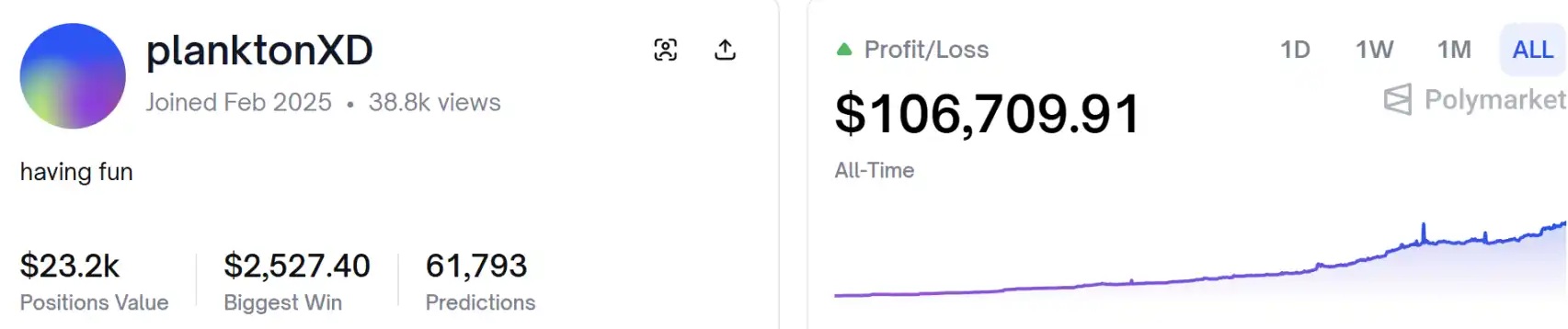
In the prediction market, most people wager on "Black Swans" or chase major news events, but planktonXD has taken a completely different path: ultimate certainty and terrifying execution frequency.
Looking at planktonXD's historical trading data, the most shocking aspect is its 61,000 predictions. From February 2025 to February 2026, an average of around 170 trades were made each day.
This frequency far exceeds the limit of human manual operation, indicating that the player is using automated trading scripts (Bot). It is not "predicting" outcomes but "harvesting" spreads.
An interesting phenomenon is that planktonXD's "Biggest Win" is only $2527.4. Compared to its total profit of $100,000, this single largest win seems very "small" (representing only about 2% of the total profit).
For some retail players, they always hope to make a big win and, with full confidence, bet all their chips.
Winning is, of course, good, but if you lose, it's very difficult to get back to the table.
To take a step back, even if you win every time you go ALL IN, but as soon as you lose once, you're going to lose big.
Reviewing its trading history, it never goes all-in on a single extreme event or bets on high-odds. Its profit curve shows a perfect 45-degree smooth upward trend with almost no major drawdowns. This indicates that it is using a market-making strategy: placing orders on both sides of the order book to earn the bid-ask spread, or taking advantage of price fluctuations between different markets for small-scale arbitrage.
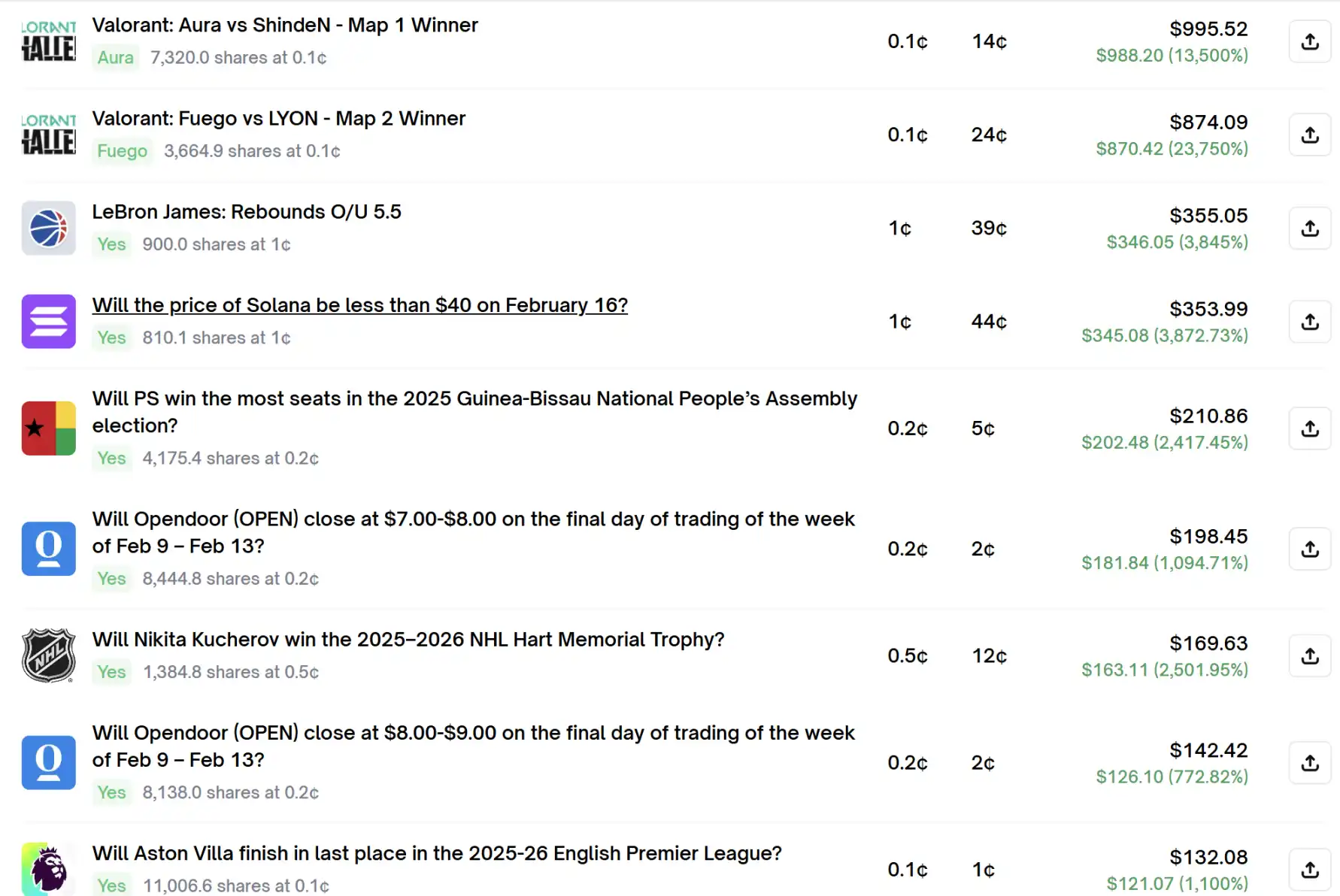
It is not always about long-term holding (Buy and Hold), but about frequently entering and exiting the market. This "light position, quick turnover" strategy greatly reduces single-point risk. Even if an unexpected event occurs in the predicted market (such as a sudden election result change), the impact on its total fund pool is minimal.
This quant robot does not specialize in trading in a specific vertical like before, such as weather, but rather it places bets on multiple tracks, including sports, weather, coin prices, politics, and more. It continuously monitors thousands of prediction markets across all platforms 24/7, searching for moments of pricing inefficiency.
VALORANT Challengers (Fearless Alliance Challenge) is a classic real-world example of this trader.
You can think of it as the esports scene's "secondary league" or "regional league." Fuego and LYON are professional teams in the Latin American region. Due to the small audience and very high information asymmetry in this type of competition, it has become the "arbitrage paradise" for the quant robot.

It purchased 3,664.9 units of Fuego's victory at a price of 0.1¢ per unit, resulting in a transaction that returned an impressive $874.09, with a staggering return rate of 23,750%!
This is a typical "small position, high odds" scenario. In markets with very low liquidity or where the public heavily underestimates a particular option in a long-tail market (such as a subgame result in an esports event), the bot exploits those options that have been erroneously priced close to "zero." It doesn't need to predict the winner; it only needs to know that the probability of Fuego winning is definitely more than 0.1%. This is essentially harvesting the market's "extreme emotions" and "lack of liquidity."
Speaking of emotions, the coin price illustrates this best.
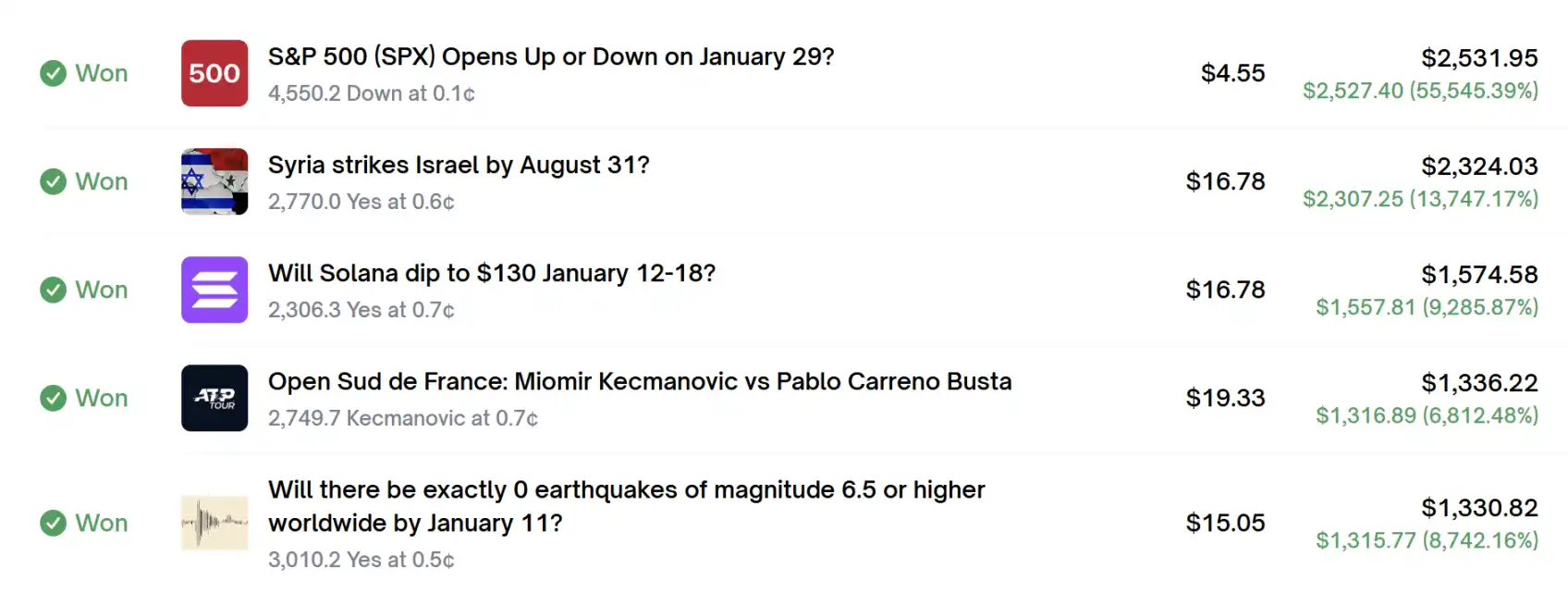
Will SOL's coin price drop to $130 between January 12-18?
It invested around $16 at a price of 0.7¢ (market thought the win rate was below 1%), and ultimately walked away with $1,574, achieving an astonishing return rate of 9,285%.
Why could it make big money on this "almost impossible to happen" prediction at that time?
During intense cryptocurrency market fluctuations, mainstream predictions tend to be bullish or sideways. planktonXD captures those "extremely bearish" options priced at 0.1¢ - 1¢ around the clock. These options are considered worthless by the average person, but in the eyes of quant trading, they are extremely cheap insurance. As long as the market experiences a deep pullback or sudden negative news, these "worthless" options will instantly spike by a thousandfold. Furthermore, in certain price ranges (such as SOL < $40), due to the significant disparity between the current price and the predicted price, the order book is often very thin. planktonXD uses automated scripts to place orders in these "no man's land" areas, picking up those cheap shares thrown out due to panic or misoperation, essentially acting as a probability porter.
The SOL strategy of planktonXD indicates that on Polymarket, buying into the "impossible" doesn't mean believing it will happen, but rather that the "probability of it happening" is underestimated by the market. With a cost of a few dollars, it hedges against a one-in-ten-thousand panic event in the market, which is a typical example of an "antifragile" trade.
planktonXD's success provides three core insights to regular retail traders:
The Power of Compounding is not to be underestimated. Earning 0.5% daily, through high-frequency trading, the annual return is much more robust than hitting a 10x coin. Technical prowess is a must-have skill. In the Crypto era, quantitative tools and API capabilities are essential for top players. The final point is that certainty is greater than odds. In prediction markets, it is easier to thrive by seeking out small-profit opportunities with very high probabilities (e.g., 90% or higher certainty) than by gambling on 50/50 major events.
After all, the most advanced play in prediction markets is not predicting the future, but managing probability and liquidity.
You may also like

Cyber Taoist Fortune Teller: Fake Taoist, AI Fortune Telling, and Northeastern Metaphysics History

Bloomberg: Stablecoin Payments Emerge as Crypto VC's Newest Favorite Thing
BeatSwap is evolving towards a full-stack Web3 infrastructure, covering the entire lifecycle of IP rights.
BeatSwap, a global Web3 Intellectual Property (IP) infrastructure project, is attempting to overcome the current fragmentation limitations of the Web3 ecosystem, building a full-stack system that covers the entire lifecycle of IP rights.
Currently, most Web3 projects are still in the stage of functional fragmentation, often focusing only on a single aspect, such as IP asset tokenization, transaction functionality, or a simple incentive model. This structural dispersion has become a key bottleneck hindering the industry's scale application.
BeatSwap's approach is more integrated, integrating multiple core modules into the same system, including:
· IP authentication and on-chain registration
· Authorization-based revenue sharing mechanism
· User-engagement-driven incentive system
· Transaction and liquidity infrastructure
Through the above integration, the platform builds an end-to-end closed-loop path, allowing IP rights to complete a full cycle of "creation, use, and monetization" within the same ecosystem.
BeatSwap is not limited to existing crypto users but is attempting to take the global music industry as a starting point, actively creating new market demand. Its core strategies include:
Exploring and incubating music creators (Artist discovery)
Building a fan community
Igniting IP-centric content consumption demand
The current global music industry is valued at around $260 billion, with over 2 billion digital music users. This means that the potential market corresponding to the tokenization and financialization of IP far exceeds the traditional crypto user base.
In this context, BeatSwap positions itself at the intersection of "real-world content demand" and "on-chain infrastructure," attempting to bridge the structural gap between content production and financial flow.
BeatSwap's upcoming core product "Space" is scheduled to launch in the second quarter of 2026. This product is defined as the SocialFi layer in the ecosystem, aiming to directly connect creators with users and achieve deep integration with other platform modules.
Key designs include:
A fan-centric interactive mechanism
Exposure and distribution logic based on $BTX staking
User paths connected to DeFi and liquidity structures
Thus, a complete user behavior loop is formed within the platform: Discovery → Participation → Consumption → Rewards → Trading
$BTX is designed to be a core utility asset within the ecosystem, rather than just a simple incentive token, with its value directly tied to platform activity and IP use cases.
Main features include:
· Yield distribution based on on-chain authorized actions
· Value reflection based on IP usage and user engagement dynamics
· Support for staking and DeFi participation mechanisms
· Value growth driven by ecosystem expansion
With the increased frequency of IP use, the utility and value support of $BTX will enhance simultaneously, helping alleviate the "disconnect between value and utility" issue present in traditional Web3 token models to some extent.
Currently, $BTX has been listed on several mainstream exchanges, including:
Binance Alpha
Gate
MEXC
OKX Boost
As the launch of "Space" approaches, BeatSwap is actively pursuing more exchange listings to further enhance liquidity and global accessibility, laying a foundation for future market expansion.
BeatSwap's goal is no longer limited to the traditional Web3 narrative but aims to target over 2 billion digital music users and a trillion KRW-scale content market.
By integrating content creators, users, capital, and liquidity into a blockchain framework centered around IP rights, BeatSwap is striving to build a next-generation infrastructure focused on "IP tokenization."
BeatSwap integrates IP authentication, authorization distribution, incentive mechanism, transaction system, and market construction to establish a unified structure that bridges the full lifecycle path of IP rights.
With the launch of the Q2 2026 "Space," the project is expected to become a key infrastructure connecting content and finance in the IP-RWA (Real World Assets) track.

Mag 7 Evaporates $2 Trillion | Rewire News Morning Edition

Losing $19K per Coin Mined, Bitcoin Mining Firms Collective AI Defection

Morning Report | Tom Lee predicts that the cryptocurrency winter will end in April; xStocks introduces a new on-chain private equity fund; Sui mainnet upgraded to V1.68.1

Polymarket rules have changed, how should airdrop participants respond?

Crypto ETF Weekly | Last week, the net outflow of Bitcoin spot ETFs in the U.S. was $296 million; the net outflow of Ethereum spot ETFs in the U.S. was $206 million

This Week's Key News Preview | The U.S. Releases March Non-Farm Payroll Data; Polymarket Expands Fee Structure

Slow Down, That's the Answer to the Age of the Agent

From Cash to Cryptocurrency: Moving Towards a Unified Regulatory Path for Illegal Payments
Who will own the most Bitcoin in 2026

A private feud lasting 10 years, if not for OpenAI's "hypocrisy," would not have led to the world's strongest AI company, Anthropic

"Crypto Tsar" steps down: 130 days of political performance come to an end, how much of Trump's crypto promise remains?

From Utopian Narratives to Financial Infrastructure: The "Disenchantment" and Shift of Crypto VC
A decade-long personal feud, if not for OpenAI's "hypocrisy," there would be no globally leading AI company Anthropic

a16z: The True Meaning of Strong Chain Quality, Block Space Should Not Be Monopolized
a16z: The True Meaning of Strong Chain Quality, Block Space Should Not Be Monopolized
Cyber Taoist Fortune Teller: Fake Taoist, AI Fortune Telling, and Northeastern Metaphysics History
Bloomberg: Stablecoin Payments Emerge as Crypto VC's Newest Favorite Thing
BeatSwap is evolving towards a full-stack Web3 infrastructure, covering the entire lifecycle of IP rights.
BeatSwap, a global Web3 Intellectual Property (IP) infrastructure project, is attempting to overcome the current fragmentation limitations of the Web3 ecosystem, building a full-stack system that covers the entire lifecycle of IP rights.
Currently, most Web3 projects are still in the stage of functional fragmentation, often focusing only on a single aspect, such as IP asset tokenization, transaction functionality, or a simple incentive model. This structural dispersion has become a key bottleneck hindering the industry's scale application.
BeatSwap's approach is more integrated, integrating multiple core modules into the same system, including:
· IP authentication and on-chain registration
· Authorization-based revenue sharing mechanism
· User-engagement-driven incentive system
· Transaction and liquidity infrastructure
Through the above integration, the platform builds an end-to-end closed-loop path, allowing IP rights to complete a full cycle of "creation, use, and monetization" within the same ecosystem.
BeatSwap is not limited to existing crypto users but is attempting to take the global music industry as a starting point, actively creating new market demand. Its core strategies include:
Exploring and incubating music creators (Artist discovery)
Building a fan community
Igniting IP-centric content consumption demand
The current global music industry is valued at around $260 billion, with over 2 billion digital music users. This means that the potential market corresponding to the tokenization and financialization of IP far exceeds the traditional crypto user base.
In this context, BeatSwap positions itself at the intersection of "real-world content demand" and "on-chain infrastructure," attempting to bridge the structural gap between content production and financial flow.
BeatSwap's upcoming core product "Space" is scheduled to launch in the second quarter of 2026. This product is defined as the SocialFi layer in the ecosystem, aiming to directly connect creators with users and achieve deep integration with other platform modules.
Key designs include:
A fan-centric interactive mechanism
Exposure and distribution logic based on $BTX staking
User paths connected to DeFi and liquidity structures
Thus, a complete user behavior loop is formed within the platform: Discovery → Participation → Consumption → Rewards → Trading
$BTX is designed to be a core utility asset within the ecosystem, rather than just a simple incentive token, with its value directly tied to platform activity and IP use cases.
Main features include:
· Yield distribution based on on-chain authorized actions
· Value reflection based on IP usage and user engagement dynamics
· Support for staking and DeFi participation mechanisms
· Value growth driven by ecosystem expansion
With the increased frequency of IP use, the utility and value support of $BTX will enhance simultaneously, helping alleviate the "disconnect between value and utility" issue present in traditional Web3 token models to some extent.
Currently, $BTX has been listed on several mainstream exchanges, including:
Binance Alpha
Gate
MEXC
OKX Boost
As the launch of "Space" approaches, BeatSwap is actively pursuing more exchange listings to further enhance liquidity and global accessibility, laying a foundation for future market expansion.
BeatSwap's goal is no longer limited to the traditional Web3 narrative but aims to target over 2 billion digital music users and a trillion KRW-scale content market.
By integrating content creators, users, capital, and liquidity into a blockchain framework centered around IP rights, BeatSwap is striving to build a next-generation infrastructure focused on "IP tokenization."
BeatSwap integrates IP authentication, authorization distribution, incentive mechanism, transaction system, and market construction to establish a unified structure that bridges the full lifecycle path of IP rights.
With the launch of the Q2 2026 "Space," the project is expected to become a key infrastructure connecting content and finance in the IP-RWA (Real World Assets) track.


 App
App