
Interpreting Stanford's 423-page AI Report: US-China Gap Narrows to 2.7%, Tsinghua's DeepSeek Enters Global Top Ten


Original Title: "Stanford's 423-Page AI Report Released, U.S.-China Gap Narrows to Just 2.7%, Tsinghua DeepSeek Enters Global Top Ten"
Original Authors: Good Sleep, Peach, Synced
Lead: Stanford's "2026 AI Index Report" has been released! This impactful 432-page document is filled with valuable insights: in the showdown between China and the U.S. in AI, the gap has nearly closed, shrinking to just 2.7%. The world's top AI talents, numbering 95, are mostly concentrated in big companies. Most cruelly, the employment opportunities for developers aged 22-25 have been cut by 20%.
On April 13, Stanford HAI released the highly anticipated "2026 AI Index Report"!
This 423-page annual report comprehensively reveals the latest power map of the global AI industry.
It presents a core conclusion: AI's capabilities have made rapid progress, but humanity's ability to measure and govern it has not kept pace.
Among them, the most shocking conclusion is —
The performance gap between Chinese and American AI models has basically disappeared, with both sides frequently exchanging the lead in the showdown, and the current Anthropic lead is only 2.7%.
The U.S. has invested more money in AI than anyone else, but attracting top talent is becoming increasingly challenging.
The report also points out that AI's evolution has not only not encountered the so-called "bottleneck" but is instead skyrocketing at an unprecedented pace.
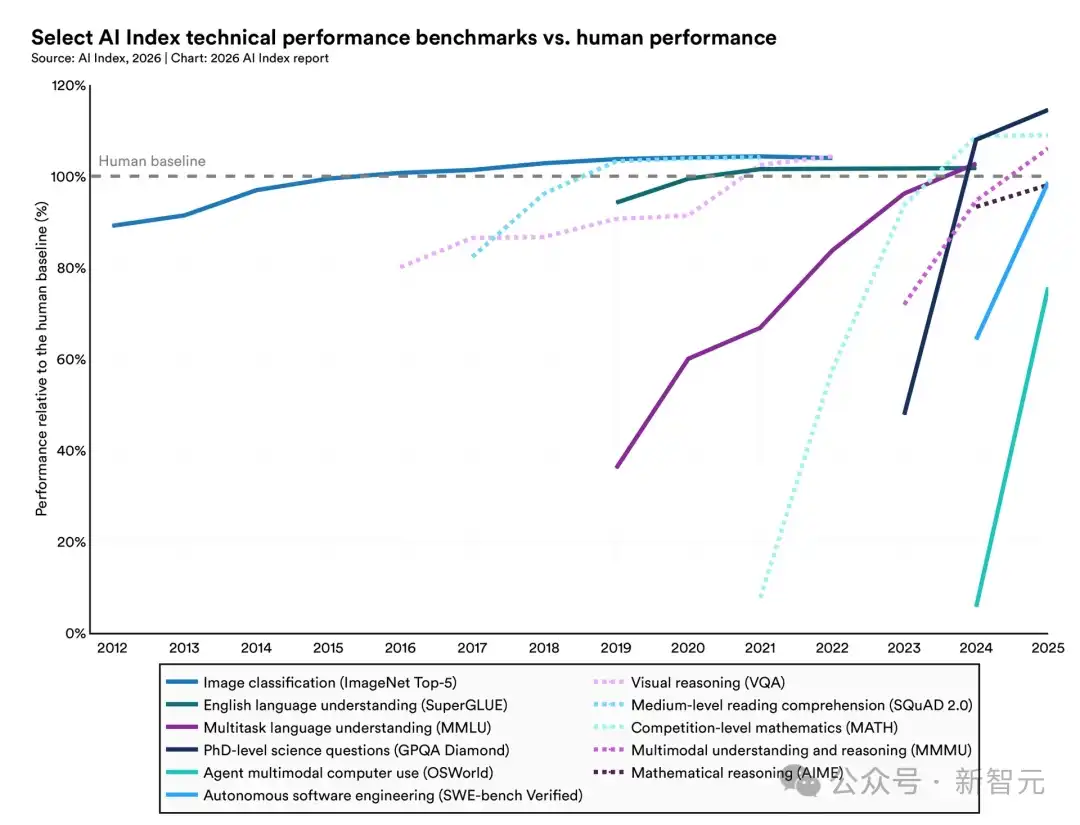
In the past year, over 90% of the world's top models have matched or even surpassed human performance in doctoral-level scientific problems, multimodal reasoning, and competitive mathematics.
Especially in coding capabilities, SWE-bench's score has surged from 60% to nearly 100% within a year.
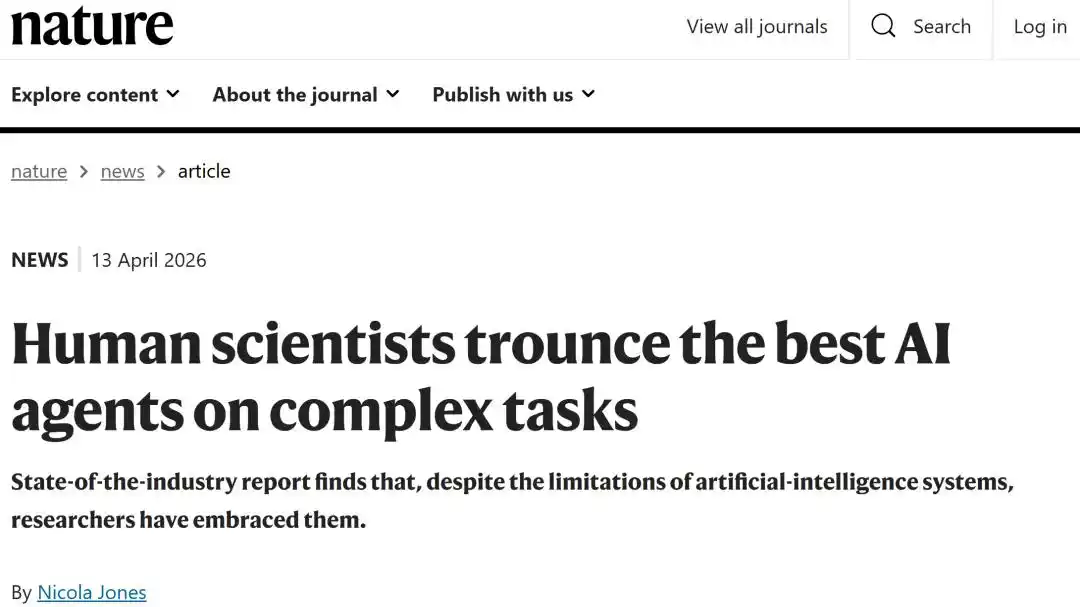
However, the phenomenon of AI's "overfitting" is extremely severe, presenting a distorted situation:
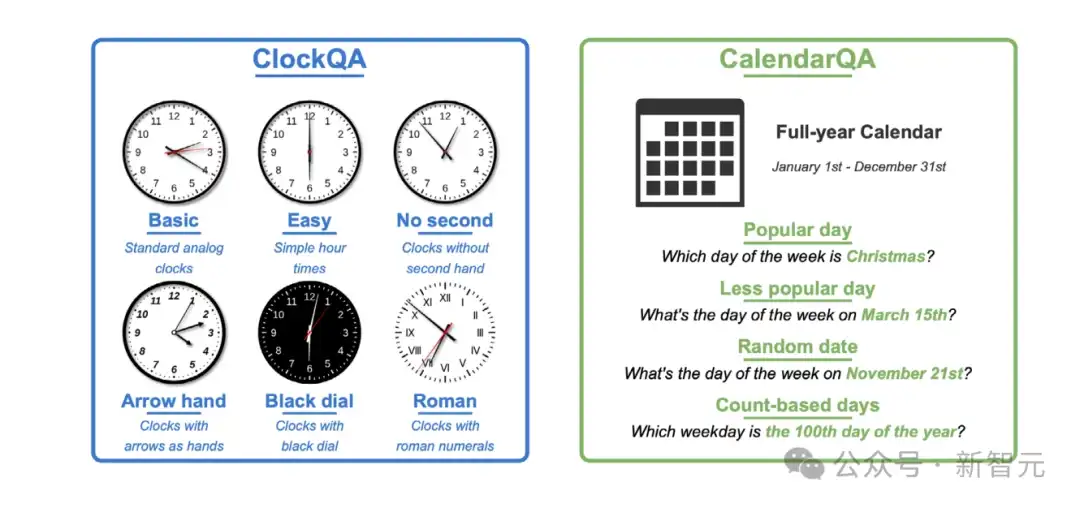
LLM can win an IMO gold medal but cannot read an analog clock accurately, with an accuracy rate of only 50.1%.
At the same time, the competition for jobs in AI has shifted from prediction to reality, and the first to suffer are the modern young "workers."
Now, let's get straight to the point - the 12 hardcore trends most worth paying attention to in the "2026 AI Index Report".
Other Highlights:
· Global AI computing power has increased 30-fold in 3 years, with NVIDIA occupying 60% and almost all chips coming from TSMC
· Global enterprise AI investment will reach $581.7 billion in 2025, doubling year-on-year, with the U.S. representing nearly half
· The number of AI researchers entering the U.S. has dropped by 89% in 7 years, with an 80% decrease in just the past year
· Employment of 22-25 year-old software developers has declined by 20% since 2024, with entry-level positions being selectively eliminated
· China has deployed over 85 public AI supercomputers, more than double North America's count, ranking first globally
· Over 80% of Chinese workplaces use AI, far exceeding the global average of 58%
· The most powerful models are becoming increasingly opaque, with 80 out of 95 representative models lacking publicly available training code
A Close Match Between China and the U.S., with the Gap Narrowing to Just 2.7%
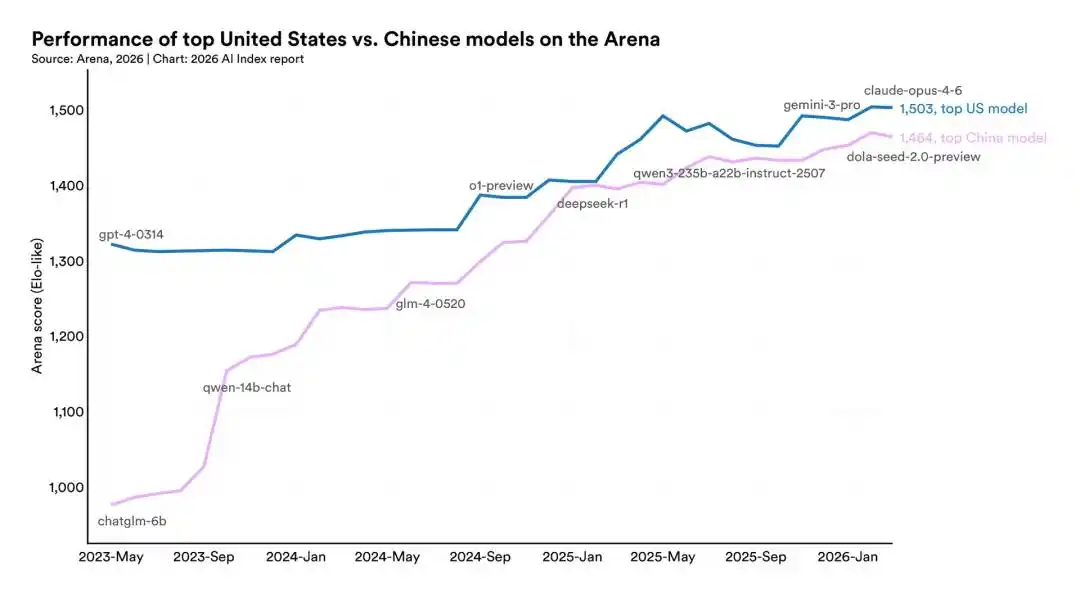
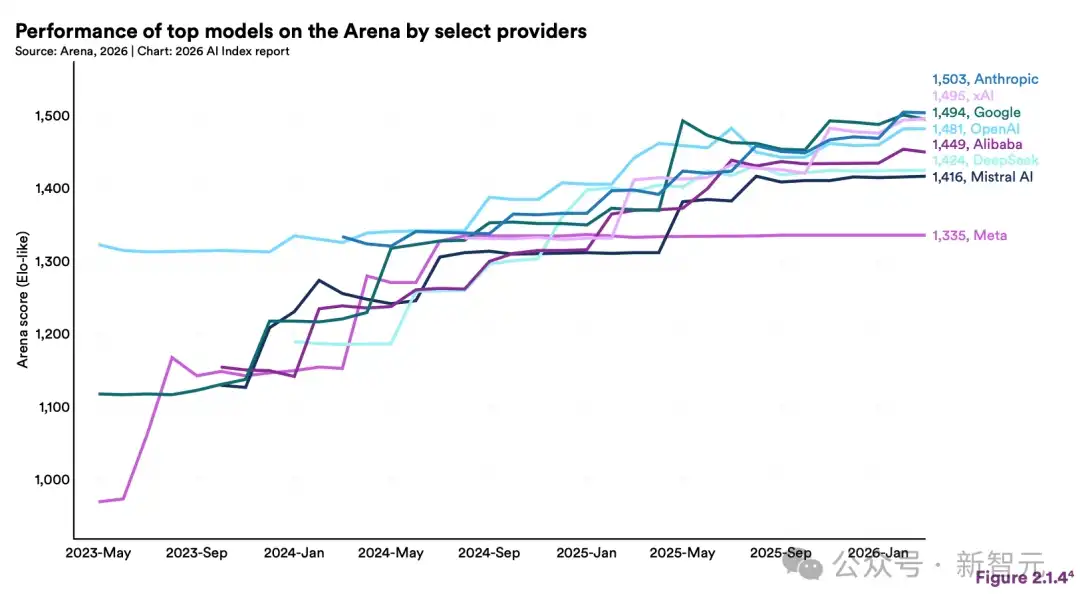
Since May 2023, Stanford has depicted the top models from the U.S. and China on the same coordinate system.
In May 2023, gpt-4-0314 took the lead with 1320 points, while China was using chatglm-6b, with a gap of over 300 points.
In February 2025, DeepSeek-R1 briefly matched the leading U.S. model for the first time.
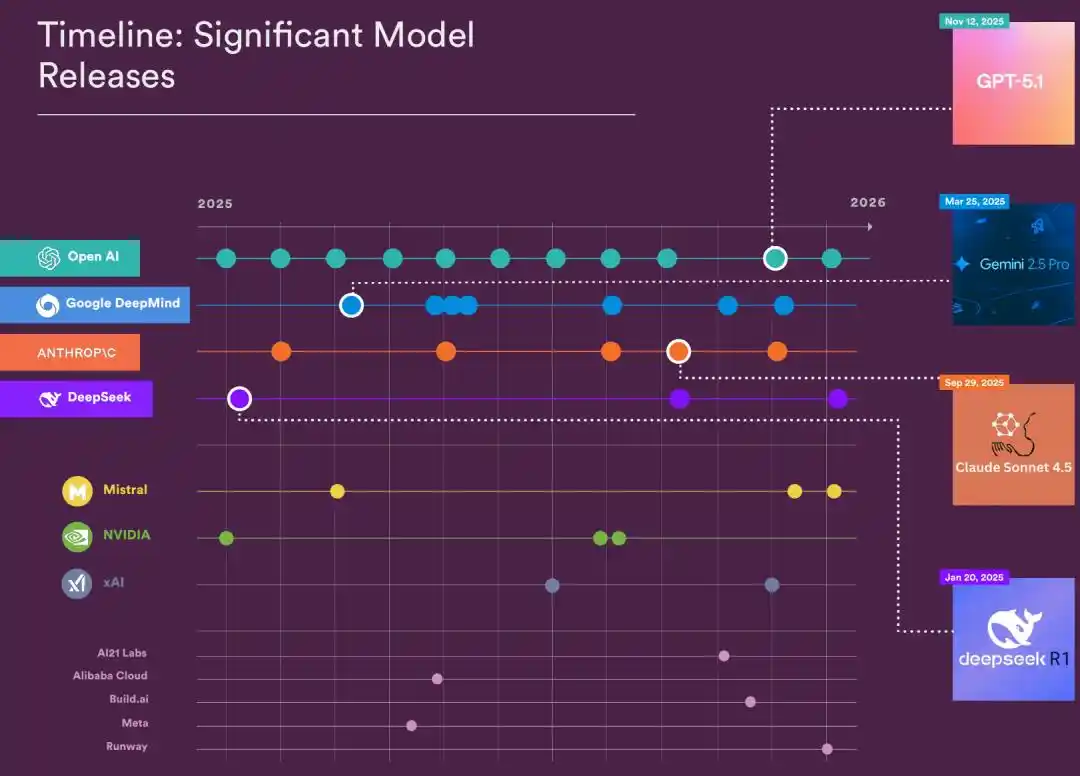
In March 2026, the U.S.'s Claude Opus 4.6 scored 1503 points, while China's dola-seed-2.0-preview scored 1464 points.
Now, the gap between China and the U.S. in AI is only 39 points. In percentage terms, that's 2.7%.
What's even more noteworthy is the frequency of changes in the past year. Since early 2025, the top models in both countries have exchanged positions several times on the Arena.
On a quantitative basis, it's also a close call.
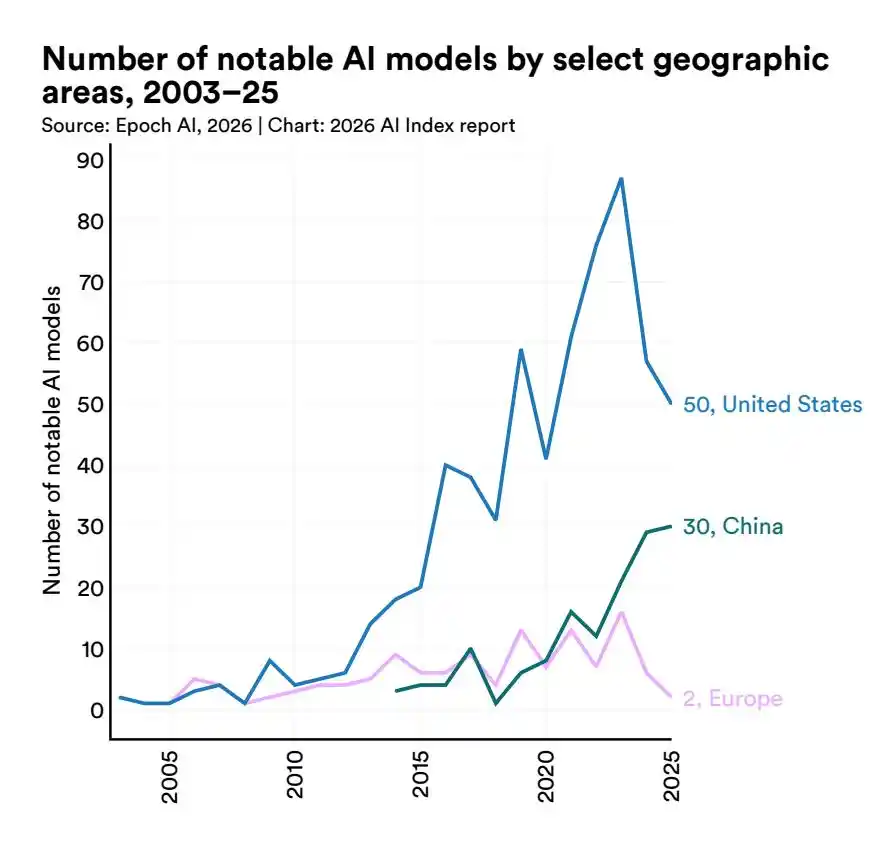
In 2025, the United States released 50 "significant models," followed closely by China, which also released 30 top-tier large models.
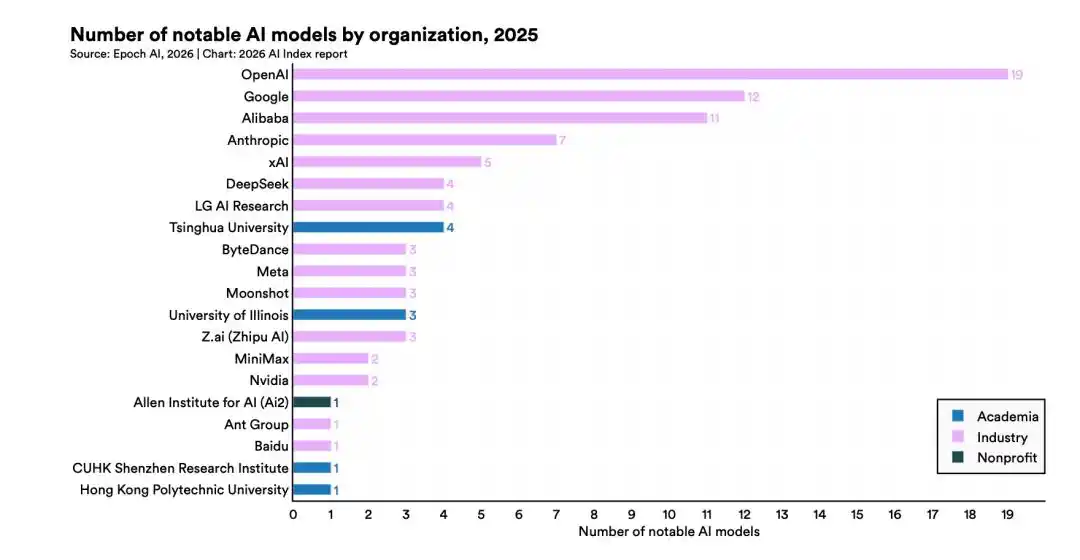
In the top tier, OpenAI, Google, Alibaba, Anthropic, and xAI stood together, sharing the top 5 spots globally.
Looking further down to the top 10, Chinese institutions and companies took four seats, including Alibaba, DeepSeek, Tsinghua University, and ByteDance.
In the open-source ecosystem, the focus shifted noticeably eastward this year.
DeepSeek, Qwen, GLM, MiniMax, and Kimi have continually pushed the open-source capability curve forward.
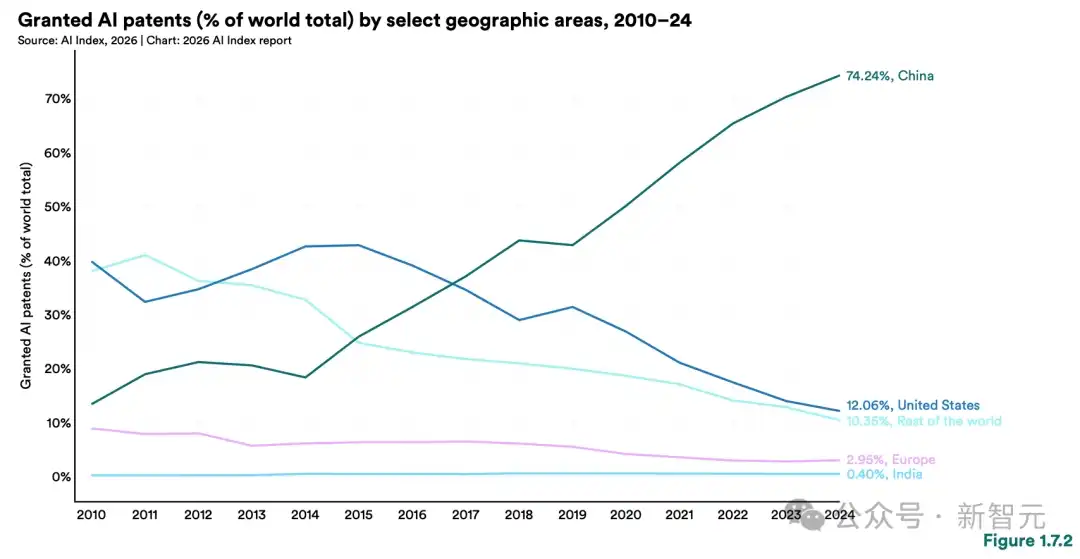
When considering research paper output, citations, patent output, and industrial robot installations, China leads globally in all aspects.
Price is another battleground.
Overseas developers did the math on X and found that the output price of Seed 2.0 Pro is only about one-tenth of Claude Opus 4.6.
With performance on par, the price is only one-tenth. The chain reaction of this matter has only just begun.
90% of Cutting-Edge Models Come from Industry, Setting Unprecedented Godly Speed
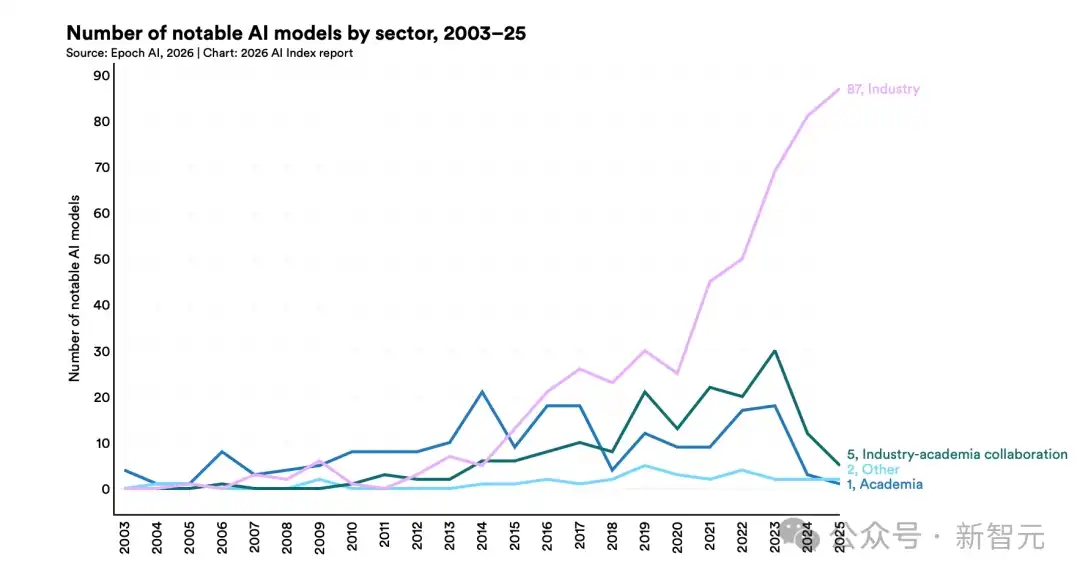
Among the 95 most representative models released last year, over 90% came from the industry, not from academic institutions or government labs.
The academic world is no longer keeping up with the cutting edge.
The pace of releases is also accelerating at an insane rate.
In just one month in February 2026, flagship models such as Gemini 3.1 Pro, Claude Opus 4.6, GPT-5.3 Codex, Grok 4.20, Qwen 3.5, Seed 2.0 Pro, MiniMax M2.5, and GLM-5 all made their entrance.
The godly cycle has shifted from "years" to "months."
Benchmark One-Year Cap, AI Has No Bottleneck
The most powerful curve is programming.
SWE-bench Verified, a benchmark that actually fixed bugs, increased from 60% to nearly 100% in one year.
It didn't increase by a few points; it basically hit the ceiling.
Terminal-Bench tested the Agent's ability to handle real terminal tasks, increasing from 20% last year to 77.3%.
Network Security Agent's successful issue resolution rate increased from 15% to 93%.
Gemini Deep Think won a gold medal at the International Mathematical Olympiad.
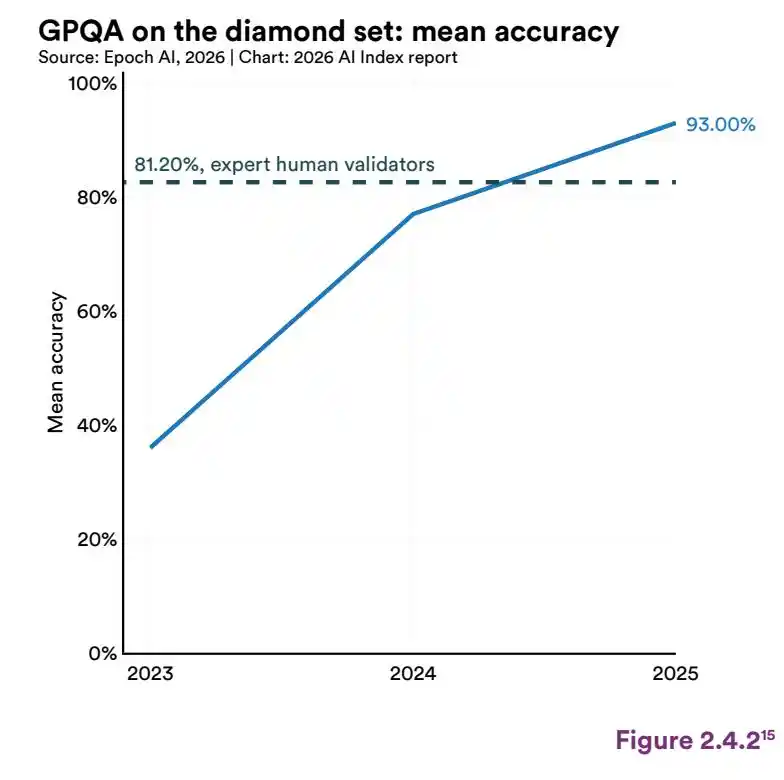
PhD-level General Problem Question Answering (GPQA Diamond), American Invitational Mathematics Examination (AIME), and Multimodal Multitask Unified Inference (MMMU) – all originally considered "humanly insurmountable" challenges – were all tackled by cutting-edge models.
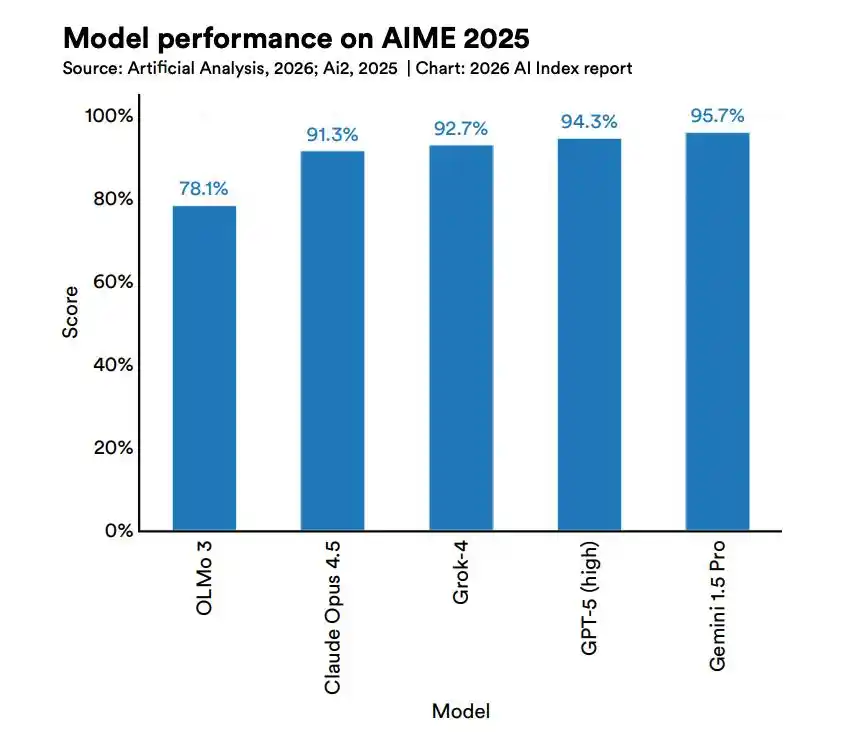
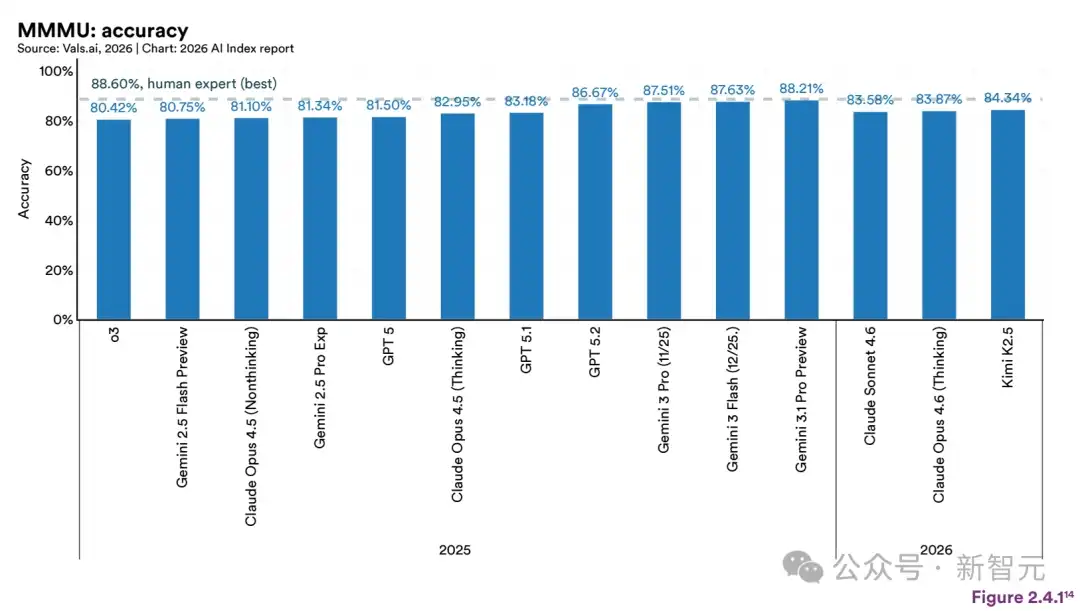
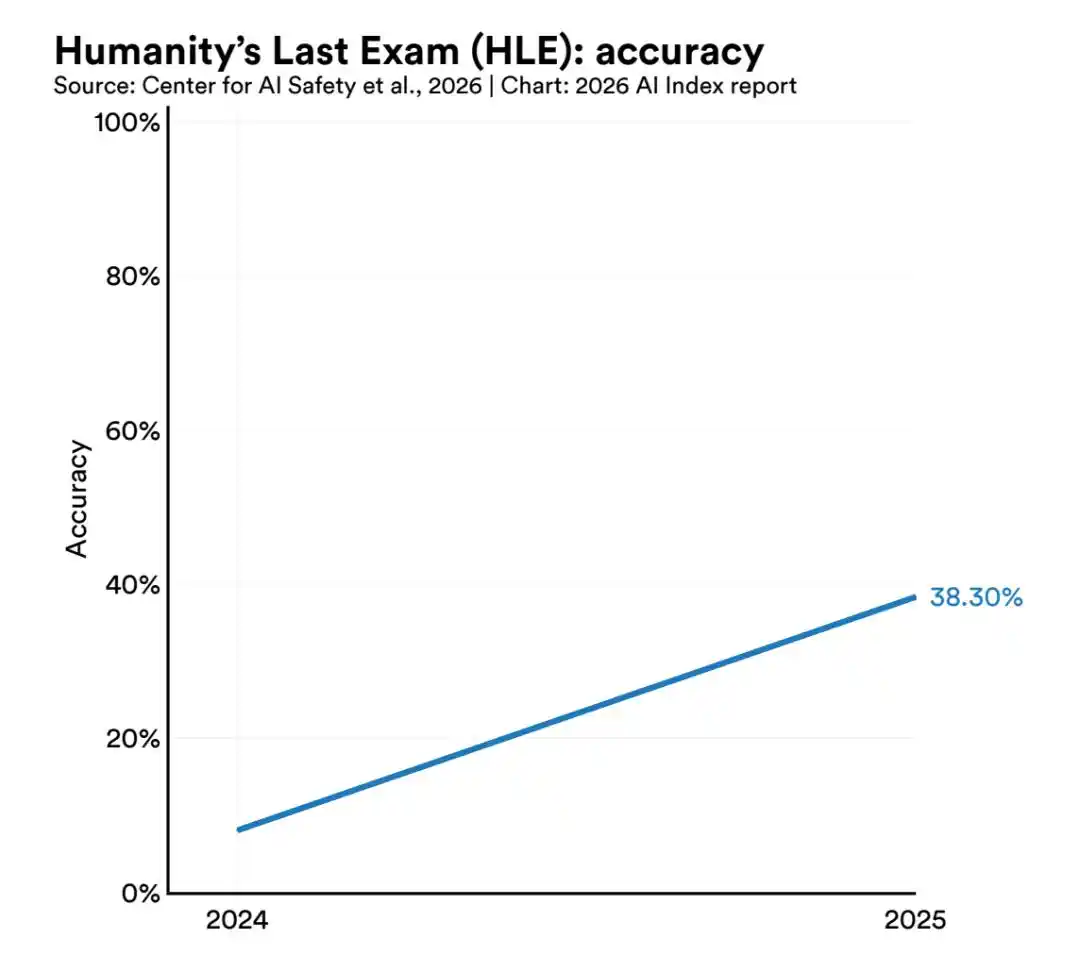
What best illustrates the point is Humanity's Last Exam.
This is a test specifically designed to "challenge AI and favor human experts," with questions provided by top experts in various fields.
Last year, OpenAI's o1 scored 8.8%, and in a year, cutting-edge models pushed the score up by another 30 percentage points. Currently, Claude Opus 4.6 and Gemini 3.1 Pro have both crossed the 50% mark.
Jagged Edge, Can Win IMO Gold but Can't Read a Chart
Yet the same index threw out another set of numbers.
The highest-performing model's accuracy on the "Reading Analog Clocks" task is 50.1%.
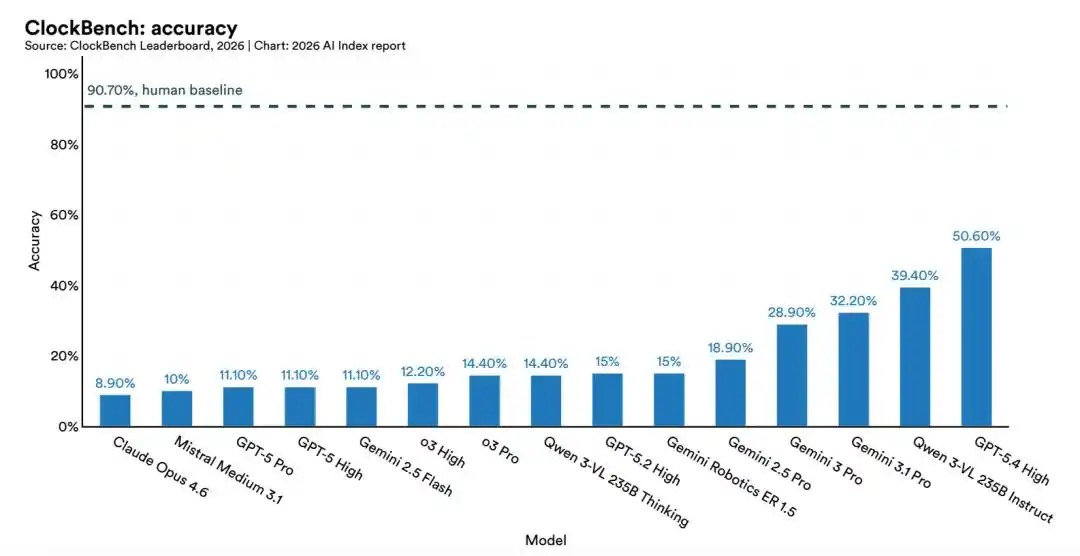
The success rate of a robot's operations in a lab simulation environment (RLBench) has reached 89.4%. However, when it is moved to real home scenarios to perform tasks like dishwashing and folding clothes, the success rate immediately drops to 12%.
There is a 77 percentage point difference between the lab and the kitchen.
Researchers have named this phenomenon the "jagged frontier." The distribution of AI capabilities is uneven, being able to win a math competition but unable to consistently tell you the time.
AI can win a math competition, but has only a 50% chance of understanding an analog clock. AI is advancing, but not in the same direction.
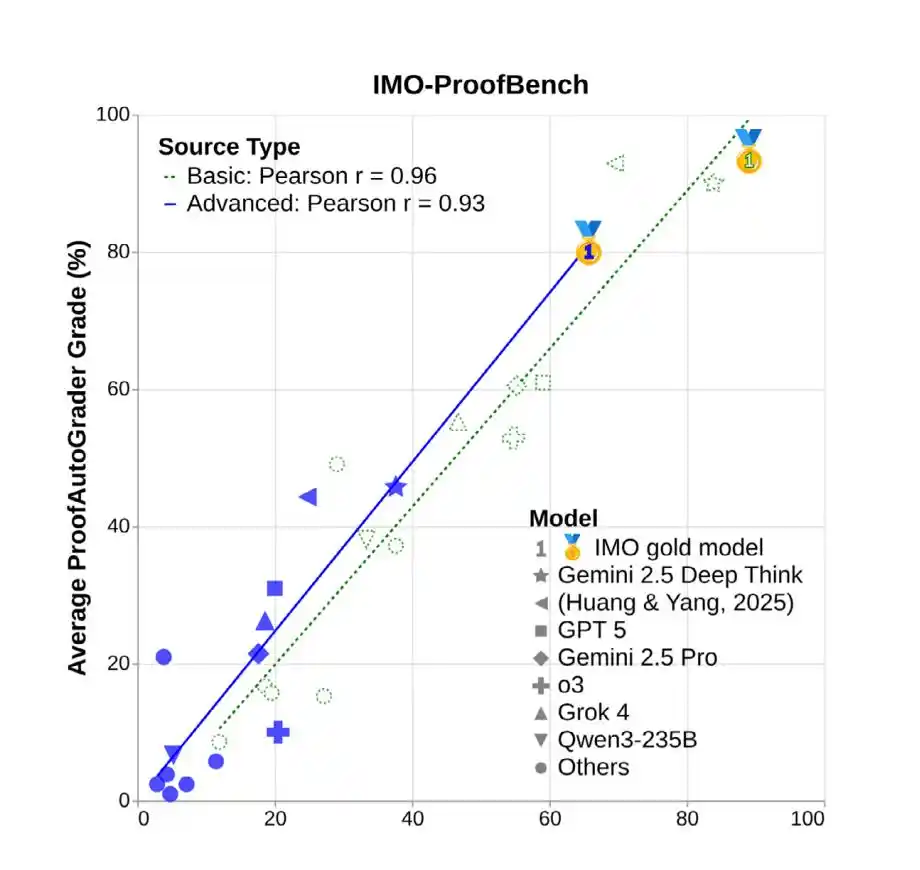
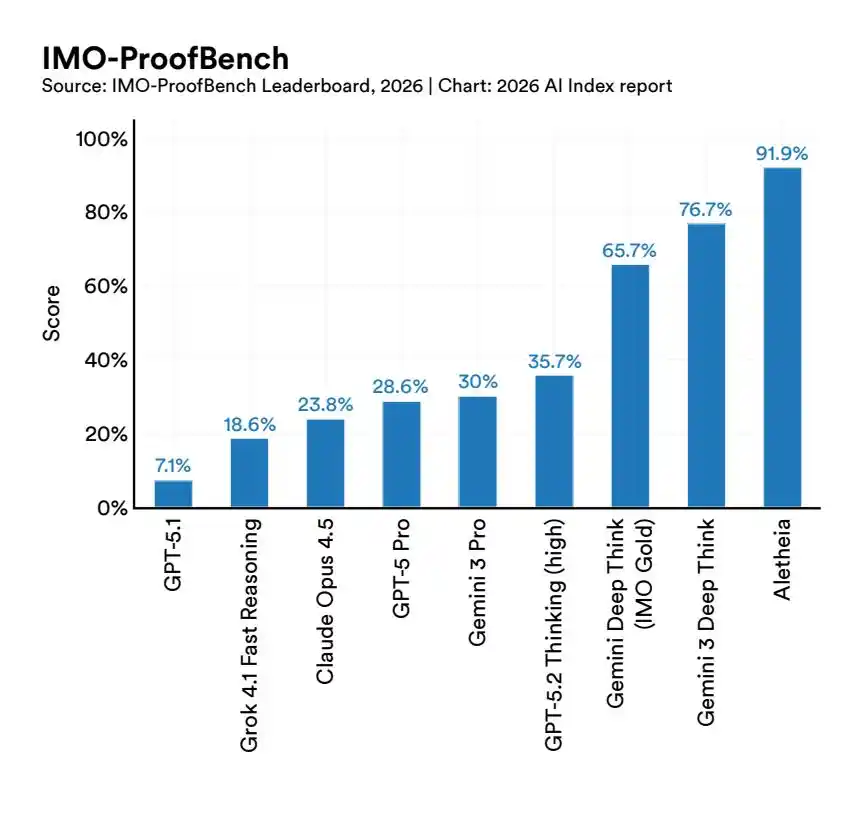
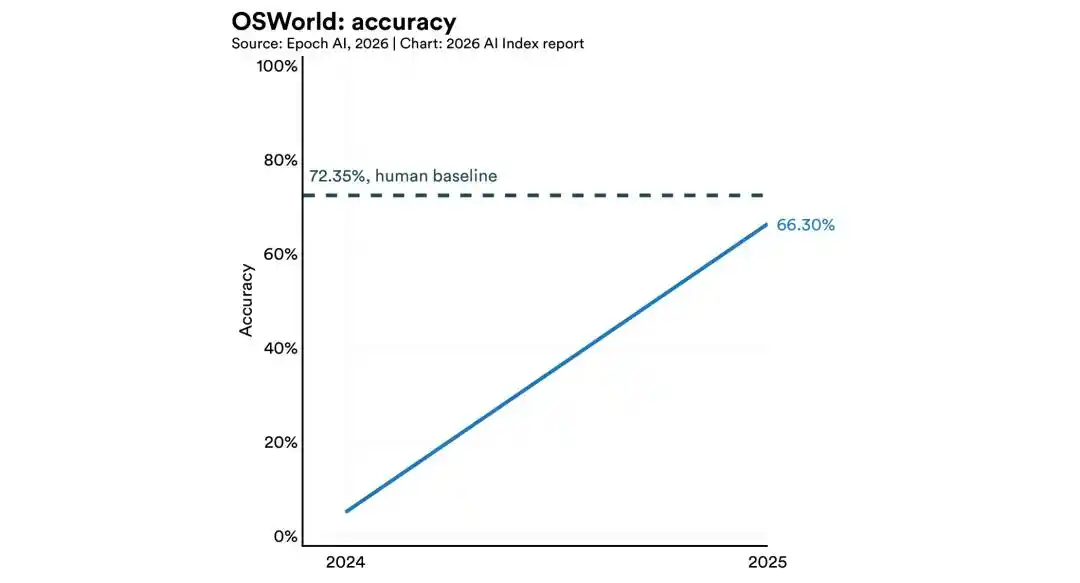
Furthermore, in the Agent Task in OSWorld tests, cutting-edge AI performance (66.3%) is approaching the human baseline.
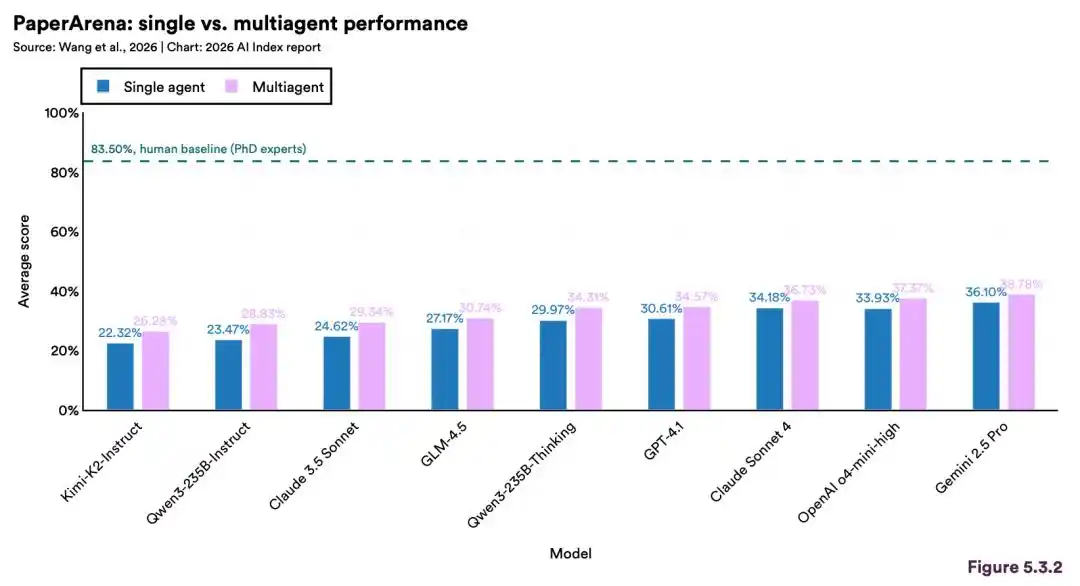
However, in the PaperArena test that specifically evaluates research logic, the highest-achieving AI-aided Agent scores only 39%, equivalent to only half the capability of a doctoral student.
Yet, this unevenness does not hinder companies from integrating AI into their production lines.
The AI Index provides another statistic: the global enterprise AI adoption rate has reached 88%. Nine out of ten companies have integrated AI into some workflow.
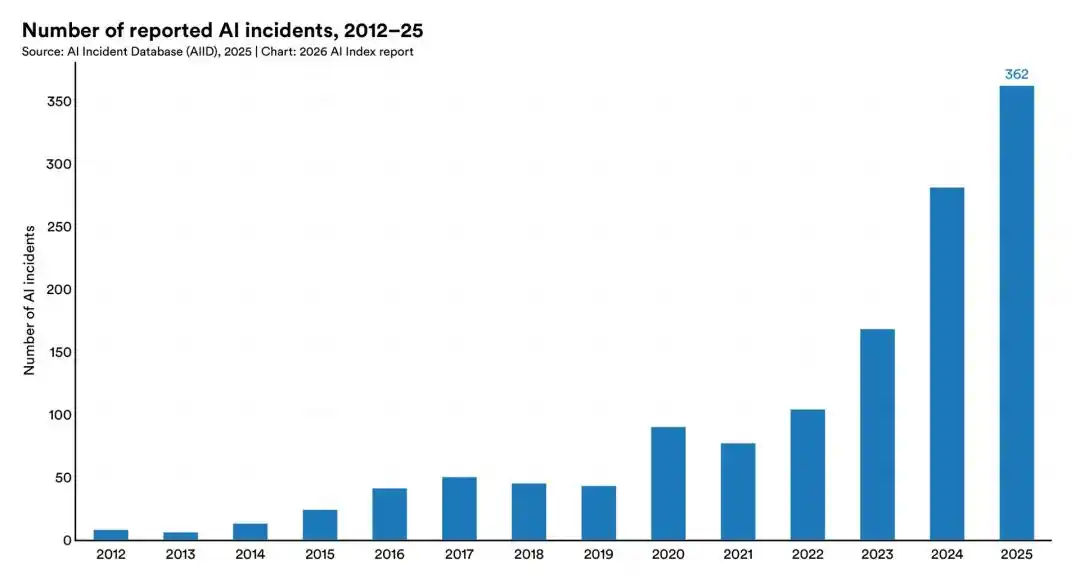
The cost is rising in parallel. The number of AI-related incidents rose from 233 in 2024 to 362.
Money is Accelerating, $581.7 Billion Invested in AI
In 2025, global enterprise AI investment reached $581.7 billion, a 130% year-on-year increase. Private investments accounted for $344.7 billion, a growth of 127.5%.
Both curves nearly doubled.
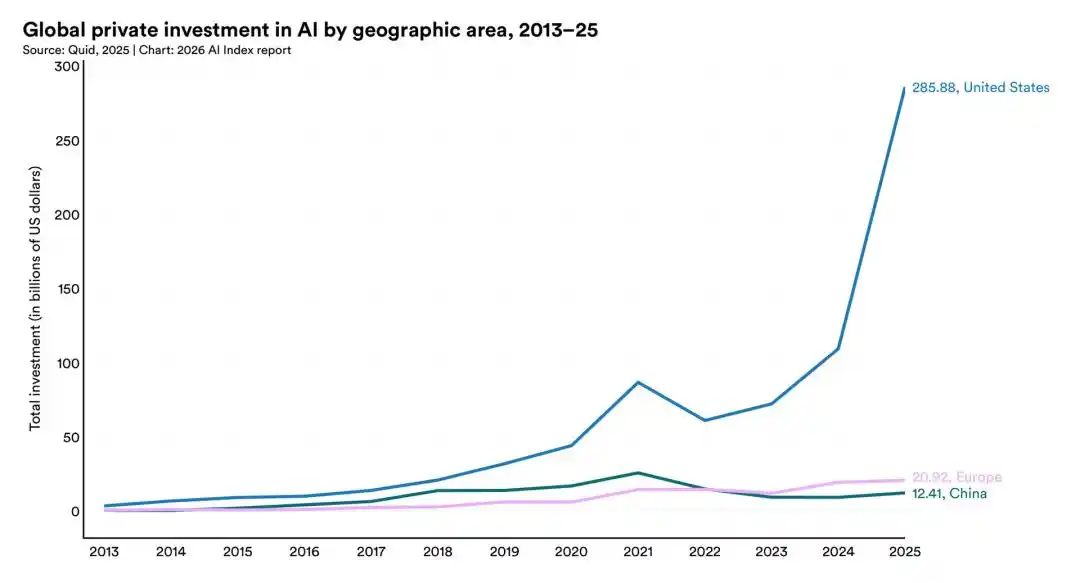
On a country basis, the U.S. is far ahead. In 2025, private AI investments in the U.S. reached $285.9 billion. Additionally, 1953 new AI startups were added in a year, over ten times the number of the second-ranked country.
Money is accelerating into the United States. But another core resource of the United States is flowing in the opposite direction.
Brain Drain: Influx of AI Researchers into the U.S. Drops by 89%
One set of numbers inside made people pause.
From 2017 to the present, the number of AI researchers and developers entering the United States has dropped by 89%.
More critically, this decline is accelerating. In just the past year, the decline rate reached 80%.
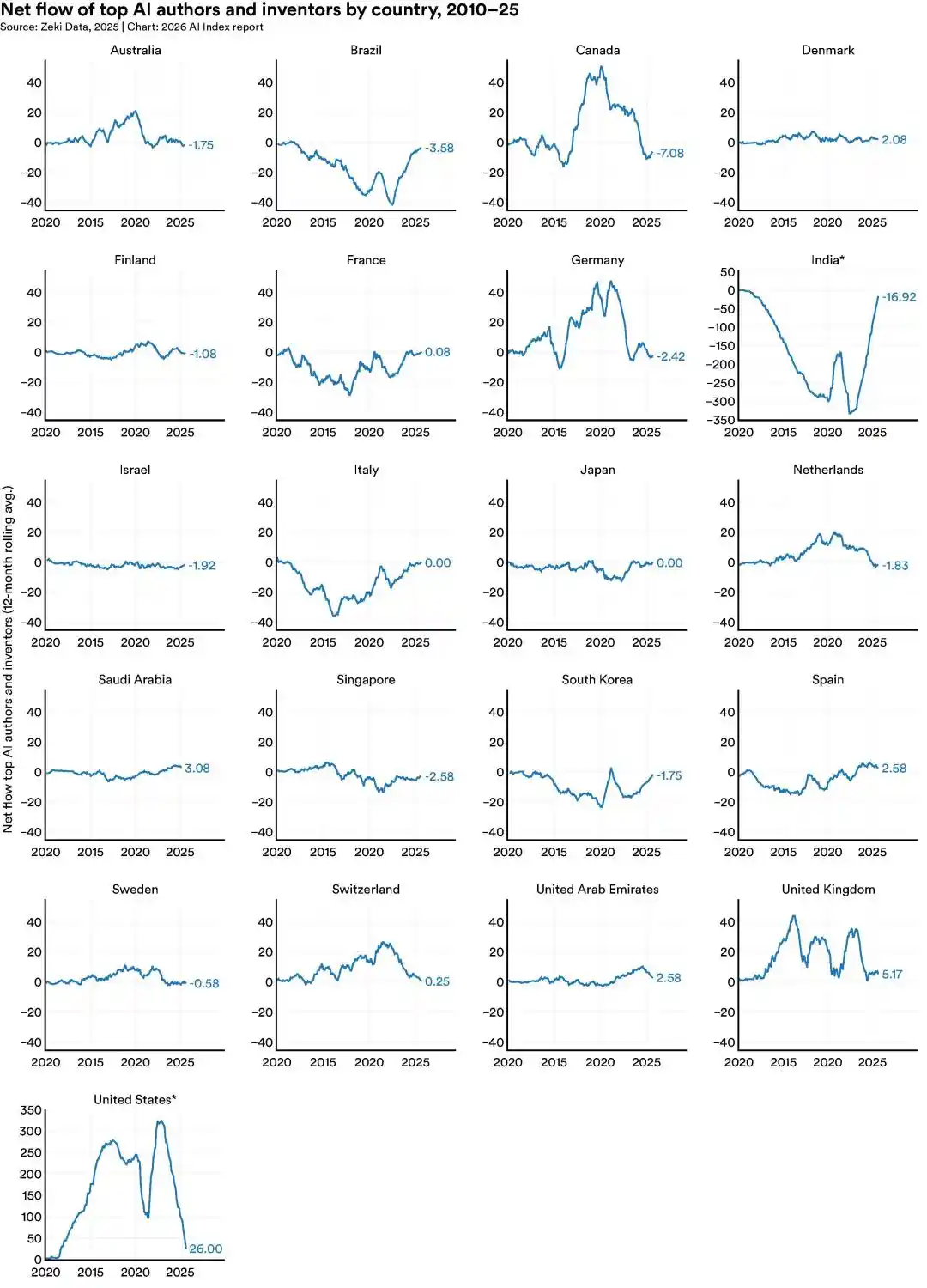
The United States remains the country with the highest density of AI researchers in the world, but the influx tap is tightening.
Both the money and people curves are now reversing. This is a situation that has not occurred in the past decade.
Compute Power Surges 30x in Three Years, Dominated by One Company
As the AI capability curve accelerates, the compute power curve behind it is running even faster.
From 2021 to the present, the global AI compute power has increased by 30 times. Over the past three years, it has been growing at over three times each year.
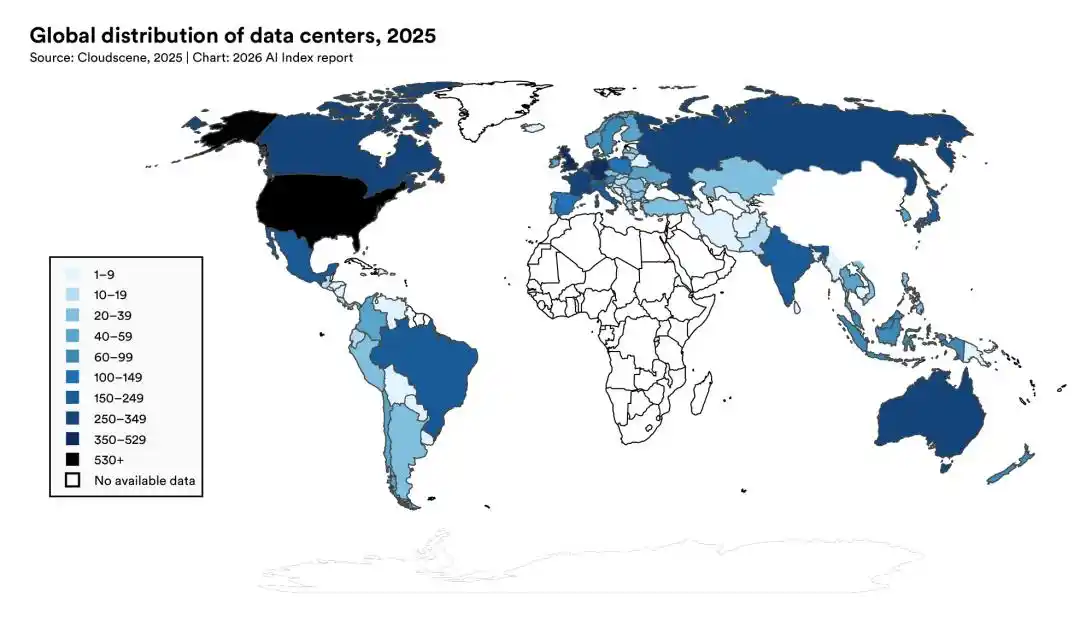
Only a few companies are propping up this curve.
NVIDIA's GPUs alone account for over 60% of the world's AI compute power. Amazon and Google follow with their own chips, but combined, they are far behind NVIDIA.
Almost all of these chips come from one foundry, TSMC. The steeper the compute power curve, the narrower the door of opportunity.
Simultaneously, the cost is also increasing.
The total power consumption of global AI data centers has reached 29.6 GW, equivalent to the entire electricity demand of New York State during peak hours. The estimated carbon emissions from one AI Grok 4 training session is 72,816 metric tons of CO2 equivalent, equivalent to the exhaust of 17,000 cars running for a whole year.
Where data centers are located, where the electricity comes from, and where the chips are produced have become the most headache-inducing issues for all AI company CEOs this year.
Generative AI Sees 53% Adoption in Three Years, Workplace Usage in China Exceeds 80%
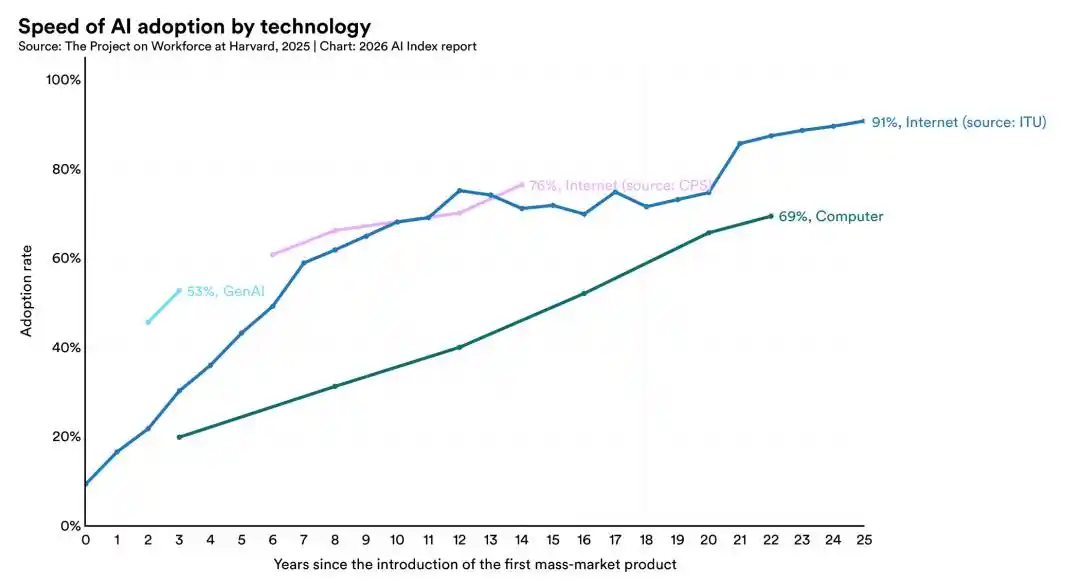
Generative AI has reached a global population penetration rate of 53% in three years.
This is faster than a personal computer, faster than the Internet.
But penetration speed is highly country-specific. Singapore 61%, UAE 54%, are both ahead of the US. The US ranks only 24th among surveyed countries, with a penetration rate of 28.3%.
If we shift the focus from consumers to the workplace, the contrast is even greater.
Another set of data in the report shows that by 2025, 58% of global employees have already started using AI regularly in their work. However, in five countries - China, India, Nigeria, UAE, and Saudi Arabia - this percentage is over 80%.
China's workplace AI penetration rate is already more than 20 percentage points above the global average.
What's more interesting is consumer value.
The AI Index estimates that by early 2026, generative AI tools will create $172 billion in value for US consumers annually. From 2025 to 2026, the median value per user tripled.
The vast majority of users are still using the free version.
The amount of money ordinary people are willing to pay for AI is much lower than the value AI creates for them. Bridging this gap is something all AI companies are currently trying to achieve.
Entry-Level Positions Decrease Sharply, 22-25 Year Old Developers Drop by 20%
Perhaps the most sobering part for Chinese readers in the whole AI Index is the section on youth employment.
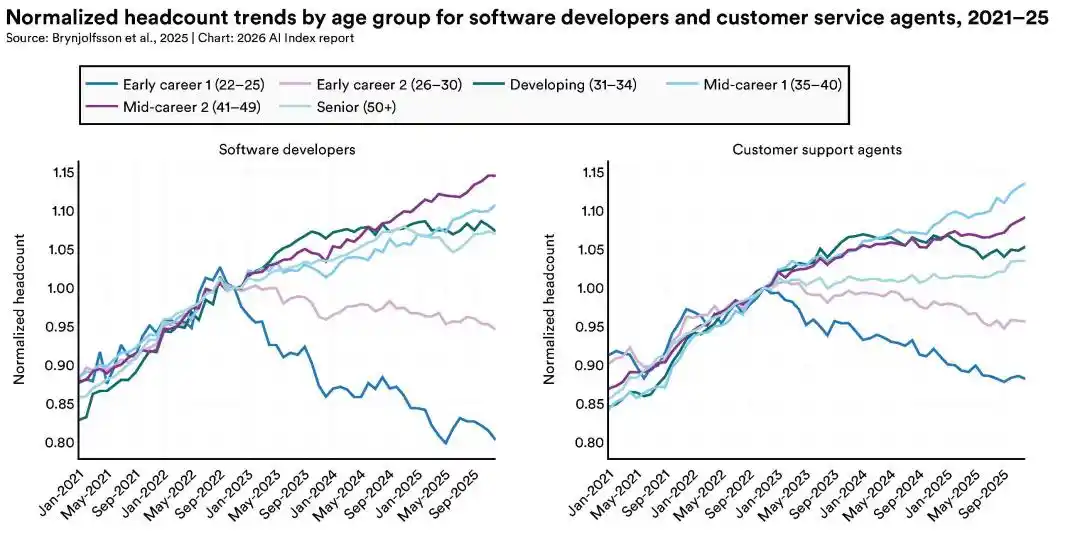
The group of software developers aged 22 to 25 has seen a decrease in employment of about 20% from 2024 to the present.
Meanwhile, older peers have experienced growth during the same period.
It's not just developer roles. Other high AI-exposed industries like customer service are also showing a similar pattern.
Even more concerning are the results of corporate surveys. The surveyed executives generally expect the scale of future layoffs to be even larger than in the past few months.
This is not about macro unemployment rates; it's about entry-level positions being precisely cut off.
Without the first job, the entire career ladder is missing a rung. The long-term impact of this, no one can currently calculate.
AI is Changing the Way Scientific Discoveries Are Made
If the section on employment is cold, then this one on science is hot.
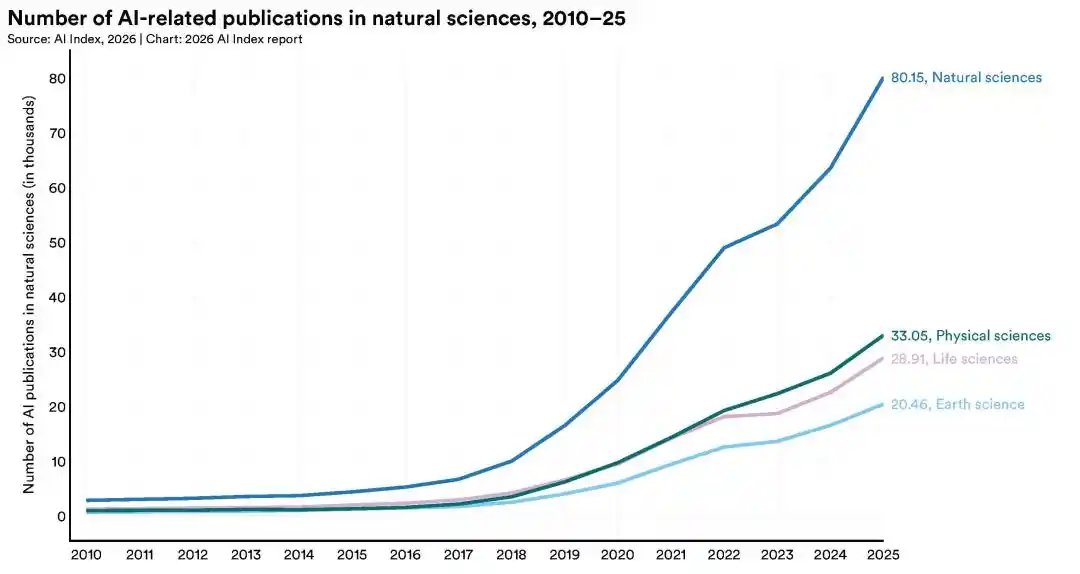
In the field of natural science, physical science, and life science, AI-related papers saw a year-over-year increase of 26% to 28% in 2025.
On a specific application note, this year marked the first time AI successfully completed an end-to-end weather forecasting process. Starting from raw meteorological observation data, it produced the final forecast for temperature, wind speed, and humidity without any intervention from traditional numerical models.
AI, from "helping you write papers" and "helping you crunch numbers," is now transitioning to "making discoveries on its own."
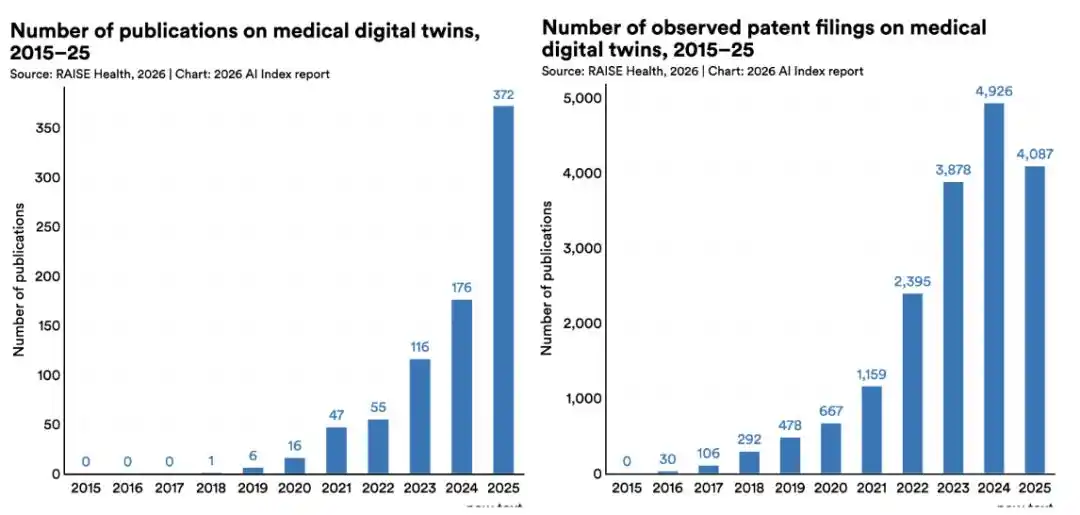
Hospitals are experiencing a similar transformation. In 2025, many hospitals began deploying AI tools that can automatically generate clinical records from patient consultations. Feedback from multiple hospital systems' physicians indicated a reduction in time spent on documenting medical records by up to 83%, leading to a significant decrease in work-related burnout.
However, a single index poured cold water on medical AI. A review of over 500 clinical AI studies found that nearly half of the studies relied on exam-style datasets, with only 5% using real clinical data.
While AI can undoubtedly reduce doctors' keyboard typing time, its actual clinical value on real patients still presents a significant question mark.
The Global Self-Learning Wave is Exploding, and Formal Education Is Falling Behind
Formal education is lagging behind AI.
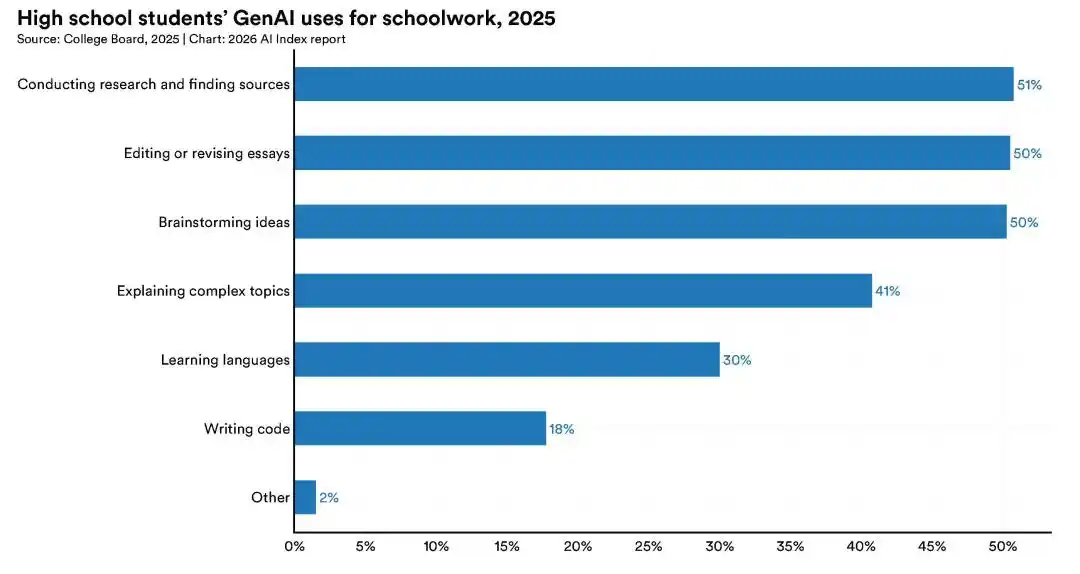
In the US, 4/5 of high school and college students now use AI to complete school assignments. However, only half of middle schools have AI usage policies, and only 6% of teachers believe these policies are clearly articulated.
Students are forging ahead, teachers are standing still, and the rules haven't appeared yet.
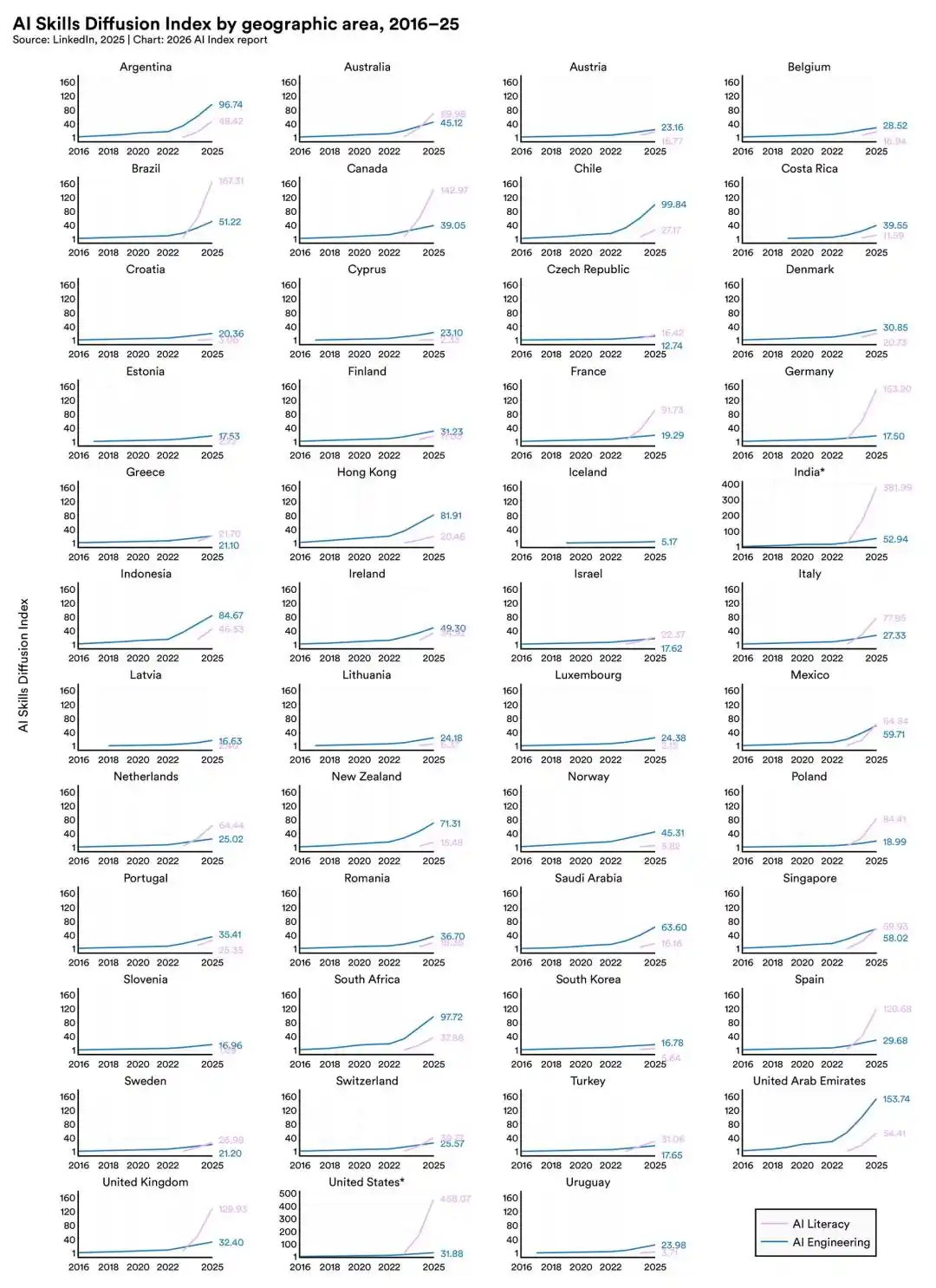
While formal education is falling behind, the global self-learning wave is surging. It notes that the three countries showing the fastest growth in AI engineering skills are the United Arab Emirates, Chile, and South Africa.
It's not the US, it's not Europe.
The steepest part of the skills curve is growing where no one is looking.
The Strongest Models Have Become the Least Transparent, Leading to a Gulf Between Experts and the Public
The most powerful model is becoming the most opaque model.
The Foundation Model Transparency Index saw this year's average score drop from 58 points last year to 40 points. The AI Index called out Google, Anthropic, and OpenAI for all opting out of disclosing the training data scale and duration for their latest models.
Of the 95 most representative models released last year, 80 did not make their training code public.
Public sentiment has also become more nuanced.
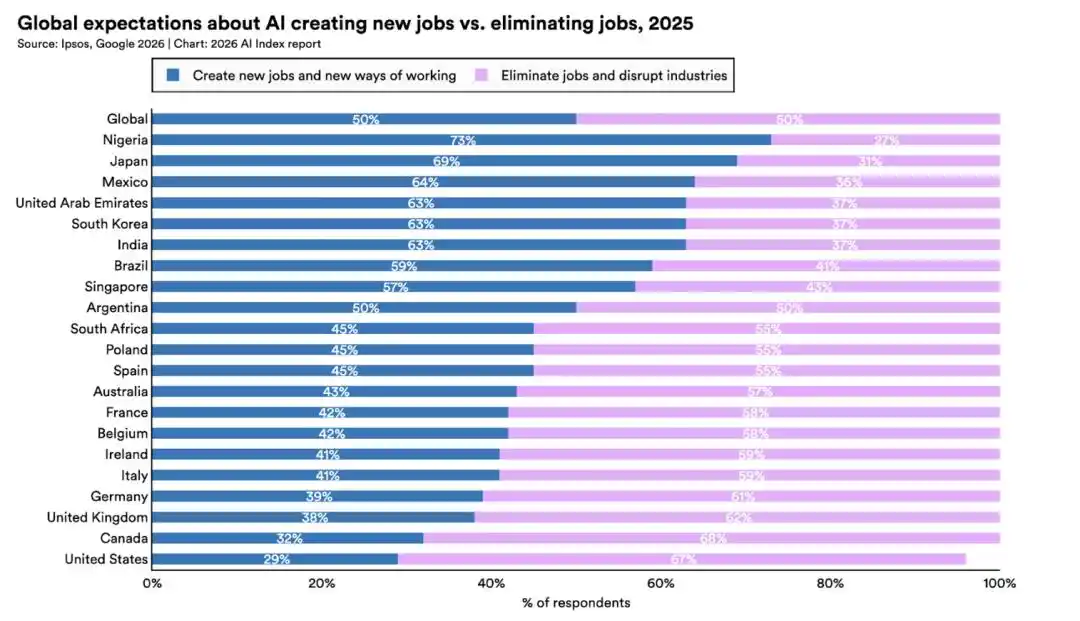
On a global scale, the proportion of those who believe the benefits of AI outweigh the risks has risen from 52% to 59%. However, during the same period, the proportion of those feeling anxious about AI has increased from 50% to 52%.
Both trends are on the rise simultaneously.
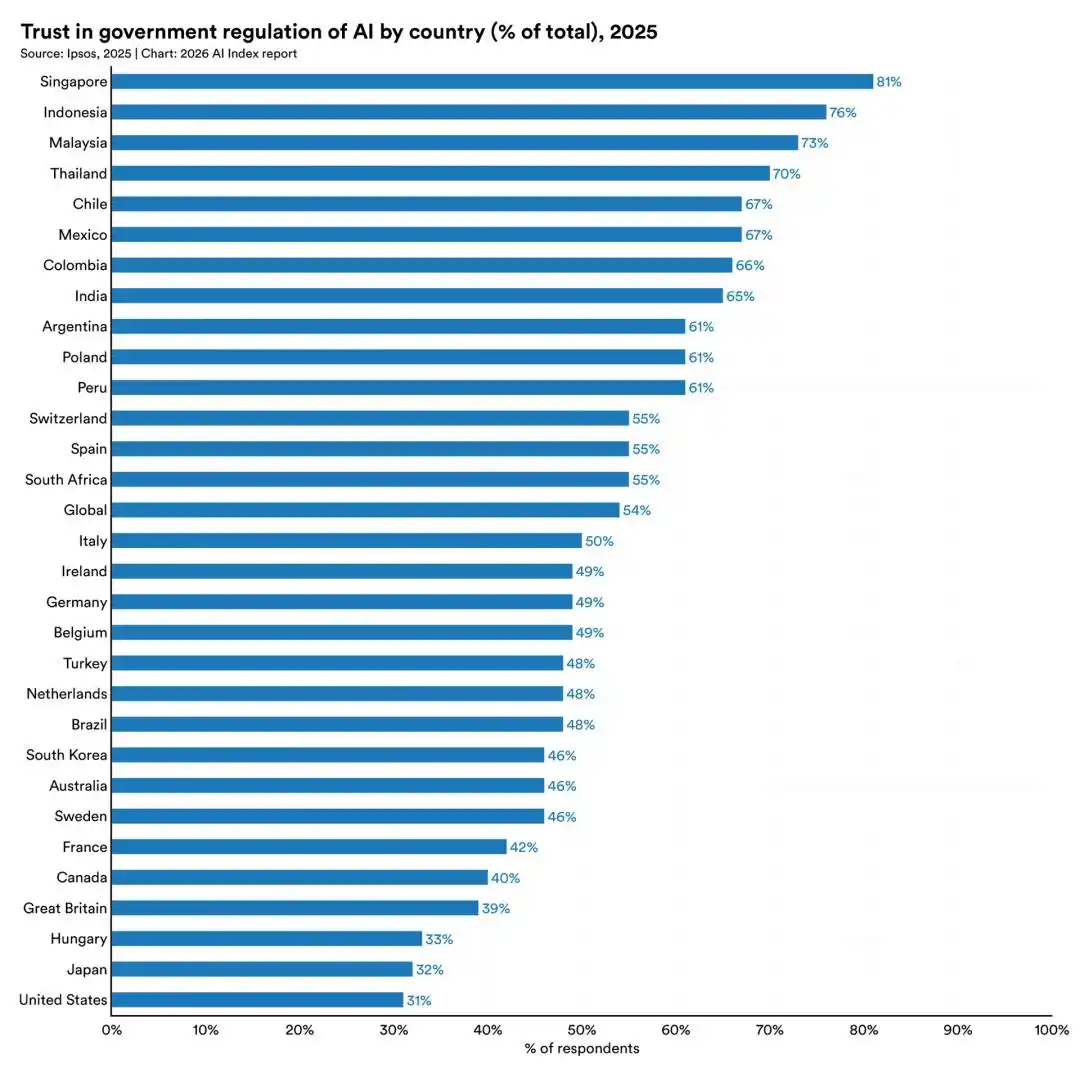
The most divided views come from the United States. Only 33% of Americans believe AI will improve their jobs, compared to a global average of 40%. The trust of Americans in their government to regulate AI is the lowest among the surveyed countries at 31%.
Singaporeans have an 81% trust level in their government's regulation of AI.
Following the recent attack on Sam Altman's home, Silicon Valley insiders were "surprised" to find that ordinary people in Instagram comments were not sympathetic, with some even feeling it should have been "more intense."
They did not realize things had deteriorated to such an extent.
Citing Pew and Ipsos data, the research report highlights the gap of over 30 percentage points between expert and public perceptions on the impact of AI on employment, healthcare, and the economy, with the largest gap reaching 50 percentage points.
While the curve in the laboratory is soaring, a sense of unease among ordinary people is accumulating.
There is no bridge between the two.
Final Thoughts
Within the 423-page report lie hundreds of charts, yet only one chart was actually drawn.
The horizontal axis represents time, and the vertical axis represents capability.
The model's capability curve is soaring, as is the computing power curve, investment curve, and adoption curve. Everything else is either stagnant or declining.
This is the full content of the 2026 AI Index.
AI is accelerating. Everything else is out of sync.
If you are in this industry, the question to ask now is not "what the future holds," but "which curve you are standing on."
References:
https://hai.stanford.edu/ai-index/2026-ai-index-report
https://hai.stanford.edu/news/inside-the-ai-index-12-takeaways-from-the-2026-report
https://www.nature.com/articles/d41586-026-01199-z
https://hai.stanford.edu/assets/files/ai_index_report_2026.pdf
You may also like

OKX Star analyzes Binance's competitive advantages: when regulation levels the playing field, competition has just begun

Full version of the debut Q&A! Federal Reserve Chairman Waller: Sticking to the 2% inflation target, establishing five special working groups, individual did not submit the dot plot

From Disruptor to Shadow Market: The Crypto Market is Becoming a Colony of Traditional Finance

Dalio's important long article: How to position in the current market environment?

DeepSeek Financing Story

Morning Report | Illinois signs the strictest digital asset tax law in the U.S.; RWA tokenization market size surpasses $43 billion, institutions accelerate the migration of on-chain assets
Morning Report | DeepSeek completes over $7 billion in financing, with a valuation exceeding $50 billion; Musk's personal wealth has surpassed the total market value of Bitcoin

Cursor, why did you get on Musk's spaceship?
In the name of charity, for the benefit of the family: How the Trump family turned charity into profit?

Will Gold Break $4,500 After Tonight's Fed Decision? What XAUT and PAXG Traders Need to Know
SharpLink CEO: How to understand that Ethereum developers have just surpassed 1 million?

Morning Report | MiCA grace period expires on July 1; Kalshi's trading volume in the first week of the World Cup breaks $5.1 billion, setting a record

The foundation of SpaceX's trillion-dollar valuation: Who is dividing Musk's annual capital expenditure of tens of billions?
How to exit after asset tokenization?
The stablecoin positioning battle escalates: When compliance is just a ticket to entry, will USD1 become the biggest winner?

A16Z: The sun bears witness, SpaceX is worth 7.5 trillion

Mergers and acquisitions in the cryptocurrency market are exceptionally active

Concerns Behind the Binance Customer Service Controversy
OKX Star analyzes Binance's competitive advantages: when regulation levels the playing field, competition has just begun
Full version of the debut Q&A! Federal Reserve Chairman Waller: Sticking to the 2% inflation target, establishing five special working groups, individual did not submit the dot plot
From Disruptor to Shadow Market: The Crypto Market is Becoming a Colony of Traditional Finance
Dalio's important long article: How to position in the current market environment?
DeepSeek Financing Story
Morning Report | Illinois signs the strictest digital asset tax law in the U.S.; RWA tokenization market size surpasses $43 billion, institutions accelerate the migration of on-chain assets


