
- Buy Crypto
- Markets
 Futures
- Spot
- Copy Trade
- Earn
- More
If you only follow the news, you may have misconstrued this Iran conflict

A prominent non-profit think tank in Washington, D.C. highlighted in a 2024 discussion on the challenges of the AI era:
“The current environment forces journalists to prioritize speed over accuracy in breaking news scenarios.”
The recent Iran conflict is a typical example: a school bombing, an assassination of a successor leader, a neighboring country’s sudden strike… Western media often provide highly impactful headlines in real-time to attract attention and quickly shape public opinion.
But there is a place that often demonstrates “true judgment” earlier than the media – the prediction markets.
Here, the probabilities of events such as “Will Hezbollah strike Israel” or “Will a country take military action against Iran” are not driven by emotions or institutional narratives but by outcomes formed by individual traders with real money.
Put simply, if a trader is convinced something will happen, they will bet “yes,” and this action itself increases the probability of the event occurring. This mechanism of expression constrained by funds makes prediction markets a different source of information from traditional media.
Two events in the Middle East over the past week perfectly illustrate this point.
Drone Attack on British Bases in Cyprus
On the evening of March 1st local time, UK Prime Minister Kiel Stammer announced through a pre-recorded video statement that the UK had agreed to allow the U.S. to use its bases to strike Iranian missile facilities. Hours later, the British Royal Air Force base in Akrotiri, Cyprus, was hit by a suspected drone attack.
Following the event, several mainstream media outlets such as the BBC, The Independent, and Reuters released reports promptly, using expressions like “Iran missiles” and “Iranian drone” in their headlines or body text, directly linking the attack to Iran.
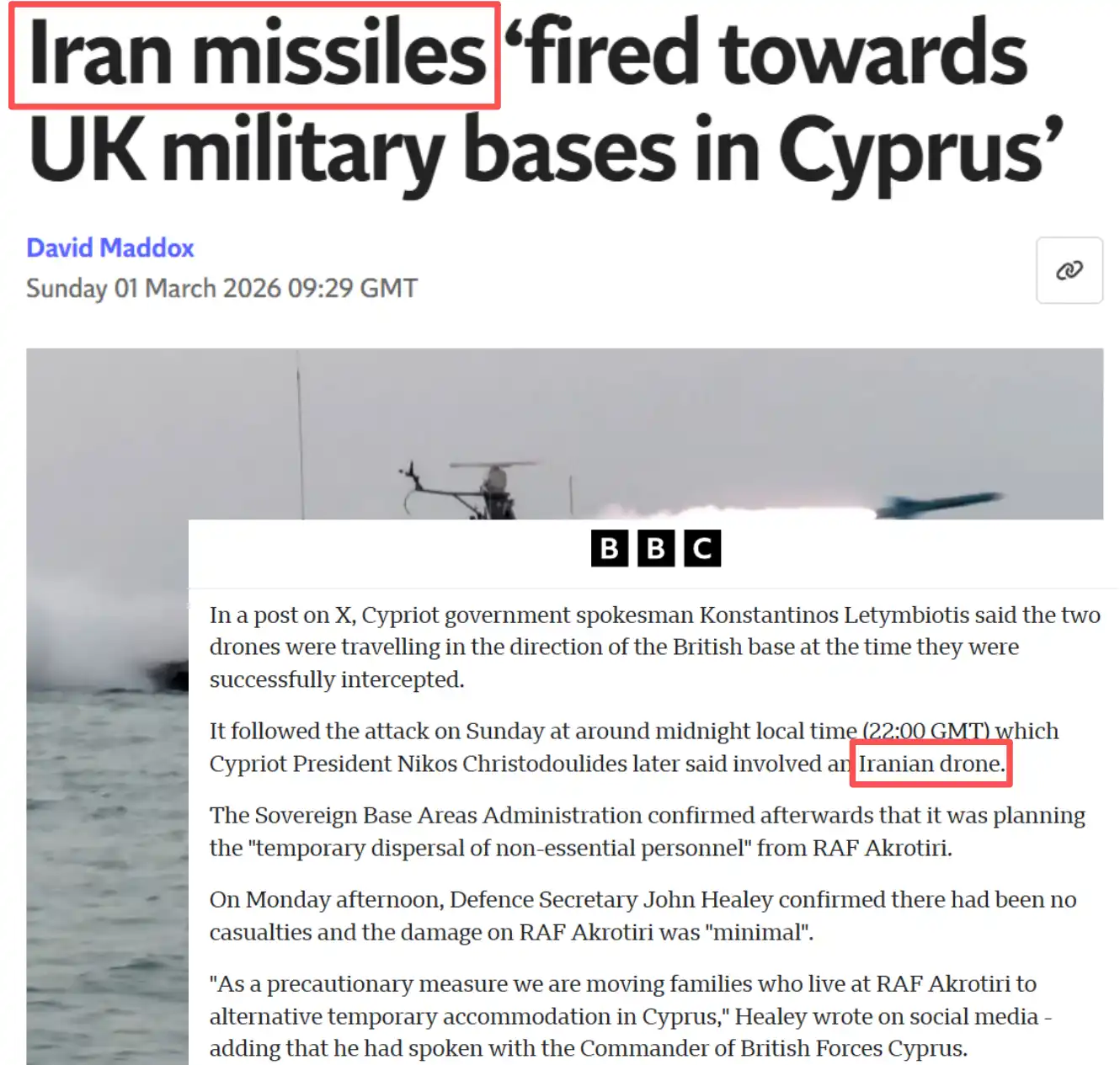
These reports quickly made headlines, leaving readers with a clear impression: Iran was directly attacking a NATO ally base.
However, in the immediate aftermath of the event, the related market on the prediction market platform Polymarket – “Will Iran strike Cyprus by March 31” – had a different response: following the release of media reports, the market did experience some typical “buy the news” trades, causing a brief increase in probability. But unlike the public opinion atmosphere shaped by the media, the market probability rapidly fell back to a level close to before the attack about 30 minutes later.
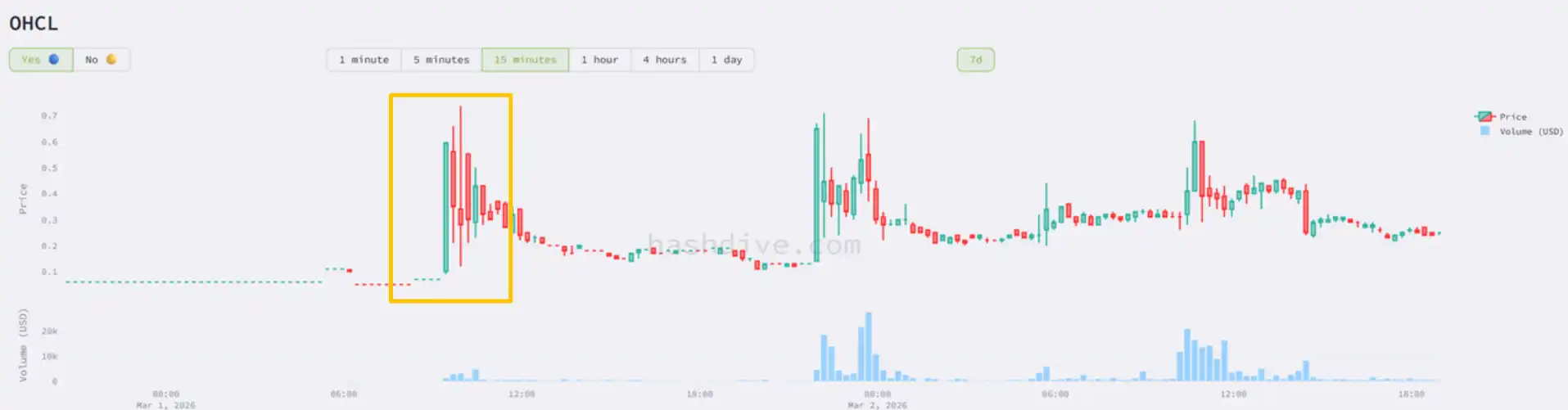
Clearly, the most information-sensitive group of people did not fully buy into the media narrative.
Hours later, the UK Ministry of Defense issued a statement saying, "There is currently no evidence to suggest that this attack came directly from Iran." The media outlets then followed up by revising their reports to state that this attack was more likely from Iran's proxy armed group, Hezbollah in Lebanon, and pointed out that the previously mentioned "Iranian drone" actually referred to an "Iranian-designed Shahed drone," not the so-called "attack directly initiated by Iran."
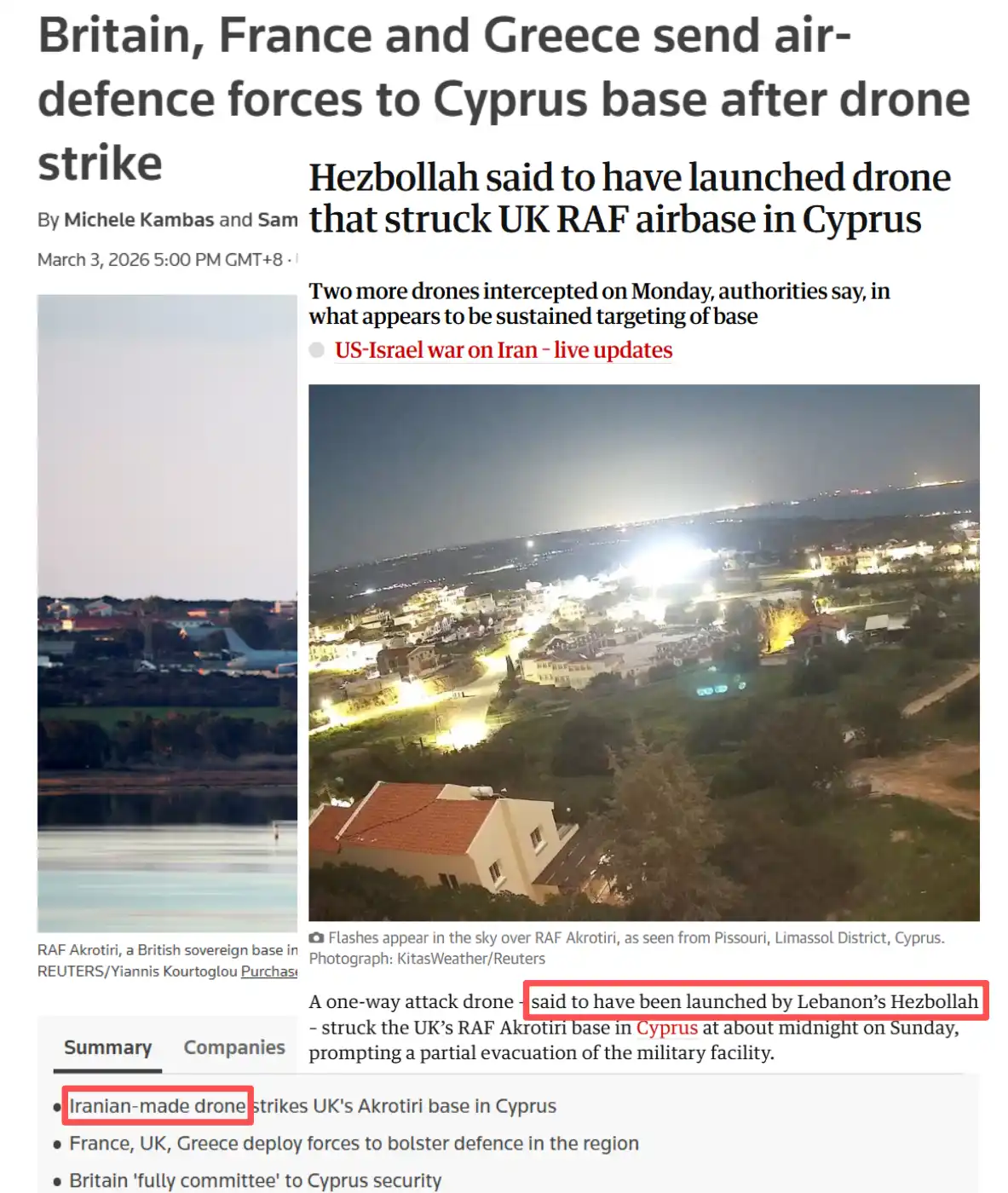
In other words, the media initially amplified Iran's direct responsibility through a narrative framework, while the prediction markets maintained a more cautious assessment from the outset.
Israeli Media Hypes UAE Strike on Iran
A similar situation occurred again this week. On March 8, several Israeli media outlets claimed that the UAE launched its first strike on Iranian soil. The reports described this action as a "symbolic retaliation" against Iran's previous attacks on Gulf states.
This narrative quickly created an impression that Gulf states were joining military action against Iran.
Similar to the Cyprus incident, the probability market on Polymarket for "Will the UAE strike Iran by March 31" saw a brief uptick after the reports were published, but rapidly fell back within about an hour.
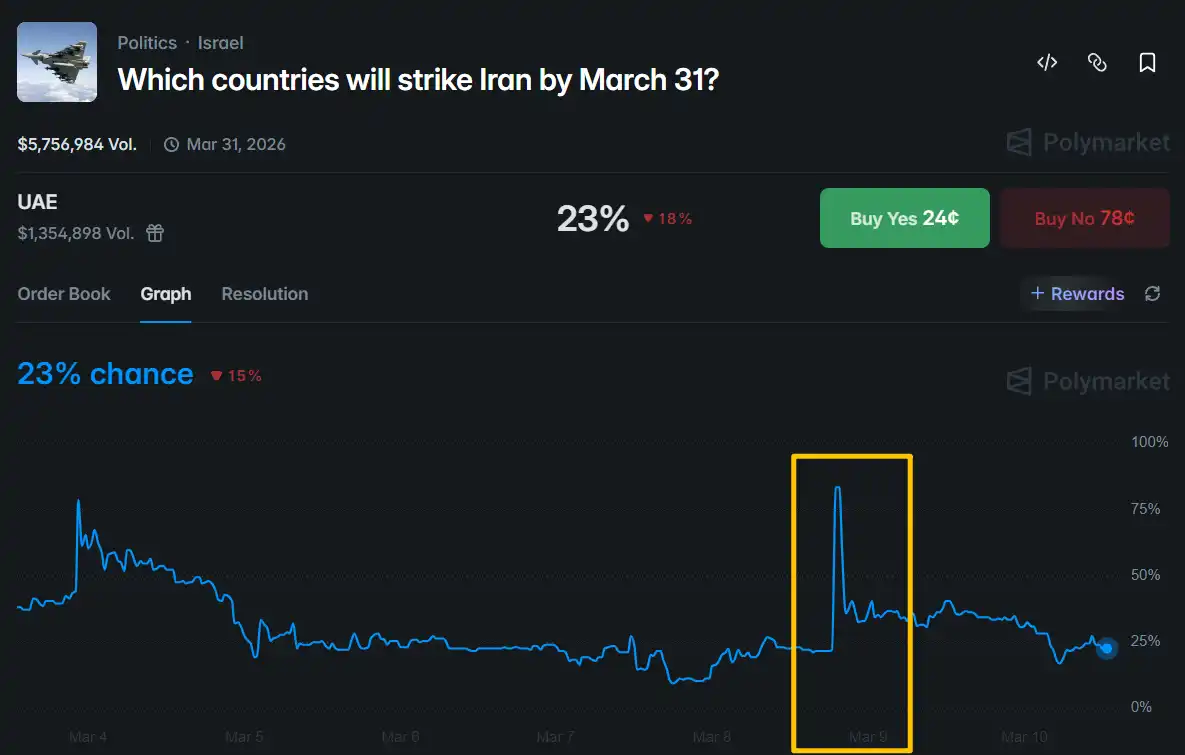
Shortly after, Ali Rashid Al Nuaimi, Chair of the UAE Federal National Council's Defense, Interior, and Foreign Affairs Committee, directly referred to it as "fake news" on X, and candidly stated, "If we did something, we have the courage to announce it openly."
From an information dissemination perspective, the extensive coverage by the Israeli media likely aimed to create a narrative atmosphere of regional united action against Iran, thereby increasing psychological pressure on Iran and pushing regional allies to more openly support US-Israeli actions.
By filtering out this media noise and focusing solely on the changes in prediction market probabilities, one could arguably have earlier realized that such reports might not be reliable.
Why Are Prediction Markets More Reliable?
As the global political environment gradually transitions from the post-Cold War era of openness to a more pronounced alignment and geopolitical competition, information dissemination is increasingly becoming a strategic tool.
In such an environment, the importance of traditional media is further amplified. Media is not only a news channel but has also become a crucial platform for influencing public opinion and policy discussions.
The differences in stance between different institutions in the U.S. media ecosystem are quite evident: CNN, long criticized by Trump, attracted many audiences supporting enhanced gun control due to its extensive coverage of school shootings. Interestingly, gun manufacturers are significant political donors to the Republican Party.
When news reporting is not just "information" but gradually becomes a tool to shape public attitudes, the reliability of traditional media as a pure information source is inevitably challenged.
In this environment, prediction markets offer a completely different information mechanism: because behind the probability of each event lies traders' decision-making on the event's outcome, profit-seeking traders must stake an amount corresponding to their judgment.
In this round of the Iran conflict, these participants may be open-source intelligence analysts, military enthusiasts, speculative traders, or even insiders involved in frontline or backstage warfare. Regardless of their backgrounds, their only way of expressing their views is through betting, with each bet representing the participant's genuine judgment based on their own understanding.
The accuracy of these genuine thoughts has been repeatedly proven in the past few years in a series of predictions such as elections, interest rates, and non-farm payroll, surpassing traditional polls and expert forecasts.
Anticipating Results in Advance Based on Prediction Market Data
As mentioned earlier, when we consider prediction market probabilities as a source of information, we are essentially observing a group of traders staking their funds on their future judgments.
However, pure market probabilities still face an issue: the skill levels of participating traders vary, with some just following the crowd. Therefore, some analytical tools further filter the data, with one common indicator being Market Strength.
In other words, participants who have been more accurate in the past predictions and earned higher trading profits will have a greater impact on the final probability. Compared to ordinary market probabilities, this indicator is closer to the so-called "smart money judgment."
You can understand this with a simple analogy: if you only look at market probabilities, it's like asking 10 anonymous individuals from different industries for investment advice; whereas, if you consider weighted market probabilities, it's like knowing the professional backgrounds and investment returns of these 10 people and naturally paying more attention to those with a higher long-term return.
With this in mind, let's take a look at a current global issue that the world is focusing on: whether other countries will join the United States and Israel in jointly combating Iran. Based on the current prediction market probabilities, the likelihood of other countries joining the strike this month is 51%; however, when looking at the weighted market probability, the likelihood of a strike occurring is only about 25%.
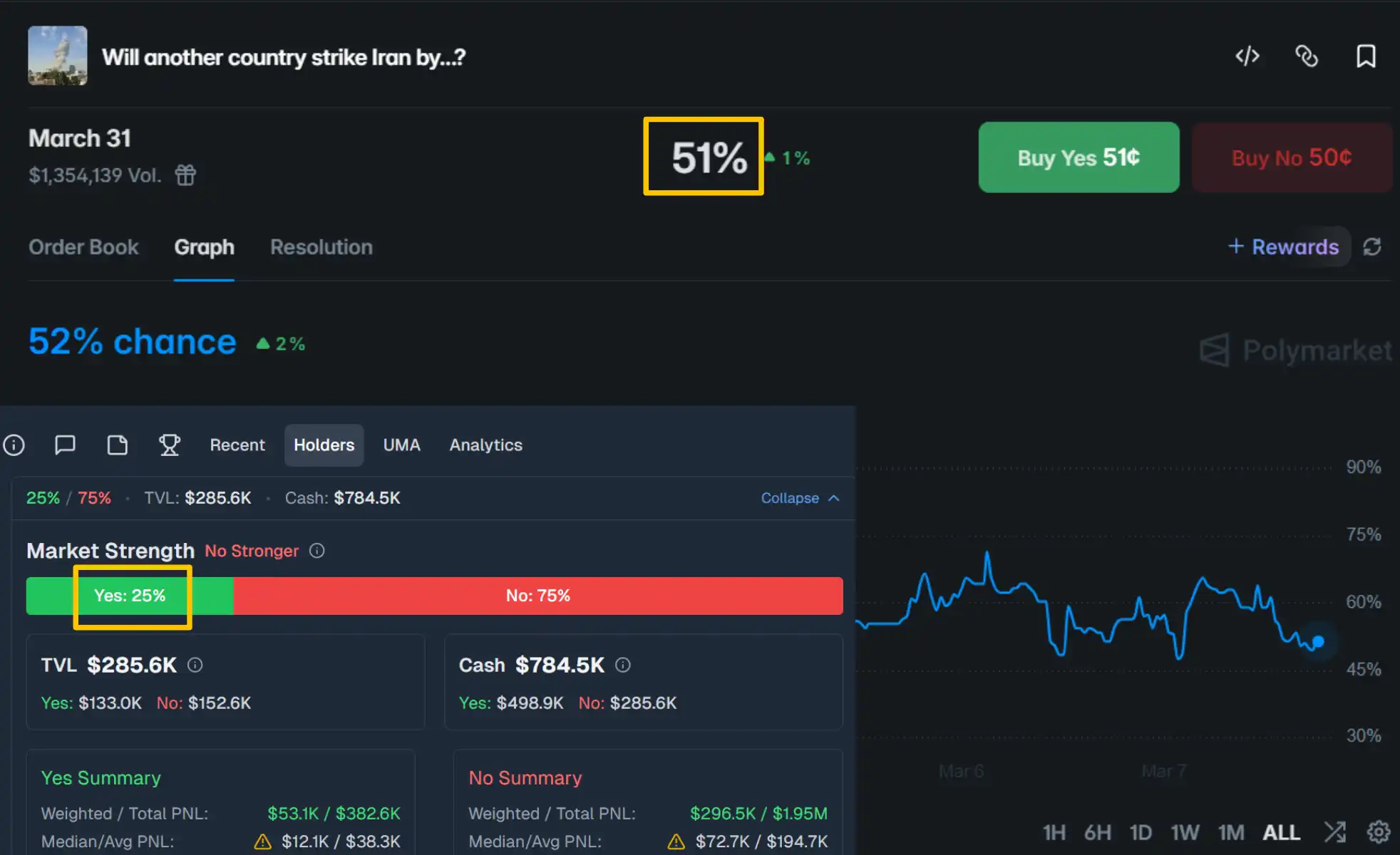
This result contrasts sharply with recent media narratives. On the surface, news reports are filled with Gulf states condemning Iran, European warships heading to the Middle East, and signals of escalating regional tensions, as if a larger conflict is imminent; but in the prediction markets, many long-time active traders familiar with geopolitics generally believe that the likelihood of other countries directly striking Iran this month is not high.
In this highly fragmented information age, the prediction market may not replace the news, but it is becoming a new information calibration mechanism. While media narratives keep amplifying emotions and positions, market prices provide a collectively judged assessment constrained by capital.
For those seeking to understand the real world, the difference between these two signals is itself important information.
You may also like

NVIDIA's Jensen Huang's new article: The "Five-Layer Cake" of AI

In-depth Analysis of ERC-8183: The Answer to the Trust Issue of Ethereum-Powered AI Agents
Stock Tokenization Revolution: Market Dynamics, Product Architecture, and Regulatory Moat Panorama Report

The current Lobster Skill is just yesterday's Fruit Ninja, only meant to get you acquainted.

Key Market Intelligence on March 10th, how much did you miss out on?

IOSG: From Interest-Bearing Stablecoins to Crypto Credit Products

NVIDIA CEO Jensen Huang's Latest Article: The "Five Layers of AI"
Daily Observation of Cryptocurrency Concept Stocks: Nasdaq Bets on Stocks on the Blockchain, Strategy Buys Another 17,994 BTC, ETH Treasury Stocks Enter Production Period
One-click onboarding to RootData, allowing project information to be accurately presented on over 200 platforms including Binance Wallet, Gate, TP, and more
To the Builders who are still persevering in the crypto industry
Oil Price Cools Off, Crypto Bounces Back

a16z Releases Top 100 AI Applications List, Models Are Moving Out of the Browser and App

ERC-8183: Write a Rule for a $3M On-Chain Agent Business

AI Mistakenly 'Tips' $260,000, Makes It All Back in 24 Hours

Arthur Hayes: Why is HYPE a 5x Moonshot?
OpenClaw Money-Saving Strategy: Saving Two Thousand a Month - What Am I Doing Right?
a16z: Making a $2 Billion Bet on the Next Dawn of Web3

Trade to Earn Series IV: WEEX Launches Up to 40% Real-Time Futures Fee Rebates
Trade futures on WEEX and earn up to 40% real-time fee rebates. Trade to Earn Series IV lets you accumulate WXT rewards while reducing trading costs.


 App
App