
Huma Finance 2.0 Officially Launches on Solana, Bringing Composable Yield to DeFi Users

Source: Huma Finance
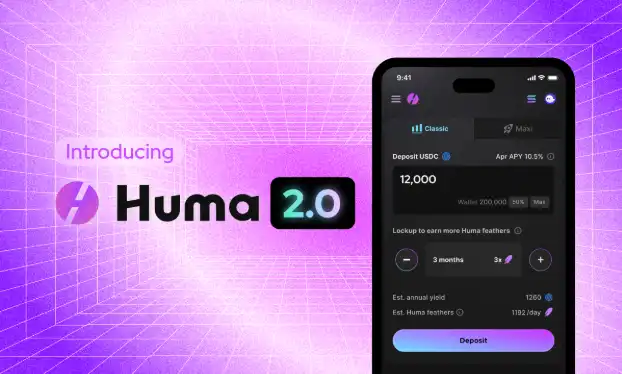
The first Payment Financial Network, Huma Finance, today announced the launch of Huma 2.0, a permissionless, compliant, and composable yield platform built on Solana. This platform opens up stable real yield generated from global payment financing derived from everyday commercial trading activities to users worldwide, marking a significant advancement where the previously elusive double-digit stable yield category, outside the realm of institutional finance, is now widely accessible to individual users. The existing permissioned service has been concurrently rebranded as Huma Institutional, continuing to serve institutions and accredited investors. Users can immediately start depositing on the brand-new Huma 2.0 platform.
Huma 2.0 provides users with diversified liquidity provision participation modes, launching two primary modes to cater to different needs: Classic Mode is designed for users seeking a stable double-digit USDC yield (currently at 10.5% APY, updated monthly) while offering a base reward called Huma Feathers; Maxi Mode is suited for users looking to maximize their accumulation of Huma Feathers, offering a 5x baseline reward rate (but without receiving USDC yield). Users can switch the mode of their existing positions at any time.
DeFi composability is a core feature of Huma 2.0 achieved through the PayFi Strategy Token (PST). This liquid interest LP token enables holders to integrate their Huma positions with leading Solana ecosystem protocols. At launch, users can swap PST for USDC through the aggregator Jupiter, marking the initial step of the integration plan with top Solana DeFi platforms. Subsequently, support will quickly follow on Kamino to use $PST as collateral and to trade future yields via RateX. Participation does not require locking, but users can opt for a 3-month or 6-month term that significantly boosts Huma Feather rewards through a multiplier. It is noteworthy that in the early stages of launch, these reward multipliers will see a substantial increase as part of a limited-time promotion, with particularly attractive bonuses in the Maxi Mode. These features provide users with enhanced flexibility and choice in managing their positions.
In just two years, Huma Finance's Payment Financial Network has rapidly scaled, processing over $3.8 billion in transactions, generating $8 million in annualized revenue. Huma assists partners in earning revenue from its payment finance business. Unlike DeFi yields relying on token incentives, market speculation, or traditional finance's low rates, payment finance yield directly stems from the fees paid by enterprise usage of the network for payment financing and settlement liquidity. Funds typically circulate rapidly within a few days, compounding continuously from fees generated by real-world economic activities. This mechanism enables Huma to consistently offer a stable double-digit USDC yield. Its sustainable model has garnered endorsements from top investors and been recognized by industry analysts such as Messari—payment finance is poised to leverage a $30 trillion market scale.
"Huma 2.0 is not just another yield product—it represents a structural shift." Huma Finance Co-Founder Erbil Karaman stated, "By providing payment institutions with a 24/7 operational and remarkably capital-efficient novel liquidity source, we are creating a new form of yield rooted in real economic activity, with composability and transparency. It finally allows DeFi to tap into a long-standing institutional-exclusive yield source without compromising DeFi's core strengths."
The launch of Huma 2.0 comes at a significant transformation period for the global financial and DeFi ecosystem. As traditional payment infrastructures like SWIFT face challenges in speed and transparency, with trillions of dollars still inefficiently deployed, the demand for blockchain-based modern solutions is increasingly evident—reportedly, stablecoin annual transaction volumes have surpassed $35 trillion. Seizing the opportunity, Huma 2.0 provides efficient settlement liquidity, enabling individuals worldwide to benefit from foundational financial activities—a realm previously dominated by institutions.
Crucially, the revenue generated by payment finance does not fluctuate with the crypto market cycle. Regardless of market boom or slump, underlying economic activities like payment and trade continue to operate, providing a stable source of revenue for Huma. This stability makes double-digit fixed income particularly valuable in bear markets, shining even brighter when speculative gains fade. As DeFi matures, the market is now prepared for such revenue rooted in real-world business (rather than token speculation). Payment finance as the foundational layer is fostering new DeFi strategies, such as Solmate, recently launched by Splyce—combining Huma's $PST yield with SOL liquidity staking, bridging DeFi and productive economic purposes.
Huma 2.0 marks a crucial step in building the new financial future, fundamentally expanding the scope of the financial revolution through an open and inclusive participation model. Early participants can enjoy various reward multipliers, including historical deposit user bonuses and promotion bonuses. As the platform expands more DeFi integrations and plans to become the launch platform's first major project for Jupiter's LFG 2.0—Huma continues to build a truly inclusive financial system.
To learn more about Huma 2.0 or get involved, please visit this link or follow @humafinance on X platform.
About Huma Finance
Huma is the first Payment Finance (PayFi) network, utilizing an open liquidity protocol stack, covering key areas such as cross-border payments, stablecoin debit cards, and trade financing applications. The network targets a market exceeding $30 trillion in total size, aiming to accelerate fund movement in an ever-active world.
This article is a contribution and does not represent the views of BlockBeats.
You may also like

SharpLink CEO: How to understand that Ethereum developers have just surpassed 1 million?

Morning Report | MiCA grace period expires on July 1; Kalshi's trading volume in the first week of the World Cup breaks $5.1 billion, setting a record

The foundation of SpaceX's trillion-dollar valuation: Who is dividing Musk's annual capital expenditure of tens of billions?

How to exit after asset tokenization?

The stablecoin positioning battle escalates: When compliance is just a ticket to entry, will USD1 become the biggest winner?

A16Z: The sun bears witness, SpaceX is worth 7.5 trillion

Mergers and acquisitions in the cryptocurrency market are exceptionally active

Concerns Behind the Binance Customer Service Controversy

SpaceX Stock Prediction After the IPO: Can SPCX Reach $200 Before QQQ Inclusion?

Congratulations to Carl Moon on His Historic Ferrari Challenge Le Mans Podium Triumph
Crypto influencer and racing enthusiast Carl Moon finished third in the Ferrari Challenge Le Mans Coppa Shell class, marking his best result of the year. As his racing partner and sponsor, WEEX celebrates this remarkable achievement and continues to lead crypto’s journey beyond boundaries, uniting the innovation of digital assets with the passion of motorsport.
Can the CLARITY Act Become Law by July 4? Everything You Need to Know About the Final Battle

France vs Senegal World Cup 2026: Mbappe’s New Era Begins Against a Historic Rival
What is the connection between Huang Zheng of Pinduoduo and blockchain?

Morning Report | Prediction market platforms like Kalshi and Polymarket jointly sue Kentucky over 14.25% trading tax; Bridgewater founder discusses decision-making in the AI era: principled thinking should run parallel to AI, human insight remains irre...

If the AI bubble has already burst, who will truly remain?

Paul Graham: How to Make a Billion Dollars

After 18 years, blockchain has finally started to head towards the main channel
Claude enforces "facial recognition for household registration," starting in July, no ID card means no access?
SharpLink CEO: How to understand that Ethereum developers have just surpassed 1 million?
Morning Report | MiCA grace period expires on July 1; Kalshi's trading volume in the first week of the World Cup breaks $5.1 billion, setting a record
The foundation of SpaceX's trillion-dollar valuation: Who is dividing Musk's annual capital expenditure of tens of billions?
How to exit after asset tokenization?
The stablecoin positioning battle escalates: When compliance is just a ticket to entry, will USD1 become the biggest winner?
A16Z: The sun bears witness, SpaceX is worth 7.5 trillion


