
FTX Repayment Initiated, Creditors Need to Complete These Claim Steps


Original Article Title: "FTX Repayment Expected to Start in February, Creditors Must Complete the Following Claim Steps by 1/20"
Original Article Author: James, BlockTempo
The bankrupt exchange FTX announced in December last year that its restructuring plan approved by the court in October last year officially took effect on January 3, 2025, and the initial repayment distribution to the first batch of creditors will take place within 60 days after that date. The initial repayment distribution is limited to creditors in the "Convenience Category" as defined in the restructuring plan.
Note: The Convenience Category refers to creditors with claims of $50,000 or less, who represent over 90% of all FTX bankruptcy case creditors. It is expected that they will be able to recover 118% of the claim value in USD, while the distribution date for other categories of claims will be announced later.
First Repayment to Start in February
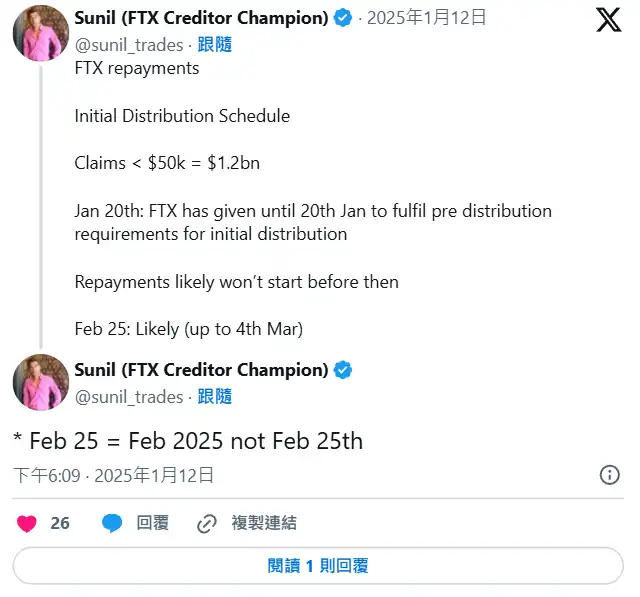
FTX creditor representative Sunil revealed the repayment schedule in a post today. According to the plan, the first round of repayment will target creditors with claims of less than $50,000, totaling approximately $1.2 billion. FTX requires creditors to complete claim registration and other pre-allocation requirements by January 20, with the first repayment expected to start in February and the distribution period may last until March 4.
To receive the initial repayment distribution, creditors in the "Convenience Category" must complete pre-allocation requirements by January 20, 2025, including submitting tax forms (Step 7), selecting and successfully registering with a distribution service provider (Step 8), and undergoing sanctions screening. The complete steps are as follows:
· Log in to the FTX Claims Portal (https://claims.ftx.com) (for clients).
· Complete the required KYC verification by January 3, 2025 (refer to BlockTempo's FTX Claim Application Guide).
· Submit the required tax forms, including the W-8 BEN form (refer to BlockTempo's Tax Form Submission Guide).
· After selecting the allocation service provider BitGo or Kraken in STEP 8, read the registration instructions for the chosen service provider and register an account with BitGo or Kraken by January 20.
BitGo is a globally regulated cryptocurrency custodian, while Kraken is a well-known U.S.-based cryptocurrency exchange offering services such as spot and derivatives trading in up to 190 countries/regions.
FTX Official has stated that creditors who do not meet the requirements by the deadline will not receive an allocation on the initial distribution date but may receive a makeup distribution in subsequent months.
Furthermore, according to Section 7.8 of the restructuring plan, if a holder fails to complete the pre-allocation requirements within 6 months from the initial allocation record date (January 3, 2025), they will forfeit their allocation rights.
Additionally, as per Section 7.14, if a holder receives a request to fulfill the requirements, they must do so within the specified timeframe; otherwise, they will also lose their allocation eligibility.
How Much Compensation Can Creditors Expect?
According to the FTX bankruptcy plan, the company anticipates having as much as $145 billion to $163 billion in cash available for distribution. This plan applies to 98% of creditors, and repayments are calculated based on "the USD price of cryptocurrency on the day of FTX's Chapter 11 bankruptcy filing on November 11, 2022."
Although FTX expects that the vast majority of creditors (claims of $50,000 or less) will be able to recover 118% of the claim value in USD, unless the assets held at FTX are stablecoins, they could still face significant losses.
For example, when FTX filed for bankruptcy protection, the price of BTC was only around $16,000, but the current BTC price is around $94,000. This means that if a creditor held one bitcoin at FTX at that time, they might only receive $16,000, representing about 17% of the current price—an enormous loss.
You may also like

Pantera Capital Partner: How Tokenization is Restructuring the Private Equity and Early Investment Ecosystem?

New York Proposes Stricter Stablecoin Issuer Rules Aligned With Federal GENIUS Act
NYDFS proposed stricter stablecoin issuer rules aligned with the GENIUS Act, covering reserves, custody, redemption timelines, audits, and capital buffers.
Every exchange is a "Universal Exchange."

The counterattack of traditional finance: Alliance chains are quietly reviving

CryptoQuant Says Bitcoin Profitable Supply Is Near 45% Pressure Zone as On-Chain Data Points to Market Repricing
CryptoQuant said Bitcoin’s profitable supply is nearing the 45% pressure zone, signaling rising market stress, unrealized losses, and a possible on-chain repricing phase.

Bitcoin Falls Below 200-Week Moving Average as On-Chain Data Shows Over Half of Supply in Loss
Bitcoin dropped below its 200-week moving average as on-chain data showed over 50% of circulating supply is now in loss, signaling rising market stress.

CFTC Reportedly Plans New Prediction Market Rules Focused on Manipulation Risk and Public Interest Review
The CFTC is reportedly preparing new prediction market rules focused on manipulation risk, public interest review, and retail trader protections.

Meet the new WEEX trial fund—your gateway to greater profits

WEEX Labs Lands at Dutch Blockchain Week: A Disruptive Crypto × AI Conversation Sets Sail in Amsterdam

SK Hynix Reportedly Plans U.S. ADR Listing as Early as August, With SEC Approval Possible in Late June
SK Hynix may pursue a U.S. ADR listing as early as August, with SEC approval reportedly possible in late June amid strong AI chip supply chain demand.

SpaceX vs Tesla vs xAI: Which Elon Musk Trade Has the Biggest Upside in 2026?
OpenAI Reveals It Has Confidentially Submitted an S-1 to the SEC, Keeping the Door Open for a Future IPO
On June 9, according to an OpenAI announcement, the company recently confidentially submitted a draft S-1 registration statement to the U.S. Securities and Exchange Commission (SEC), beginning the preliminary compliance process for a potential initial public offering. OpenAI said it chose to disclose this proactively because it expected the news might leak; however, the company has not yet set a specific listing timeline, and related arrangements may still take some time.

Latest research from 13 top universities including Cornell University: The current state, challenges, and misconceptions of the fusion of Crypto and AI
Deconstructing Anthropic: The Best AI Company, Possibly Also a Type of Organizational Invention
Apollo and Blackstone Reportedly Back $35 Billion Anthropic Chip Financing as Deal Details Remain Unclear
On June 9, according to currently available news alerts, Apollo and Blackstone Group participated in a $35 billion financing for an Anthropic “chip project.” Based on the original wording of the report, the funding has already been raised, but public information remains limited. The financing structure, use of proceeds, project entity, and whether Apollo and Blackstone participated through equity, debt, or project financing have not yet been disclosed.

Humanity Protocol Security Incident Escalates: More Than $31 Million Stolen From Related Addresses as Attacker Continues Selling H for ETH
On June 9, according to monitoring by Onchain Lens, more than $31 million has been stolen from addresses linked to Humanity Protocol, and the attack is still ongoing, with the hacker continuously swapping H tokens for ETH. Project founder Terence Kwok later confirmed the security incident on X, saying the issue involved a private key leak.

Bloomberg: As Bitcoin Weakens, Stablecoins and RWA Continue to Drive Expansion in Crypto Businesses
In June, Bloomberg reported that despite Bitcoin falling below $60,000 last week, wiping out about $235 billion in market value within seven days, and dropping close to 50% from last year’s peak, some core businesses in the crypto industry are still expanding, mainly in stablecoins, real-world asset tokenization (RWA), payments, and infrastructure. The report also noted that overall altcoin activity has contracted significantly: altcoin market capitalization has fallen from a peak of about $431 billion in November 2021 to around $170 billion, and among the tens of millions of tokens issued in recent years, fewer than 1,700 still maintain meaningful trading activity.

Galaxy Deep Research Report: How Hyperliquid's HIP-4 Upgrade Changes the Landscape of Prediction Markets?
Pantera Capital Partner: How Tokenization is Restructuring the Private Equity and Early Investment Ecosystem?
New York Proposes Stricter Stablecoin Issuer Rules Aligned With Federal GENIUS Act
NYDFS proposed stricter stablecoin issuer rules aligned with the GENIUS Act, covering reserves, custody, redemption timelines, audits, and capital buffers.
Every exchange is a "Universal Exchange."
The counterattack of traditional finance: Alliance chains are quietly reviving
CryptoQuant Says Bitcoin Profitable Supply Is Near 45% Pressure Zone as On-Chain Data Points to Market Repricing
CryptoQuant said Bitcoin’s profitable supply is nearing the 45% pressure zone, signaling rising market stress, unrealized losses, and a possible on-chain repricing phase.
Bitcoin Falls Below 200-Week Moving Average as On-Chain Data Shows Over Half of Supply in Loss
Bitcoin dropped below its 200-week moving average as on-chain data showed over 50% of circulating supply is now in loss, signaling rising market stress.


