
- Buy Crypto
- Markets
 Futures
- Spot
- Copy Trade
- Earn
- More
Coinbase Anti-Money Laundering Reform Proposal: Balancing Innovation and Compliance

Original Title: "Coinbase Anti-Money Laundering Reform Proposal: Balancing Innovation and Compliance"
Recently, Coinbase, one of the largest cryptocurrency exchanges in the United States, submitted a 30-page policy proposal to the U.S. Treasury, calling for a thorough reform of decades-old anti-money laundering (AML) regulations. Its core argument — "When bad actors innovate, good actors must also innovate" — quickly sparked widespread discussion within and outside the cryptocurrency industry. Coinbase argues that in the face of increasingly sophisticated digital asset crimes, reliance on technological innovation rather than simple law enforcement enhancements is necessary. As an institution dedicated to upholding the integrity of the financial system, the Hong Kong Anti-Money Laundering Alliance believes that Coinbase's proposal touches on a core issue of the global anti-money laundering system: how to encourage financial innovation while ensuring the solidity and effectiveness of the regulatory framework to prevent increased risk exposure.
We acknowledge that technology is an indispensable ally in the fight against money laundering. However, while embracing innovation, we must carefully assess the potential risks it may bring and beware of any attempts to weaken core regulatory principles under the guise of "innovation." From a regulatory perspective, this article will delve into the rationale and potential risks of Coinbase's proposal and, drawing on Hong Kong's experience in global virtual asset regulation, explore the balanced path forward for anti-money laundering in the digital asset space.
The Double-Edged Sword of Innovation: Coinbase Proposal's Key Demands and Potential Risks
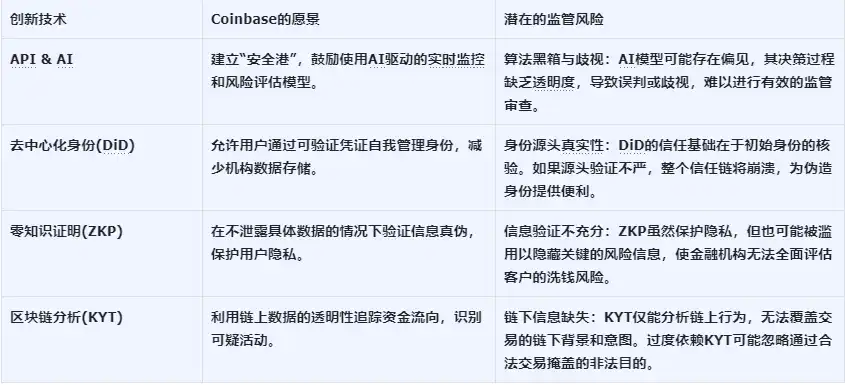
Coinbase's proposal mainly revolves around four major technological innovations: Application Programming Interfaces (APIs), Artificial Intelligence (AI), Decentralized Identity (DiD) and Zero-Knowledge Proofs (ZKPs), and Blockchain-based Know Your Transaction (KYT) analysis. Its key demand is to establish "Regulatory Safe Harbors" for financial institutions adopting these innovative technologies to reduce their compliance burden and encourage technological applications.
In its response document, Coinbase clearly states: "Gone are the days of someone walking into a bank with their ID to open an account... requiring companies to collect ID card copies online not only poses a significant risk of identity theft but also requires a significant amount of compliance resources." [1]
This viewpoint reflects the reality of financial services in the digital age. However, the establishment of a "safe harbor" must be based on extremely cautious and explicit conditions. If the standards are too lenient, it could lead to the following risks:
Hong Kong Experience: Leading Innovation Through Prudent Regulation
In the global wave of virtual asset regulation, Hong Kong has chosen a prudent and forward-looking path. Starting from June 1, 2023, Hong Kong has officially implemented a Virtual Asset Service Provider (VASP) licensing regime, bringing all centralized cryptocurrency exchanges under the comprehensive oversight of the Securities and Futures Commission (SFC). This framework has not sacrificed regulatory certainty and rigor in favor of innovation, providing a model worth emulating globally.
Unlike Coinbase's pursuit of a "safe harbor," Hong Kong's regulatory philosophy is "same business, same risks, same rules." This means that regardless of the innovative technologies VASPs adopt, their core AML/CFT obligations—including Customer Due Diligence (CDD), ongoing transaction monitoring, Suspicious Transaction Reports (STRs), and compliance with the Financial Action Task Force's "Travel Rule"—must be fully enforced.
The Hong Kong SFC has explicitly stated in its regulatory framework that when VASPs adopt new technologies, they must demonstrate to the regulators the reliability, security, and compliance of their technology, and establish robust governance and oversight mechanisms. For example, when using AI for transaction monitoring, a platform must be able to explain the logic of its algorithm to the regulators, validate its effectiveness, and take responsibility for the final decisions. This approach is not to stifle innovation but to guide innovation along a responsible path.
Conclusion: Towards a Path of Responsible Innovation
Coinbase's proposal has sounded the alarm for global regulatory agencies: in the face of the rapidly evolving digital asset space, sticking to tradition may indeed lead to regulatory failure. We support enhancing the efficiency and accuracy of anti-money laundering work through technology. However, the core principles of anti-money laundering—Know Your Customer (KYC), risk assessment, and behavior monitoring—must not be compromised by the cloak of technology.
We call for any reform of the anti-money laundering system to follow the following principles:
1. Technologically Neutral, Risk-Based: Regulation should focus on the risks inherent in financial activities themselves, rather than the technological form in which they are enacted. Whether it is a traditional bank or a crypto platform, they should be subject to regulation commensurate with their risk level.
2. Clear Responsibility, Not Reliance on a "Safe Harbor": Financial institutions should always be the primary actors in fulfilling anti-money laundering obligations. Regulators can provide guidance, but should not establish vague "safe harbors" to excuse or lighten institutions' core responsibilities.
3. Enhance International Cooperation, Fill Regulatory Gaps: As highlighted by Coinbase, non-compliant offshore entities pose a significant risk. Regulatory agencies worldwide should strengthen cooperation within the frameworks of international organizations like the FATF to collectively combat cross-border money laundering activities.
The Hong Kong Anti-Money Laundering Alliance will continue to closely monitor the latest developments in global digital asset regulation and work closely with the industry and regulatory agencies to promote the establishment of a healthy financial ecosystem that embraces innovation while effectively mitigating risks. We believe that only through a careful balance of innovation and compliance can the digital asset industry achieve a sustainable future.
References
[1] Coinbase. (2025, October 17). Response to Treasury RFC on Innovative Methods to Detect Illicit Activity Involving Digital Assets.https://assets.ctfassets.net/sygt3q11s4a9/2JiDDSZgdu1zwNlwkLgE24/12b9465b1b96198a702288555713dbd3/Coinbase_Response_to_Treasury_RFC_on_Innovative_Methods_To_Detect_Illicit_Activity_Involving_Digital_Assets__1_.pdf
This article is contributed content and does not represent the views of BlockBeats.
You may also like

Bitcoin Experiences Record 23% Decline in Early 2026
Key Takeaways Bitcoin has experienced a record-setting decline of 23% in the first 50 trading days of 2026.…

Whale Holding 105,000 ETH Faces $8.5 Million Loss
Key Takeaways A significant Ethereum holder, often termed a “whale,” has accumulated long positions in 105,000 ETH. The…

Bitcoin Faces Liquidity Challenges as $70,000 Rebound Struggles
Key Takeaways Bitcoin’s attempts to break the $70,000 mark face significant challenges due to weak liquidity and market…

Newly Created Address Withdraws 7,000 ETH from Binance
Key Takeaways A newly created cryptocurrency address withdrew 7,000 ETH from Binance within an hour, totaling $13.55 million.…

Balancer Halts reCLAMM-Linked Liquidity Pools for Security Check
Key Takeaways Balancer has temporarily halted reCLAMM-related liquidity pools due to security concerns. A report from the bug…

Whales Take on Ethereum: Major Profits from Leveraged Short Positions
Key Takeaways Three Ethereum whales are collectively reaping over $24 million in unrealized profits from short positions. The…

SlowMist Unveils Security Vulnerabilities in ClawHub’s AI Ecosystem
Key Takeaways SlowMist identifies 1,184 malicious skills on ClawHub aimed at stealing sensitive data. The identified threats include…

Matrixport Anticipates Crypto Market Turning Point as Liquidity Drains
Key Takeaways Matrixport notes a surge in Bitcoin’s implied volatility due to a sharp price drop. Bitcoin price…

Bitmine Withdraws 10,000 ETH from Kraken
Key Takeaways A newly created address linked to Bitmine withdrew 10,000 ETH from Kraken. The withdrawal value amounts…

In the face of the Quantum Threat, Bitcoin Core developers have chosen to ignore it

Don't Just Focus on Trading Volume: A Guide to Understanding the "Fake Real Volume" of Perpetual Contracts
Crypto Price Prediction Today 18 February – XRP, Bitcoin, Ethereum
Key Takeaways XRP’s potential as a replacement for SWIFT is bolstered by regulatory approvals, potentially driving its price…

XRP Price Prediction: XRP is Outpacing Solana and Targeting Binance Coin Next – Should You Invest Now?
Key Takeaways XRP Ledger has moved into the sixth place by tokenized real-world asset value, surpassing Solana and…

New AI Predicts the Price of XRP, Dogecoin, and Solana By 2026
Key Takeaways ChatGPT anticipates significant price increases for XRP, Dogecoin, and Solana by the end of 2026. XRP…

Arthur Hayes Shares Two Scenarios for Bitcoin Price, Calling for a Major Crypto Rally
Key Takeaways Arthur Hayes predicts a significant crypto rally fueled by a $572 billion liquidity injection from the…

Bitcoin Price Prediction: Abu Dhabi Gov Funds Buy $1 Billion in BTC – What Do They Know?
Key Takeaways Abu Dhabi has revealed a $1 billion stake in Bitcoin through major ETF investments, signaling strong…

Bitcoin’s Divergence From Nasdaq Signals Dollar Liquidity Risk, Says Arthur Hayes
Key Takeaways Arthur Hayes highlights a concerning divergence between Bitcoin and the Nasdaq, pointing to a potential dollar…
Lagarde’s Possible Early Exit Could Alter Digital Euro Plans and Stablecoin Oversight
Key Takeaways Christine Lagarde’s potential departure as ECB president may disrupt the digital euro timeline and stablecoin policies.…
Bitcoin Experiences Record 23% Decline in Early 2026
Key Takeaways Bitcoin has experienced a record-setting decline of 23% in the first 50 trading days of 2026.…
Whale Holding 105,000 ETH Faces $8.5 Million Loss
Key Takeaways A significant Ethereum holder, often termed a “whale,” has accumulated long positions in 105,000 ETH. The…
Bitcoin Faces Liquidity Challenges as $70,000 Rebound Struggles
Key Takeaways Bitcoin’s attempts to break the $70,000 mark face significant challenges due to weak liquidity and market…
Newly Created Address Withdraws 7,000 ETH from Binance
Key Takeaways A newly created cryptocurrency address withdrew 7,000 ETH from Binance within an hour, totaling $13.55 million.…
Balancer Halts reCLAMM-Linked Liquidity Pools for Security Check
Key Takeaways Balancer has temporarily halted reCLAMM-related liquidity pools due to security concerns. A report from the bug…
Whales Take on Ethereum: Major Profits from Leveraged Short Positions
Key Takeaways Three Ethereum whales are collectively reaping over $24 million in unrealized profits from short positions. The…


 App
App