
- Buy Crypto
- Markets
 Futures
- Spot
- Copy Trade
 Earn
Earn- More
Bitwise: The bear market started in January 2025, so the good news didn't matter

Original Title: Crypto Winter Started in January 2025
Original Author: @Matt_Hougan
Translation: Peggy, BlockBeats
Editor's Note: In a dislocation where good news abounds but prices continue to weaken, Bitwise Chief Investment Officer (CIO) Matt Hougan points out that this is not a normal pullback in a bull market, but rather a crypto winter that began in early 2025 and was once masked by institutional funds.
Bitwise is one of the world's largest cryptocurrency index fund providers, managing assets of over $3 billion. Hougan formerly served as CEO of ETF.com and Inside ETFs, and was one of the key creators of an institutional-grade ETF classification and rating system.
By comparing the performance of different assets, the article further reveals that institutional investability is determining who can weather the winter, while the retail-dominated market has in fact entered a deep bear market. Historical experience indicates that crypto winters often end in exhaustion rather than a sudden turnaround. When pessimism becomes the mainstream narrative, the turning point of the cycle is often not far away.
The following is the original text:
In fact, we have been in a crypto winter since January 2025. It is highly likely that we are now closer to the end point than the starting point.
This is a full-fledged crypto winter.
Crypto Twitter has only recently begun to realize this, but the fact could not be clearer: Bitcoin has dropped 39% from its historical high in October 2025, Ethereum has dropped 53%, and many other crypto assets have seen even more devastating declines.
This is not a so-called "bull market correction" or a "brief retracement." This is a full-throttle crypto winter, akin to the 2022 crypto winter — a "The Revenant" style of extreme survival. It was triggered by multiple factors acting together: excessive leverage, massive profit-taking by early holders (OG), and so on.
Truly recognizing and accepting this fact has made the perspective unusually clear.
Why, amid positive developments in adoption, regulation, and various areas, are crypto asset prices still falling?
Because we are in the depths of a crypto winter.
Why, with a new Fed chair who supports Bitcoin, is the "fear and greed index" of the crypto market still approaching historically high levels of fear?
Because we are in the midst of the crypto winter.
If you've experienced a previous winter, whether in 2018 or 2022, you surely remember that during the deepest cold, good news doesn't matter. Even if Wall Street is aggressively hiring, Morgan Stanley is ramping up its crypto efforts, the market won't bounce back. These factors matter in the long run, not now.
The crypto winter doesn't end in excitement; it ends in utter exhaustion.
So, when will the end come?
The good news is: closer than you imagine.
A History of Crypto Winters
From historical experience, a crypto winter typically lasts about 13 months. For example, Bitcoin peaked in December 2017 and bottomed in December 2018; it peaked again in October 2021 and bottomed in November 2022.
Following this pattern, the road ahead seems arduous. After all, Bitcoin is set to peak in October 2025. Should we then hibernate until next November?
I don't think so.
The more I analyze this "winter," the more I realize it actually started back in January 2025. We just didn't notice then—ETF inflows and Digital Asset Treasury (DAT) allocations masked the true market conditions.
ETF and DAT Flows Masked the 2025 Winter
Take a close look at this chart: it shows the performance of the Bitwise Top 10 Market Cap Crypto Index constituents since January 1, 2025.
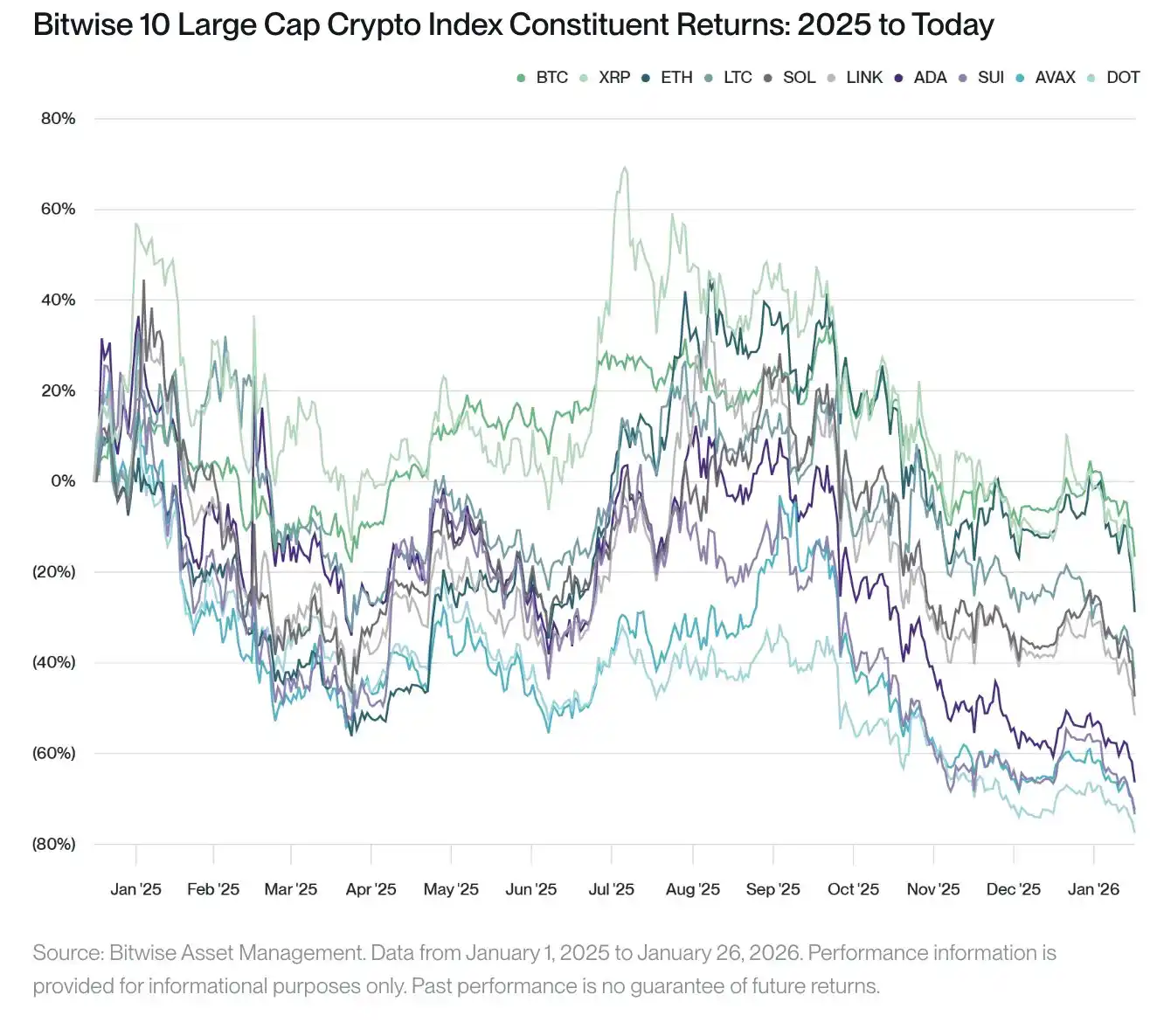
It can be clearly divided into three groups of assets.
The first group of assets (BTC, ETH, XRP) has performed decently, with declines ranging from 10.3% to 19.9%.
The second group of assets (SOL, LTC, LINK) went through a standard bear market, dropping between 36.9% and 46.2%.
Meanwhile, the third group of assets (ADA, AVAX, SUI, DOT) faced a "slaughterhouse" drop, plummeting by 61.9% to 74.7%.
The core factor distinguishing these three groups of assets is essentially one: whether institutions can invest in them.
The first group of assets has benefited all year from extensive ETF/Digital Asset Treasury (DAT) support (XRP also benefited additionally from its legal victory against the SEC); the second group of assets only received ETF approval in 2025; and the third group of assets has never had access to such channels.
Just look at the third group—you will see that they rely entirely on support from crypto-native capital.
The institutional support received by the first group of assets is at a historic level. For example, during the time period shown in this chart, ETFs and DATs collectively purchased 744,417 bitcoins, valued at around $75 billion. Imagine where Bitcoin would fall without this $75 billion support? My estimate is: potentially a 60% decline.
Since January 2025, the retail-dominated crypto market has been enduring a harsh winter. It's just that institutional capital has "embellished" this reality for certain assets for a period of time.
The Darkest Hour is Just Before Dawn
One thing to keep in mind right now is: there is indeed a plethora of bullish news in the crypto industry.
Regulatory progress is real; institutional adoption is real; stablecoins and asset tokenization are real; Wall Street's embrace is also real.
In a bear market, bullish news may be overlooked, but it does not disappear; instead, it is stored as potential energy. Once the gloom disperses, and sentiment returns to normal, this stored energy often unleashes in a powerful manner.
So, what could cause the clouds to part?
Strong economic growth triggering a round of aggressive risk-on rebound; Positive policy surprises from the Clarity Act; Signs of Bitcoin adoption at the sovereign nation level; or simply, the passage of time itself.
As a veteran of multiple crypto winters, I can tell you: the feeling before the end of a winter cycle often feels like it does now—desperate, powerless, universally fatigued. But this market correction has not altered any of the fundamental realities of the crypto industry.
I believe the rebound will arrive sooner than most expect. After all, it has been winter since January 2025—the spring is bound to be not far away.
Risk Warning and Important Disclaimer
Not Investment Advice; Risk of Loss: Before making any investment decision, each investor should conduct their own independent examination and research, including carefully considering the investment's objectives and risks, based on their own particular financial circumstances. Such investment decisions should be made based upon your own judgment and not in reliance on any view expressed in this translation.
Cryptocurrencies are a digital representation of value that functions as a medium of exchange, a unit of account, or a store of value, but they do not have legal tender status. Cryptocurrencies can be exchanged for U.S. dollars or other currencies in some regions around the world, but they are not backed or supported by any government or central bank. Their value is derived purely from market supply and demand dynamics, and their value is highly volatile compared to traditional currencies, stocks, or bonds.
Cryptocurrency trading carries significant risks, including price volatility, flash crashes, market manipulation risks, cybersecurity risks, and the risk of partial or total loss of capital. Additionally, cryptocurrency markets and exchanges are not regulated or subject to the same investor protections as stocks, options, futures, or foreign exchange markets.
Cryptocurrency trading requires a deep understanding of the market. When attempting to profit from cryptocurrency trading, you are competing directly with global traders. Prior to engaging in large-scale cryptocurrency trading, you should have the requisite knowledge and experience. Cryptocurrency trading can lead to rapid and substantial financial losses; under certain market conditions, you may find it difficult or impossible to liquidate a position at a reasonable price quickly.
The views expressed in this translation reflect the judgment of the market environment at a specific point in time and do not constitute a prediction or guarantee of future events or results, and they may be added to, revised, or adjusted as discussions progress. The information in this translation does not constitute, and should not be construed as, accounting, legal, tax, or investment advice. Consult your own accountant, legal counsel, tax advisor, or other professional advisor regarding matters discussed in this translation.
You may also like

February 10th Key Market Information Gap, A Must-See! | Alpha Morning Report

About ERC-8004: Everything You Need to Know

ai.com's Debut Flop: After $70 Million Transaction, Did It Get a '504' Timeout?

FedNow versus The Clearing House: Who Will Win the Fed Payments Fray?

Recovering $70,000 in Lost Funds: The "Fragile Logic" Behind Bitcoin's Rebound

Mr. Beast acquires Step, Farcaster Founder Joins Tempo, what are the international crypto circles talking about today?
February 9th Market Key Intelligence, How Much Did You Miss?

After being questioned by Vitalik, L2s are collectively saying goodbye to the "cheap" era

WEEX AI Trading Hackathon Paris Workshop Reveals: How Retail Crypto Traders Can Outperform Hedge Funds
Witness how WEEX's Paris AI Trading Hackathon revealed AI's edge over human traders. Explore key strategies, live competition results & how to build your own AI trading bot.

U.S. Oil (USOR) Price Prediction 2026–2030
Key Takeaways U.S. Oil (USOR) is a speculative Solana-based crypto project that aims to index the United States…

USOR Surges on Meme Narrative Despite No Real-World Asset Backing
Key Takeaways: USOR, a Solana-based token, has seen a notable surge driven by speculative narratives rather than verifiable…

How to Buy U.S. Oil Reserve (USOR) Cryptocurrency
Key Takeaways U.S. Oil Reserve (USOR) is a Solana-based token primarily traded on decentralized exchanges (DEXs). Claims have…

USOR vs Oil ETFs: Understanding Why the ‘Oil Reserve’ Token Doesn’t Track Crude Prices
Key Takeaways The U.S. Oil Reserve (USOR) token has become noteworthy for its claims, yet it does not…

Trend Research Reduces Ether Holdings After Major Market Turbulence
Key Takeaways: Trend Research has significantly cut down its Ether holdings, moving over 404,000 ETH to exchanges recently.…
Investors Channel $258M into Crypto Startups Despite $2 Trillion Market Sell-Off
Key Takeaways: Investors pumped approximately $258 million into crypto startups in early February, highlighting continued support for blockchain-related…
NBA Star Giannis Antetokounmpo Becomes Shareholder in Prediction Market Kalshi
Key Takeaways: Giannis Antetokounmpo, the NBA’s two-time MVP, invests in the prediction market platform Kalshi as a shareholder.…

Arizona Home Invasion Targets $66 Million in Cryptocurrency: Two Teens Charged
Key Takeaways Two teenagers from California face serious felony charges for allegedly attempting to steal $66 million in…

El Salvador’s Bukele Approval Reaches Record 91.9% Despite Limited Bitcoin Use
Key Takeaways: El Salvador President Nayib Bukele enjoys a record high approval rating of 91.9% from his populace,…


 App
App