
Bitcoin V-Shaped Reversal, CME Gap Could Be the Biggest "Risk"

Original Article Title: "After Bitcoin's V-Shaped Reversal, Could the CME Gap Be the Biggest 'Hidden Danger'?"
Original Source: BitpushNews
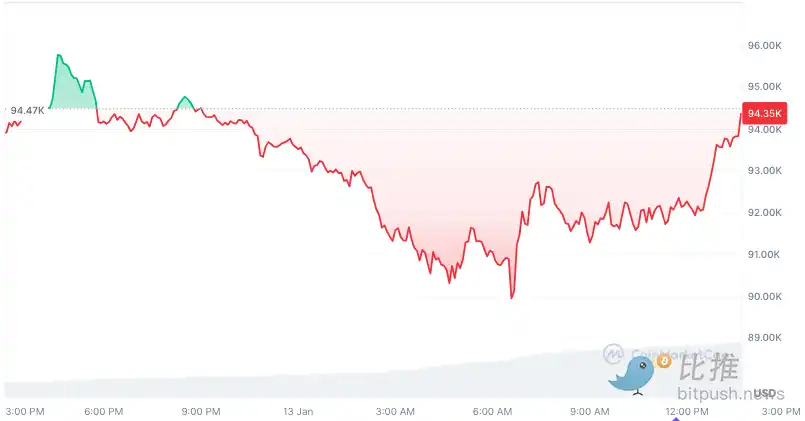
Over the past 24 hours, Bitcoin has staged a V-shaped reversal drama, hitting a low of $90,000, an eight-week low, and bouncing back above $94,000 after the U.S. stock market close, with the market's longs and shorts in a tense situation. Bitcoin's price has dropped over 7% in the past week. Although its market cap continues to hover around $1.864 trillion, its dominance has slightly decreased to 54.2%.
Macroeconomic Factors Lead to Temporary Market Cooling
Experts believe that the pullback that began last week is attributed to optimistic U.S. economic data, including better-than-expected initial jobless claims and labor participation rate. This data has heightened concerns that interest rates may remain high for a longer period than expected.
Chris Chung, CEO and Founder of Titan, stated: "The market seems very concerned that there won't be any more rate cuts in 2025, especially given the incredibly strong jobs report released on Friday. But we also saw a big rally in December, so it's not uncommon for the market to readjust after such a large rally."
He pointed out that with U.S. President-elect Donald Trump set to be inaugurated next week, there is still "further downside risk" in the cryptocurrency market.
Chris Chung said: "Everyone expects Trump to announce regulatory support for cryptocurrency on day one, but he may start with more pressing issues given the Republican control of the House and Senate, along with macro concerns and upcoming token unlocks, this market adjustment may continue into February or even March."
James Butterfill, Head of Research at CoinShares, stated in his fund report: "The honeymoon period after the U.S. election is over, and macroeconomic data once again becomes a key driver of asset prices."
Derivatives Data Shows Sentiment Ranges from Mildly Bullish to Neutral
It is worth noting that the reaction in the Bitcoin derivatives market has been relatively mild.
Firstly, the futures premium is high, as Bitcoin futures contracts typically trade at a premium to the spot market, reflecting market optimism about future prices. Data shows that the current annualized premium rate is at 11%, above the 5%-10% neutral range, indicating that market participants overall remain optimistic.
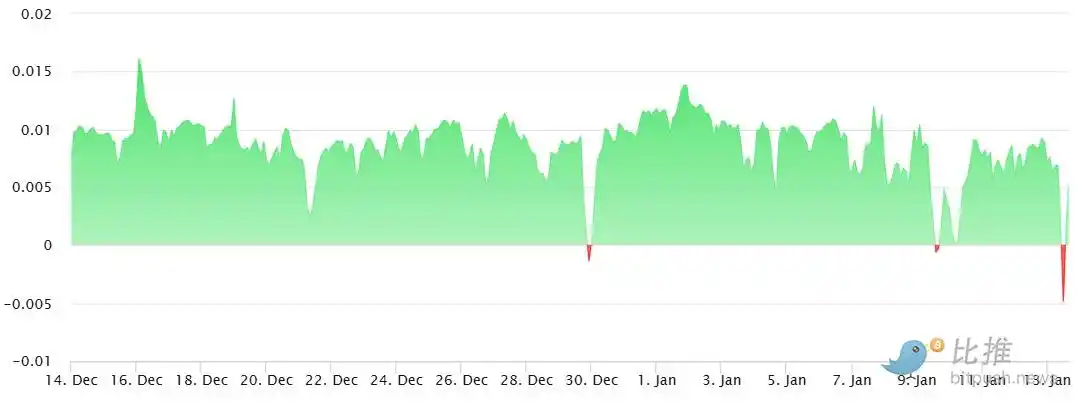
Another indicator is the perpetual contract funding rate (usually reflecting market sentiment). Although on January 13, due to a large number of short positions entering the market, the funding rate briefly turned negative, accompanied by $1.07 billion in long liquidations. However, it quickly rebounded to around 0.5% monthly rate, showing that the market did not exhibit sustained bearish sentiment.
CME Gap Pressure, Will It Be Filled?
Analysts say there is a gap between $88,500 and $77,500 on the CME chart. When there is a difference in the Bitcoin futures price between the close of one trading day and the open of the next trading day, a CME gap occurs, which usually causes Bitcoin to tend to return to a certain level. If Bitcoin faces a downward correction, this gap represents a potential bearish target.
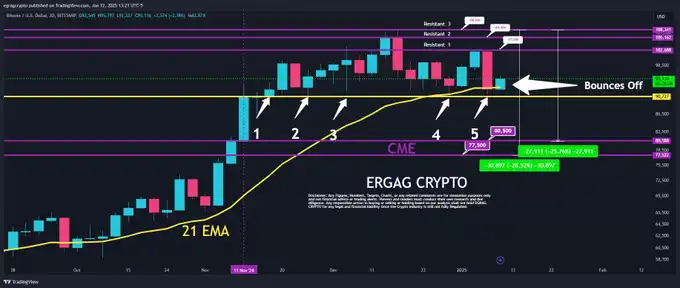
Analysts believe that given Bitcoin's current price of around $94,000, a drop from this level could lead to a significant pullback, potentially resulting in a decline of up to 18% to fill this CME gap.
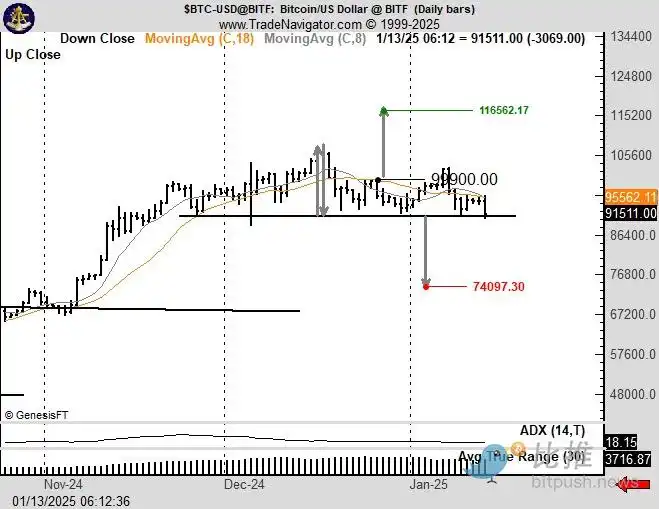
In addition to the CME gap, veteran market analysts like Peter Brandt also point out a potential bearish signal on the Bitcoin daily chart. Brandt suggests that a head and shoulders pattern could form, which may indicate that the Bitcoin price could fall to $73,000. However, Brandt also warns against relying too heavily on this chart as BTC's high volatility often leads to changes in chart patterns.
Therefore, Bitcoin's current trend is influenced by multiple complex factors. While the derivatives market remains relatively calm, the presence of the CME futures market gap, a potential head and shoulders pattern, and key support levels increase the risk of a price downturn. If Bitcoin continues to face pressure, the market will closely monitor whether it will fill the CME gap, which could trigger significant market volatility.
You may also like

Pantera Capital Partner: How Tokenization is Restructuring the Private Equity and Early Investment Ecosystem?

New York Proposes Stricter Stablecoin Issuer Rules Aligned With Federal GENIUS Act
NYDFS proposed stricter stablecoin issuer rules aligned with the GENIUS Act, covering reserves, custody, redemption timelines, audits, and capital buffers.
Every exchange is a "Universal Exchange."

The counterattack of traditional finance: Alliance chains are quietly reviving

CryptoQuant Says Bitcoin Profitable Supply Is Near 45% Pressure Zone as On-Chain Data Points to Market Repricing
CryptoQuant said Bitcoin’s profitable supply is nearing the 45% pressure zone, signaling rising market stress, unrealized losses, and a possible on-chain repricing phase.

Bitcoin Falls Below 200-Week Moving Average as On-Chain Data Shows Over Half of Supply in Loss
Bitcoin dropped below its 200-week moving average as on-chain data showed over 50% of circulating supply is now in loss, signaling rising market stress.

CFTC Reportedly Plans New Prediction Market Rules Focused on Manipulation Risk and Public Interest Review
The CFTC is reportedly preparing new prediction market rules focused on manipulation risk, public interest review, and retail trader protections.

Meet the new WEEX trial fund—your gateway to greater profits

WEEX Labs Lands at Dutch Blockchain Week: A Disruptive Crypto × AI Conversation Sets Sail in Amsterdam

SK Hynix Reportedly Plans U.S. ADR Listing as Early as August, With SEC Approval Possible in Late June
SK Hynix may pursue a U.S. ADR listing as early as August, with SEC approval reportedly possible in late June amid strong AI chip supply chain demand.

SpaceX vs Tesla vs xAI: Which Elon Musk Trade Has the Biggest Upside in 2026?
OpenAI Reveals It Has Confidentially Submitted an S-1 to the SEC, Keeping the Door Open for a Future IPO
On June 9, according to an OpenAI announcement, the company recently confidentially submitted a draft S-1 registration statement to the U.S. Securities and Exchange Commission (SEC), beginning the preliminary compliance process for a potential initial public offering. OpenAI said it chose to disclose this proactively because it expected the news might leak; however, the company has not yet set a specific listing timeline, and related arrangements may still take some time.

Latest research from 13 top universities including Cornell University: The current state, challenges, and misconceptions of the fusion of Crypto and AI
Deconstructing Anthropic: The Best AI Company, Possibly Also a Type of Organizational Invention
Apollo and Blackstone Reportedly Back $35 Billion Anthropic Chip Financing as Deal Details Remain Unclear
On June 9, according to currently available news alerts, Apollo and Blackstone Group participated in a $35 billion financing for an Anthropic “chip project.” Based on the original wording of the report, the funding has already been raised, but public information remains limited. The financing structure, use of proceeds, project entity, and whether Apollo and Blackstone participated through equity, debt, or project financing have not yet been disclosed.

Humanity Protocol Security Incident Escalates: More Than $31 Million Stolen From Related Addresses as Attacker Continues Selling H for ETH
On June 9, according to monitoring by Onchain Lens, more than $31 million has been stolen from addresses linked to Humanity Protocol, and the attack is still ongoing, with the hacker continuously swapping H tokens for ETH. Project founder Terence Kwok later confirmed the security incident on X, saying the issue involved a private key leak.

Bloomberg: As Bitcoin Weakens, Stablecoins and RWA Continue to Drive Expansion in Crypto Businesses
In June, Bloomberg reported that despite Bitcoin falling below $60,000 last week, wiping out about $235 billion in market value within seven days, and dropping close to 50% from last year’s peak, some core businesses in the crypto industry are still expanding, mainly in stablecoins, real-world asset tokenization (RWA), payments, and infrastructure. The report also noted that overall altcoin activity has contracted significantly: altcoin market capitalization has fallen from a peak of about $431 billion in November 2021 to around $170 billion, and among the tens of millions of tokens issued in recent years, fewer than 1,700 still maintain meaningful trading activity.

Galaxy Deep Research Report: How Hyperliquid's HIP-4 Upgrade Changes the Landscape of Prediction Markets?
Pantera Capital Partner: How Tokenization is Restructuring the Private Equity and Early Investment Ecosystem?
New York Proposes Stricter Stablecoin Issuer Rules Aligned With Federal GENIUS Act
NYDFS proposed stricter stablecoin issuer rules aligned with the GENIUS Act, covering reserves, custody, redemption timelines, audits, and capital buffers.
Every exchange is a "Universal Exchange."
The counterattack of traditional finance: Alliance chains are quietly reviving
CryptoQuant Says Bitcoin Profitable Supply Is Near 45% Pressure Zone as On-Chain Data Points to Market Repricing
CryptoQuant said Bitcoin’s profitable supply is nearing the 45% pressure zone, signaling rising market stress, unrealized losses, and a possible on-chain repricing phase.
Bitcoin Falls Below 200-Week Moving Average as On-Chain Data Shows Over Half of Supply in Loss
Bitcoin dropped below its 200-week moving average as on-chain data showed over 50% of circulating supply is now in loss, signaling rising market stress.


