
 Buy Crypto
- Markets
 Futures
- Spot
- Copy Trade
- Earn
- More
Besides Resolv Hack, This DeFi Vulnerability Type Has Occurred Four Times

Original Title: DeFi Has Seen Resolv's $25M USR Exploit Many Times Before
Original Author: Camila Russo, The Defiant
Original Translation: DeepFlow Tech
On a quiet Sunday morning, someone turned $100,000 into $25 million in about 17 minutes.
The target was the yield-bearing stablecoin protocol Resolv. Before Resolv paused the contract, its USD-pegged stablecoin USR had plummeted to a few cents. As of the time of writing, USR remains severely off-peg, trading around $0.25, with a drop of over 70% this week.
The impact wave goes far beyond Resolv itself. Fluid/Instadapp absorbed over $10 million in bad debt in a single day, experiencing over $300 million in net outflows on the same day, marking its largest daily outflow in history. 15 Morpho vaults were affected. Euler, Venus, Lista DAO, and Inverse Finance all successively paused USR-related markets.
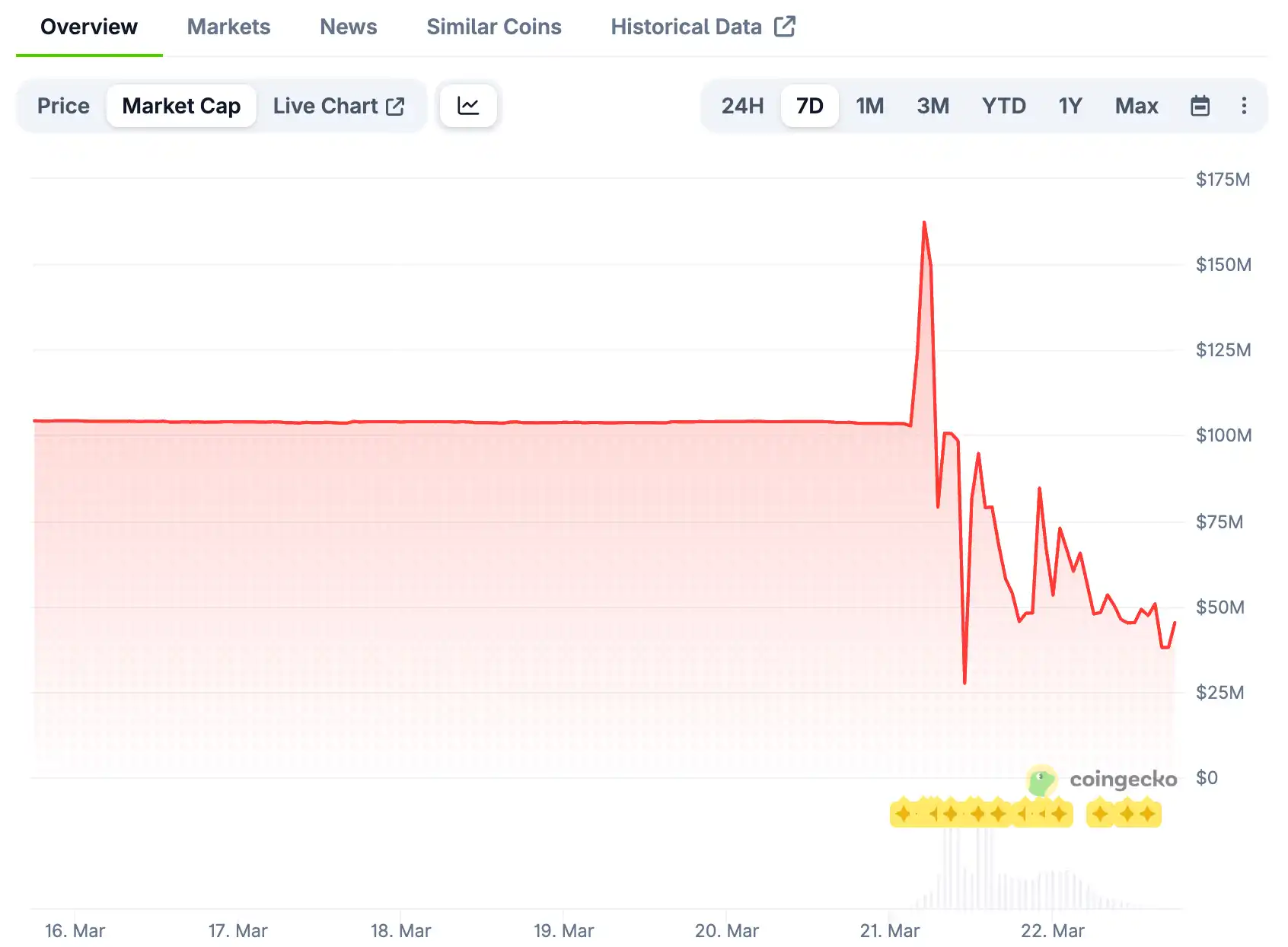
The mechanism that led to the spread of losses from this vulnerability—pricing the off-peg stablecoin at $1 in the lending market—is not a novelty. Over the past 14 months, this situation has occurred at least four times.
How the Exploit Worked
The minting of USR follows a two-step off-chain process: Users deposit USDC through the `requestSwap` function, and a privileged off-chain signing key `SERVICE_ROLE` finalizes the issuance of the USR amount through `completeSwap`.
The contract has a minimum output restriction but no upper limit. Whatever the key holder signs, the contract executes.
The attacker gained access to this key through Resolv's AWS Key Management Service. They submitted two USDC deposits totaling around $100,000 to $200,000 and then utilized the stolen key to mint 80 million USR as a reward. On-chain data shows two transactions of 50 million USR and 30 million USR, both minted within minutes.
「The Resolv USR vulnerability is not a bug - it's a feature working as intended. That's the problem.」 On-chain analyst Vadim (@zacodil) stated.
The SERVICE_ROLE is a regular external account address, not a multisig. The admin key has multisig protection, but the minting key does not.
「Resolv went through 18 audits,」 Vadim said, 「and one of the findings was directly named 'missing cap.'」
The attacker methodically exited: first converting minted USR to wstUSR (a wrapped staking version) to soften the market impact, then swapping it for ETH through Curve, Uniswap, and KyberSwap. The attacker's wallet holds around 11,400 ETH (about $24 million). The system's ETH and BTC collateral pools remain intact amid the stablecoin crash.
How the Contagion Spread
The Resolv vulnerability is actually the overlap of two events. The first being the minting bug and the second the failure of the cascade lending market.
When USR and wstUSR collapsed, every lending market that accepted them as collateral faced the same issue: their oracle still priced wstUSR near $1.
Risk analysis firm Chaos Labs founder Omer Goldberg documented this mechanism. His key finding was: 「The oracle is hardcoded, so it was never repriced. wstUSR was marked at $1.13, while its secondary market trading price was around $0.63.」
Traders bought wstUSR at a low price on the open market, then used the oracle's $1.13 price on Morpho or Fluid to collateralize it and borrowed USDC before exiting.
At Fluid, the team raised short-term loans to cover 100% of the default and pledged to compensate every user in full. At Morpho, co-founder Paul Frambot stated approximately 15 treasuries hold significant exposure, all part of a high-risk, long-tail collateral strategy.
Renowned curator Gauntlet has stated, "Several high-yield vaults have limited exposure."
However, D2 Finance directly refuted this claim, releasing on-chain data showing that Gauntlet's flagship "USDC Core Vault" allocated $4.95 million to the wstUSR/USDC market. Goldberg then stated that Gauntlet's vault holds 98% of the lending-side liquidity in that market.
Responding in writing to The Defiant, Frambot stated, "We've been researching how to present various risks more comprehensively. However, we don't believe the core issue here is a lack of labeling."
Frambot added, "Morpho is oracle agnostic, meaning it allows curators to choose any oracle they deem most suitable for a specific market. Morpho is an open, permissionless infrastructure designed to outsource risk management to curators."
"It is difficult to enforce an objectively 'correct' threshold in all scenarios," Frambot said. "Imposing constraints at the protocol level also carries the risk of hindering the implementation of legitimate strategies."
While the underlying protocol leaves risk management to the curator, some industry insiders believe that curators have not fulfilled their duties.
"I believe there is a flaw in the curator industry's design, as there is no genuine curation taking place," Marc Zeller stated on X.
As of the time of writing, Resolv, Gauntlet, and Fluid have not responded to The Defiant's request for comment.
A Recurring Pattern of Failure
This is not a new type of attack. In January 2025, Usual Protocol's USD0++ was hard-coded to $1 by curator MEV Capital in the Morpho Vault.
Usual then suddenly adjusted the redemption floor to $0.87 without any warning, leaving lenders locked in the MEV Capital Vault, which saw its utilization surge to 100%.
In November 2025, Stream Finance's xUSD collapsed, as the curator had routed USDC deposits into a leverage loop backed by that synthetic stablecoin. When its oracle refused to update, assets worth an estimated $2.85 billion to $7 billion on Morpho, Euler, and Silo faced risk.
In October and November 2025, Moonwell experienced two consecutive oracle failures, resulting in over $5 million in defaults.
What Does This Mean for the Curator Model
Morpho's architecture outsources all risk decisions to a third-party "curator," who builds the vault, selects collateral, sets loan-to-value ratios, and chooses oracles. This theoretical framework posits that professional entities possess deeper expertise, competition leads to better risk management, and the protocol is responsible for rule execution.
However, curators rely on generated yields to earn fees, creating an incentive for higher-risk, higher-yield collateral (such as yield-bearing stablecoins). The issue arises when these stablecoins lose their peg, with depositors bearing the brunt of the loss instead of the curator.
In the Resolv incident, some curators' automated bots continued to deposit funds into the affected vault hours after the exploit, exacerbating the loss.
The reason for using hard-coded oracles for yield-bearing stablecoins is to prevent unnecessary liquidations triggered by short-term fluctuations. However, this protection is only effective when the stablecoin remains stable.
Chainalysis, a blockchain analysis firm, stated in a post-mortem analysis that real-time on-chain monitoring capabilities are essential.
"The on-chain smart contract execution worked perfectly fine. The issue clearly stemmed from broader system design and off-chain infrastructure." The analysis firm stated.
You may also like

Huang Renxun's Latest Podcast: Will NVIDIA Reach $1 Trillion? Will the Number of Programmers Increase Instead of Decrease? How to Deal with AI Anxiety?

Trump Cries Peace, $1.5 Billion Dash | Rewire News Evening Brief

From x402 to MPP: Cloudflare's crucial vote, will it go to Coinbase or Stripe?

BlackRock CEO issues annual open letter: The wave of tokenization has arrived, and we will lead this trend
When Backpack backstabs the community

When gold is no longer a safe haven, and Bitcoin continues to panic

Trump, the World's Largest Oil Trader

If the US and Iran have not reached an agreement in 5 days, what other cards does Trump have?

Tether Whale Dumps £12 Million, Backing Crypto’s ‘British Trump’
Ethereum Foundation Post: Rethinking the Division of Work Between L1 and L2 to Build the Ultimate Ethereum Ecosystem

Two Major Prediction Market Platforms Unite Rarely, What Is the Story Behind This New Fund?
Dragonfly Partners: Most agents will not engage in autonomous trading, how can crypto payments prevail?

US AI Startup Goes All In on Chinese Mega-Model | Rewire News Morning Brief

Trump Lies Again: A "Five-Day Pause" Psyop, How Wall Street, Bitcoin, and Polymarket Insiders Synced Uposciogen
When a Token Becomes Labor, People Become the Interface

Ceasefire News Leaked Ahead of Time? Large Polymarket Bets on Outcome Before Trump's Tweet
BlackRock CEO's Annual Shareholder Letter: How is Wall Street Using AI to Keep Profiting from National Pension Funds?

Sun Valley Releases 2025 Financial Report: Bitcoin Mining Revenue Reaches $670 Million, Accelerating Transformation to AI Infrastructure Platform
On March 16, 2026, in Dallas, Texas, USA, CanGu Company (New York Stock Exchange code: CANG, hereinafter referred to as "CanGu" or the "Company") today announced its unaudited financial performance for the fourth quarter and full year ended December 31, 2025. As a btc-42">bitcoin mining enterprise relying on a globally operated layout and dedicated to building an integrated energy and AI computing power platform, CanGu is actively advancing its business transformation and infrastructure development.
• Financial Performance:
Total revenue for the full year 2025 was $688.1 million, with $179.5 million in the fourth quarter.
Bitcoin mining business revenue for the full year was $675.5 million, with $172.4 million in the fourth quarter.
Full-year adjusted EBITDA was $24.5 million, while the fourth quarter was -$156.3 million.
• Mining Operations and Costs:
A total of 6,594.6 bitcoins were mined throughout the year, averaging 18.07 bitcoins per day; of which 1,718.3 bitcoins were mined in the fourth quarter, averaging 18.68 bitcoins per day.
The average mining cost for the full year (excluding miner depreciation) was $79,707 per bitcoin, and for the fourth quarter, it was $84,552;
The all-in sustaining costs were $97,272 and $106,251 per bitcoin, respectively.
As of the end of December 2025, the company has cumulatively produced 7,528.4 bitcoins since entering the bitcoin mining business.
• Strategic Progress:
The company has completed the termination of the American Depositary Receipt (ADR) program and transitioned to a direct listing on the NYSE to enhance information transparency and align with its strategic direction, with a long-term goal of expanding its investor base.
CEO Paul Yu stated: "2025 marked the company's first full year as a bitcoin mining enterprise, characterized by rapid execution and structural reshaping. We completed a comprehensive adjustment of our asset system and established a globally distributed mining network. Additionally, the company introduced a new management team, further strengthening our capabilities and competitive advantage in the digital asset and energy infrastructure space. The completion of the NYSE direct listing and USD pricing also signifies our transformation into a global AI infrastructure company."
"As we enter 2026, the company will continue to optimize its balance sheet structure and enhance operational efficiency and cost resilience through adjustments to the miner portfolio. At the same time, we are advancing our strategic transformation into an AI infrastructure provider. Leveraging EcoHash, we will utilize our capabilities in scalable computing power and energy networks to provide cost-effective AI inference solutions. The relevant site transformations and product development are progressing simultaneously, and the company is well-positioned to sustain its execution in the new phase."
The company's Chief Financial Officer, Michael Zhang, stated: "By 2025, the company is expected to achieve significant revenue growth through its scaled mining operations. Despite recording a net loss of $452.8 million from ongoing operations, mainly due to one-time transformation costs and market-driven fair value adjustments, the company, from a financial perspective, will reduce its leverage, optimize its Bitcoin reserve strategy and liquidity management, introduce new capital to strengthen its financial position, and seize investment opportunities in high-potential areas such as AI infrastructure while navigating market volatility."
The total revenue for the fourth quarter was $1.795 billion. Of this, the Bitcoin mining business contributed $1.724 billion in revenue, generating 1,718.3 Bitcoins during the quarter. Revenue from the international automobile trading business was $4.8 million.
The total operating costs and expenses for the fourth quarter amounted to $4.56 billion, primarily attributed to expenses related to the Bitcoin mining business, as well as impairment of mining machines and fair value losses on Bitcoin collateral receivables.
This includes:
· Cost of Revenue (excluding depreciation): $1.553 billion
· Cost of Revenue (depreciation): $38.1 million
· Operating Expenses: $9.9 million (including related-party expenses of $1.1 million)
· Mining Machine Impairment Loss: $81.4 million
· Fair Value Loss on Bitcoin Collateral Receivables: $171.4 million
The operating loss for the fourth quarter was $276.6 million, a significant increase from a loss of $0.7 million in the same period of 2024, primarily due to the downward trend in Bitcoin prices.
The net loss from ongoing operations was $285 million, compared to a net profit of $2.4 million in the same period last year.
The adjusted EBITDA was -$156.3 million, compared to $2.4 million in the same period last year.
The total revenue for the full year was $6.881 billion. Of this, the revenue from the Bitcoin mining business was $6.755 billion, with a total output of 6,594.6 Bitcoins for the year. Revenue from the international automobile trading business was $9.8 million.
The total annual operating costs and expenses amount to $1.1 billion.
Specifically, they include:
· Revenue Cost (excluding depreciation): $543.3 million
· Revenue Cost (depreciation): $116.6 million
· Operating Expenses: $28.9 million (including related-party expenses of $1.1 million)
· Miner Impairment Loss: $338.3 million
· Bitcoin Collateral Receivable Fair Value Change Loss: $96.5 million
The full-year operating loss is $437.1 million. The continuing operations net loss is $452.8 million, while in 2024, there was a net profit of $4.8 million.
The 2025 non-GAAP adjusted net profit is $24.5 million (compared to $5.7 million in 2024). This measure does not include share-based compensation expenses; refer to "Use of Non-GAAP Financial Measures" for details.
As of December 31, 2025, the company's key assets and liabilities are as follows:
· Cash and Cash Equivalents: $41.2 million
· Bitcoin Collateral Receivable (Non-current, related party): $663.0 million
· Miner Net Value: $248.7 million
· Long-Term Debt (related party): $557.6 million
In February 2026, the company sold 4,451 bitcoins and repaid a portion of related-party long-term debt to reduce financial leverage and optimize the asset-liability structure.
As per the stock repurchase plan disclosed on March 13, 2025, as of December 31, 2025, the company had repurchased a total of 890,155 shares of Class A common stock for approximately $1.2 million.


 App
App