
- Buy Crypto
- Markets
 Futures
- Spot
- Copy Trade
- Earn
- More
Arthur Hayes Breaks Down Debt, Buybacks, and Money Printing: The Ultimate Dollar Liquidity Loop

Original Title: Hallelujah
Original Author: Arthur Hayes, Co-Founder of BitMEX
Original Translation: Bitpush News
Introduction: The Political Incentive and the Inevitability of Debt
Praise be to Satoshi, the existence of time and the rule of compound interest, independent of individual identity.
Even for governments, there are only two ways to fund expenses: using savings (taxation) or issuing debt. For a government, savings are equivalent to taxation. It is well known that taxation is not popular among the people, but spending is. Therefore, when providing welfare to both plebeians and patricians, politicians prefer issuing debt. Politicians always lean towards borrowing from the future to guarantee their current reelection, as when the bill comes due, they are likely not in office.
If due to officials' incentive mechanisms, all governments are "hard-coded" to prefer issuing debt rather than raising taxes to provide welfare, the next key question is: how do purchasers of US Treasuries finance these purchases? Do they use their own savings/capital or do they finance through borrowing?
Answering these questions, especially against the backdrop of the "Pax Americana," is crucial for our prediction of future dollar currency creation. If the marginal buyers of US Treasuries finance their purchases through borrowing, then we can observe who is lending to them. Once we know the identity of these debt financiers, we can determine if they are creating money out of thin air (ex nihilo) to lend or if they are using their own capital for lending. If after answering all questions, we find that the financiers of the Treasuries are creating money during lending, then we can draw the following conclusions:
Government-issued debt will increase the money supply.
If this assertion holds, then we can estimate the upper limit of credit that the financiers can issue (assuming there is a limit).
These questions are important because my argument is this: if government borrowing continues to grow as forecasted by Too Big to Fail (TBTF) Banks, the US Treasury, and the Congressional Budget Office, then the Federal Reserve's balance sheet will also expand. If the Federal Reserve's balance sheet grows, it is a boon for dollar liquidity, ultimately driving up the prices of Bitcoin and other cryptocurrencies.
Next, we will answer these questions one by one and evaluate this logical puzzle.
Question Time
Will President Trump Use Tax Cuts to Finance the Deficit?
No. He recently extended the 2017 tax cut policy with the "Red Camp" Republicans.
Is the U.S. Treasury Borrowing to Fill the Federal Deficit and Will Continue to Do So in the Future?
Yes.
The following are estimates from large bankers and U.S. government institutions. As seen, they predict a deficit of around $2 trillion and finance it through $2 trillion in borrowing.
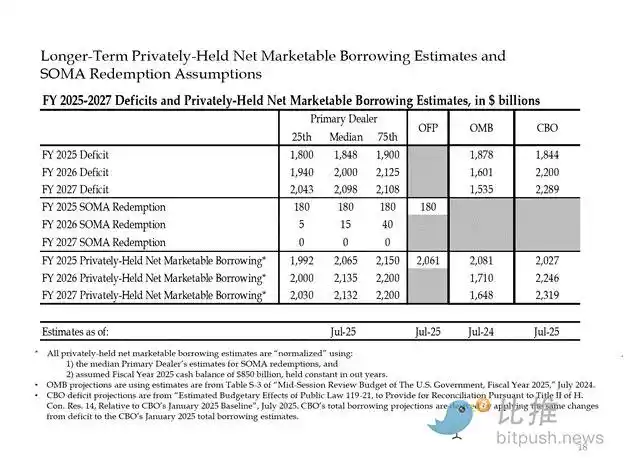
Given that the answer to both previous questions is "yes," then:
Annual Federal Deficit = Annual Treasury Issuance
Next, we will analyze the main purchasers of Treasury bonds and how they fund their purchases.
Debt-Eating "Waste"
Foreign Central Banks
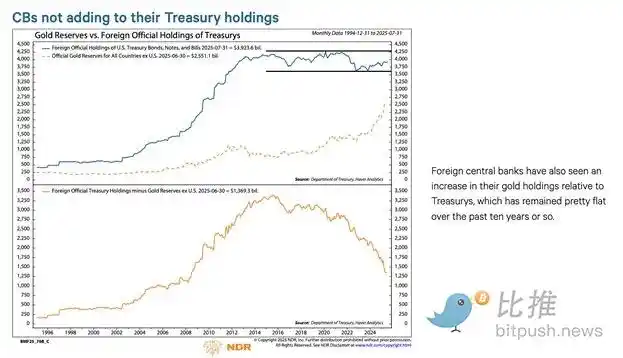
If the "Land of the Free" is willing to pilfer funds from Russia (a nuclear power and the world's largest commodity exporter), then any foreign holder of U.S. Treasuries cannot be assured of safety. Foreign central bank reserve managers, aware of the risk of expropriation, would rather buy gold than U.S. treasuries. Therefore, since Russia invaded Ukraine in February 2022, gold prices have truly skyrocketed.
2. U.S. Private Sector
According to data from the U.S. Bureau of Labor Statistics, the personal saving rate in 2024 is 4.6%. In the same year, the U.S. federal deficit accounts for 6% of GDP. Given that the deficit is larger than the savings rate, the private sector cannot be the marginal buyer of Treasury bonds.
3. Commercial Banks
Are the four major currency center commercial banks heavily purchasing U.S. Treasuries? The answer is yes.
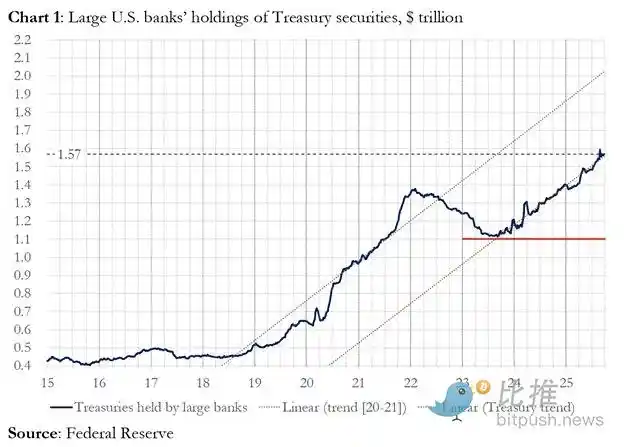
In the 2025 fiscal year, the four major central banks purchased approximately $300 billion worth of US treasuries. In the same fiscal year, the Treasury Department issued $1.992 trillion in US treasuries. While these buyers are undoubtedly significant purchasers of treasuries, they are not the ultimate marginal buyers.
4. Relative Value (RV) Hedge Funds
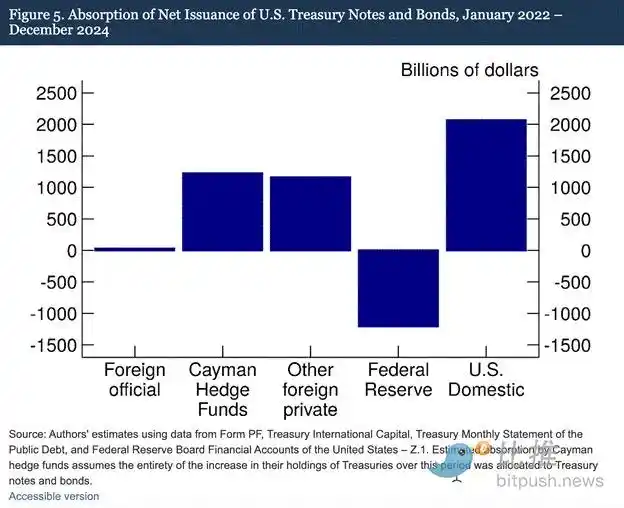
RV funds are marginal buyers of government bonds, a fact acknowledged in a recent Federal Reserve document.
Our findings indicate that Cayman Islands hedge funds are increasingly becoming marginal foreign buyers of US treasuries and bonds. As shown in Figure 5, from January 2022 to December 2024—a period during which the Federal Reserve reduced its balance sheet by allowing maturing US treasuries to roll off—Cayman Islands hedge funds net purchased $1.2 trillion in treasuries. Assuming these purchases were all in treasuries and bonds, they absorbed 37% of the net issuance of treasuries and bonds, nearly equivalent to the sum of all other foreign investor purchases.
RV Fund Trading Mechanism:
· Buy spot treasury bonds
· Sell corresponding treasury bond futures contracts
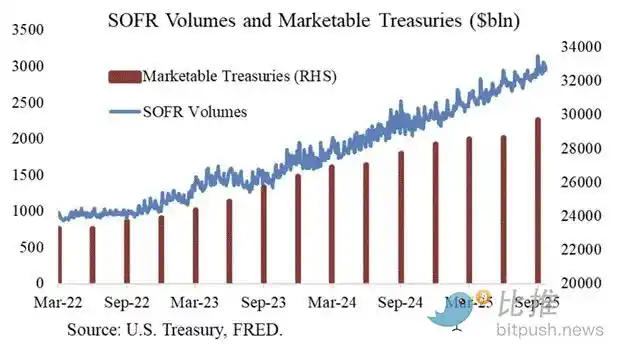
Special thanks to Joseph Wang for providing the chart. SOFR trading volume serves as a proxy measure of RV fund participation in the treasury market. As you can see, the growth in debt issuance corresponds to an increase in SOFR trading volume. This indicates that RV funds are marginal buyers of treasuries.
RV funds engage in this trade to earn a small spread between the two instruments. Due to the minuscule size of this spread (measured in basis points; 1 basis point = 0.01%), the only way to make money is to finance the treasury purchases.
This leads us to the most crucial part of this article: understanding the Federal Reserve's next move—how do RV funds finance their treasury purchases?
Part Four: Repurchase Market, Implicit Quantitative Easing, and Dollar Creation
The RV Fund finances its Treasury purchases through a repurchase agreement (repo). In a seamless transaction, the RV Fund uses the purchased Treasury securities as collateral to borrow overnight cash, then settles the Treasury in cash using this borrowed amount. If cash is plentiful, the repo rate will trade at a level below or exactly at the Upper Federal Funds Rate Cap. Why?
How the Fed Manipulates Short-Term Rates
The Fed has two policy rates: the Upper Federal Funds Rate and the Lower Federal Funds Rate; currently at 4.00% and 3.75%, respectively. To forcefully keep the effective short-term rate (SOFR, i.e., Secured Overnight Financing Rate) within this range, the Fed deploys the following tools (sorted by rate from low to high):
· Overnight Reverse Repurchase Facility (RRP): Money Market Funds (MMFs) and commercial banks deposit cash here overnight, earning interest paid by the Fed. Incentive Rate: Lower Federal Funds Rate.
· Interest on Reserves Balances (IORB): Commercial banks earn interest on excess reserve balances held at the Fed. Incentive Rate: Between the Upper and Lower limits.
· Standing Repo Facility (SRF): Allows commercial banks and other financial institutions to pledge eligible securities (mainly U.S. Treasuries) and receive cash from the Fed when cash is tight. Essentially, the Fed prints money in exchange for collateral securities. Incentive Rate: Upper Federal Funds Rate.
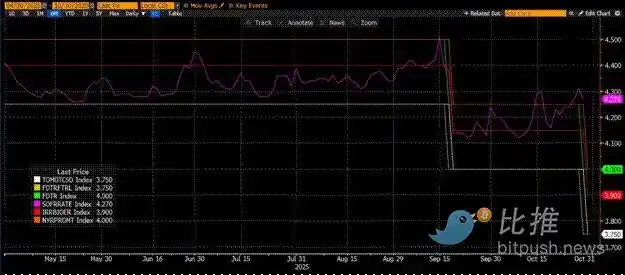
Relationship among the three:
Lower Federal Funds Rate = RRP < IORB < SRF = Upper Federal Funds Rate
SOFR (Secured Overnight Financing Rate) is the Fed's target rate, representing a composite rate of various repo transactions. If the SOFR transaction price trades above the Upper Federal Funds Rate, it indicates a systemic cash crunch, triggering significant issues. Once there is a cash crunch, SOFR will spike, and the highly leveraged fiat financial system will seize up. This is because if marginal liquidity providers can't roll their liabilities near the predictable Federal Funds Rate, they will suffer massive losses and stop providing liquidity to the system. No one will buy Treasuries because they can't obtain cheap leverage, causing the U.S. government to be unable to finance at an affordable cost.
Exit of Marginal Liquidity Providers
What is causing the SOFR transaction price to exceed the upper limit? We need to examine the marginal cash providers in the repo market: Money Market Funds (MMFs) and commercial banks.
· Money Market Fund (MMF) exodus: The goal of MMFs is to earn short-term interest with minimal credit risk. Previously, MMFs would withdraw funds from RRP and redirect them to the repo market because RRP < SOFR. However, now, due to the highly attractive yield of short-term Treasury bills, MMFs are withdrawing funds from RRP and lending to the US government instead. The RRP balance has been reduced to zero, and MMFs have essentially exited the cash supply of the repo market.
· Commercial banks' constraints: Banks are willing to provide reserves to the repo market because IORB < SOFR. However, the ability of banks to provide cash depends on whether their reserves are sufficient. Since the Fed began quantitative tightening (QT) in early 2022, banks' reserves have decreased by trillions of dollars. Once the balance sheet capacity shrinks, banks are forced to charge higher rates to provide cash.
Starting in 2022, both marginal cash providers, MMFs and banks, have less cash to supply to the repo market. At some point, neither is willing or able to provide cash at a rate below or equal to the federal funds rate upper limit.
Meanwhile, the demand for cash is rising. This is because both former President Biden and current President Trump continue to spend lavishly, requiring more issuance of Treasury bonds. The marginal buyers of Treasury bonds, RV funds, must fund these purchases in the repo market. If they cannot obtain daily funding at a rate below or slightly below the federal funds rate upper limit, they will stop buying Treasuries, and the US government will not be able to finance itself at affordable rates.
SRF Activation and Stealth QE
Due to a similar incident in 2019, the Fed established the SRF (Standing Repo Facility). As long as acceptable collateral is provided, the Fed can provide unlimited cash at the SRF rate (i.e., the federal funds rate upper limit). Therefore, RV funds can rest assured that no matter how tight cash may be, they can always get funding at the worst-case scenario—the federal funds rate upper limit.
If the SRF balance is above zero, we know that the Fed is cashing the politicians' checks with freshly printed money.
Treasury Issuance = Increase in Dollar Supply
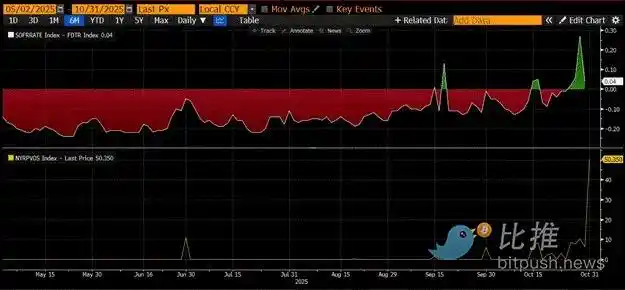
The top panel in the chart above shows the difference (SOFR - Federal Funds Rate Ceiling) . When this difference approaches zero or is positive, cash is tight. During these periods, SRF (bottom panel, in billions of dollars) is used non-trivially. Using the SRF can help borrowers avoid paying a higher, less manipulated SOFR rate.
Stealth QE: The Fed has two ways to ensure there is enough cash in the system: one is by creating bank reserves through buying bank securities, known as Quantitative Easing (QE). The other is by freely lending to the repo market through SRF.
QE is now a "dirty word," commonly associated with money printing and inflation. To avoid being accused of triggering inflation, the Fed will strive to claim that its policy is not QE. This means that the SRF will become the primary channel for money printing into the global financial system, rather than creating more bank reserves through QE.
This can only buy some time. However, eventually, the exponential expansion of Treasury issuances will force repeated use of the SRF. Remember, Treasury Secretary Buffalo Bill Bessent not only needs to issue $2 trillion annually to fund the government but also needs to roll over trillions in maturing debt.
Stealth QE is about to begin. While I don't know the exact timing, if the current money market conditions persist, with a mountain of Treasury issuance, the SRF balance as the lender of last resort must grow. As the SRF balance grows, the global supply of USD fiat will also expand. This phenomenon will reignite the Bitcoin bull market.
Part Five: Current Market Stagnation and Opportunities
Before the onset of Stealth QE, we must control capital. Expect the market to continue to be volatile, especially until the U.S. government shutdown concludes.
Currently, the Treasury borrows money through debt auctions (USD liquidity negative), but has not spent this money (USD liquidity positive). The Treasury General Account (TGA) balance is about $150 billion above the $850 billion target, and this additional liquidity will only be released into the market once the government reopens. This liquidity siphon effect is one of the reasons for the current weakness in the crypto market.
Given the upcoming four-year cycle anniversary of Bitcoin's all-time high in 2021, many mistakenly interpret this period of market weakness and fatigue as the top and sell their holdings. Of course, provided they were not "deaded" in the altcoin rug pull a few weeks back.
But that's a misconception. The operating logic of the US dollar money market does not lie. This corner of the market is shrouded in obscure terms, but once you translate these terms into "printing money" or "destroying money," you can easily understand how to grasp the trend.
You may also like

Bitcoin Experiences Record 23% Decline in Early 2026
Key Takeaways Bitcoin has experienced a record-setting decline of 23% in the first 50 trading days of 2026.…

Whale Holding 105,000 ETH Faces $8.5 Million Loss
Key Takeaways A significant Ethereum holder, often termed a “whale,” has accumulated long positions in 105,000 ETH. The…

Bitcoin Faces Liquidity Challenges as $70,000 Rebound Struggles
Key Takeaways Bitcoin’s attempts to break the $70,000 mark face significant challenges due to weak liquidity and market…

Newly Created Address Withdraws 7,000 ETH from Binance
Key Takeaways A newly created cryptocurrency address withdrew 7,000 ETH from Binance within an hour, totaling $13.55 million.…

Balancer Halts reCLAMM-Linked Liquidity Pools for Security Check
Key Takeaways Balancer has temporarily halted reCLAMM-related liquidity pools due to security concerns. A report from the bug…

Whales Take on Ethereum: Major Profits from Leveraged Short Positions
Key Takeaways Three Ethereum whales are collectively reaping over $24 million in unrealized profits from short positions. The…

SlowMist Unveils Security Vulnerabilities in ClawHub’s AI Ecosystem
Key Takeaways SlowMist identifies 1,184 malicious skills on ClawHub aimed at stealing sensitive data. The identified threats include…

Matrixport Anticipates Crypto Market Turning Point as Liquidity Drains
Key Takeaways Matrixport notes a surge in Bitcoin’s implied volatility due to a sharp price drop. Bitcoin price…

Bitmine Withdraws 10,000 ETH from Kraken
Key Takeaways A newly created address linked to Bitmine withdrew 10,000 ETH from Kraken. The withdrawal value amounts…

In the face of the Quantum Threat, Bitcoin Core developers have chosen to ignore it

Don't Just Focus on Trading Volume: A Guide to Understanding the "Fake Real Volume" of Perpetual Contracts
Crypto Price Prediction Today 18 February – XRP, Bitcoin, Ethereum
Key Takeaways XRP’s potential as a replacement for SWIFT is bolstered by regulatory approvals, potentially driving its price…

XRP Price Prediction: XRP is Outpacing Solana and Targeting Binance Coin Next – Should You Invest Now?
Key Takeaways XRP Ledger has moved into the sixth place by tokenized real-world asset value, surpassing Solana and…

New AI Predicts the Price of XRP, Dogecoin, and Solana By 2026
Key Takeaways ChatGPT anticipates significant price increases for XRP, Dogecoin, and Solana by the end of 2026. XRP…

Arthur Hayes Shares Two Scenarios for Bitcoin Price, Calling for a Major Crypto Rally
Key Takeaways Arthur Hayes predicts a significant crypto rally fueled by a $572 billion liquidity injection from the…

Bitcoin Price Prediction: Abu Dhabi Gov Funds Buy $1 Billion in BTC – What Do They Know?
Key Takeaways Abu Dhabi has revealed a $1 billion stake in Bitcoin through major ETF investments, signaling strong…

Bitcoin’s Divergence From Nasdaq Signals Dollar Liquidity Risk, Says Arthur Hayes
Key Takeaways Arthur Hayes highlights a concerning divergence between Bitcoin and the Nasdaq, pointing to a potential dollar…
Lagarde’s Possible Early Exit Could Alter Digital Euro Plans and Stablecoin Oversight
Key Takeaways Christine Lagarde’s potential departure as ECB president may disrupt the digital euro timeline and stablecoin policies.…
Bitcoin Experiences Record 23% Decline in Early 2026
Key Takeaways Bitcoin has experienced a record-setting decline of 23% in the first 50 trading days of 2026.…
Whale Holding 105,000 ETH Faces $8.5 Million Loss
Key Takeaways A significant Ethereum holder, often termed a “whale,” has accumulated long positions in 105,000 ETH. The…
Bitcoin Faces Liquidity Challenges as $70,000 Rebound Struggles
Key Takeaways Bitcoin’s attempts to break the $70,000 mark face significant challenges due to weak liquidity and market…
Newly Created Address Withdraws 7,000 ETH from Binance
Key Takeaways A newly created cryptocurrency address withdrew 7,000 ETH from Binance within an hour, totaling $13.55 million.…
Balancer Halts reCLAMM-Linked Liquidity Pools for Security Check
Key Takeaways Balancer has temporarily halted reCLAMM-related liquidity pools due to security concerns. A report from the bug…
Whales Take on Ethereum: Major Profits from Leveraged Short Positions
Key Takeaways Three Ethereum whales are collectively reaping over $24 million in unrealized profits from short positions. The…


 App
App