
- Buy Crypto
- Markets
 Futures
- Spot
- Copy Trade
- Earn
- More
AI Payments Through the Lens of Fintech Giants: Five Levels, Stablecoin Infrastructure, Next-Gen Globalized Commerce

By Sleepy.txt
On February 25th, Stripe released an annual public letter.
By 2025, the total transaction volume flowing through the Stripe payment network reached $19 trillion, equivalent to 1.6% of global GDP, surpassing a year's GDP of Australia. However, Stripe's founders, the Collison brothers, did not use this annual letter to boast about performance; instead, they discussed the industrial revolution, the Nobel Prize in Economics, and black hole physics.
Why would a payment company talk about these things? What is it really trying to say?
Stripe believes that a war over "who will build the next generation of global business infrastructure" has quietly begun. And they aim to be the ones setting the rules. This letter is their call to arms, a proclamation written to CEOs and entrepreneurs worldwide.
This Machine is Accelerating
Stripe sees this as a critical moment because the machine called the "market" is operating at an unprecedented speed.
The purpose of this machine is not to make everyone prosperous, but to ruthlessly sift profits, capital, and talent, redistributing them to the most productive companies. In the past, this machine ran slowly, and everyone had a share. But now, AI has equipped this machine with a new engine.
In the letter, Stripe cited a set of data: the most profitable 1/3 of publicly traded US companies took 2/3 of the entire stock market's value, the highest proportion since data has been available since 1963. JPMorgan also described the winner-takes-all situation in its early 2026 outlook, highlighting the state of over-concentration in the market. The top 10% of companies in the S&P 500 contributed 59% of the profits.
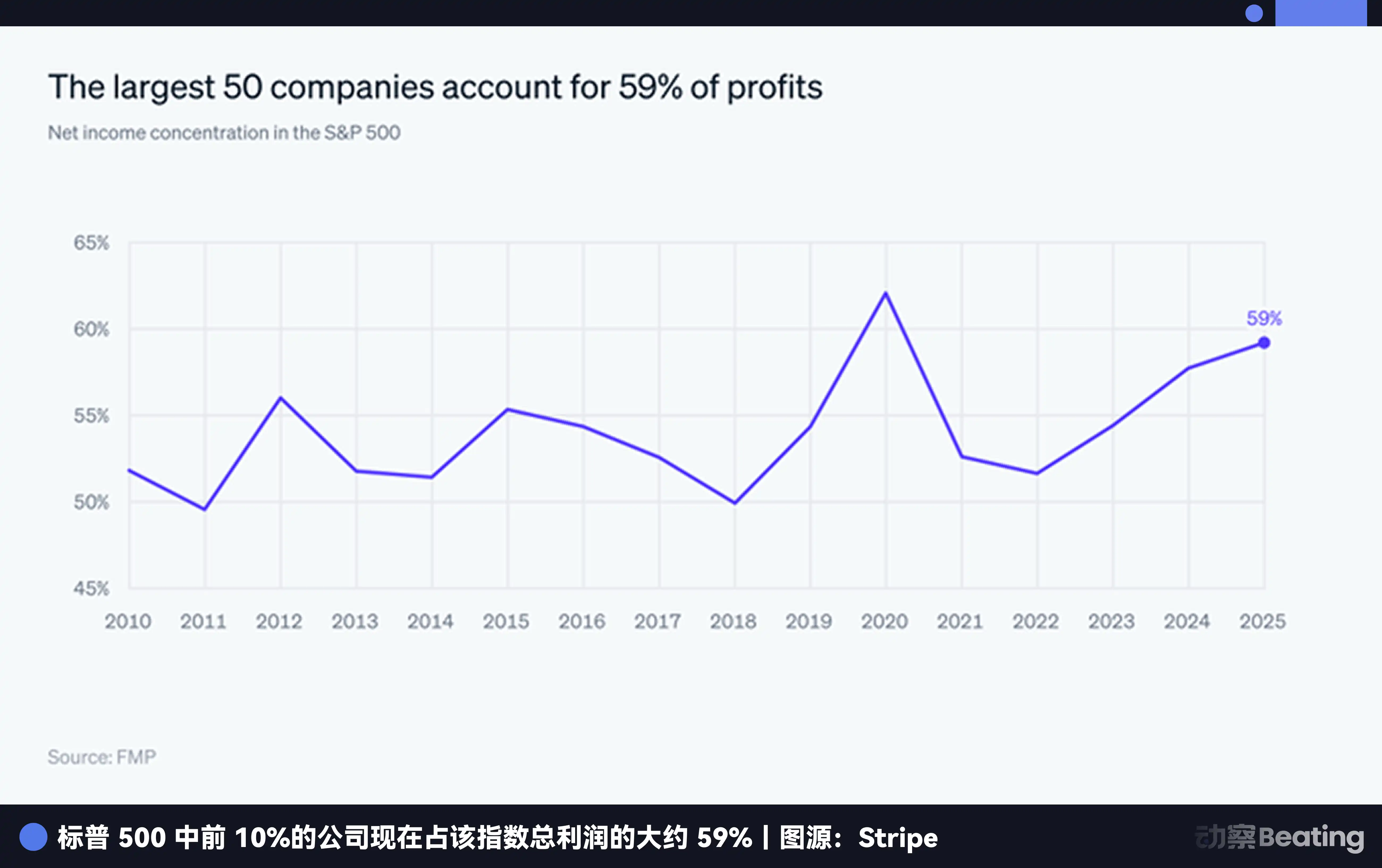
This differentiation is not only between small and large companies but also a life-and-death struggle within industries. The letter gave examples from various industries; let's provide some context:
Retail: In the past 3 years, offline physical retail sales, adjusted for inflation, have only grown by 5%, while e-commerce has grown by 30% during the same period. This means that if you are a pure offline retailer, you may feel like your business is still holding on, but in reality, you have already been left behind by the times.
Aviation: The two giants, Delta Air Lines and United Airlines, almost took all the profits of the US aviation industry in 2025. The other airlines are struggling for survival.
Healthcare Industry: The profit share of traditional hospitals and insurance companies is expected to shrink significantly, while the EBITDA (Earnings Before Interest, Taxes, Depreciation, and Amortization) of the healthcare technology sector is projected to exceed $110 billion by 2029. Money is flowing from the old model to the new model.
On a more macro level, the demand for software, computing, and data centers has been driving nearly half of the US GDP growth by 2025. We used to say software was eating the world, now it's compute power driving growth. Industries that are not leveraging compute power and software are having a harder time every day.
Let's look at some more data on "entrepreneurship." The number of code commits on GitHub surged by 41% in 2025 (previously growing at an average of only 10-12% per year), iOS App releases saw a 60% year-over-year increase in December, and the number of companies achieving $10 million in annualized revenue within three months doubled.
AI is pushing entrepreneurial speed to the extreme.
Stripe's own company formation service, Stripe Atlas, also saw a 41% increase in registrations in 2025, and 20% of new Atlas companies received their first payment within 30 days, a proportion that was only 8% in 2020.
They also introduced Claimable Sandboxes, allowing developers to deploy a Stripe account directly from AI programming tools like Vercel and Replit with a single click. Over 100,000 sandboxes have been created using this method. This means that from ideation to code to first payment, the entire process for a developer has been compressed to an unprecedented short.
Sorting machines are accelerating, new species are emerging in large numbers, and they are global from birth. This leads to the next question: these new species are born global, but can they really receive global payments?
Products Without Borders, Money With Borders
The answer is definitely no.
The internet has made information and products borderless, but the flow of money is still hindered by invisible barriers. This is the biggest structural contradiction in current global business and also the most critical battlefield for Stripe.
What was past globalization like? It took Coca-Cola 20 years to bottle the first soda in Cuba; McDonald's and Starbucks took 27 and 16 years, respectively, to open their first stores in Canada. In the internet age, Facebook took 5 years to support international currencies, and Google took 4 years to receive its first pound of ad revenue.
But now, the strategy of first dominating the domestic market and then seeking overseas expansion is no longer popular.
Today's AI products, from the day of their inception, have had the entire internet as their "domestic market," with global simultaneous releases covering all markets in a second. However, even though their customers are global, their ability to receive payments is severely restricted by national borders.
Behind the flow of funds is an infrastructure built on the nation-state system—SWIFT, central bank clearing systems, local payment licenses, foreign exchange controls, and anti-money laundering compliance. This system was designed for money to flow within a country, not for money to flow on the internet.
When a developer wants to sell their software online, they need to apply for a merchant account, a process that may take weeks; they need to integrate a payment gateway, which requires writing a lot of code; they need to deal with different currencies, involving complex foreign exchange calculations; they need to comply with regulations in each country, requiring a legal team. For a small team of only two or three people, this is almost an impossible task.
Stripe's founders, the Collison brothers, have firsthand experience with this.
In 2007, when they were still Irish teenagers, they founded their first company, Auctomatic, a software that provided management tools for eBay sellers. They quickly realized that the hardest part was not writing code or finding customers, but figuring out how to receive money from customers around the world.

At that time, they only had two options: either to use PayPal, which was extremely unfriendly to developers and could randomly freeze accounts, or to deal with banks, which was even more cumbersome.
It was precisely because of this that Stripe was born. What they wanted to do was to take online payments, which were a complex, licensed, friction-filled process, and make it as simple as calling an API.
Stripe's success is also due to its focus on this pain point. They handled all the complex backend work themselves, such as dealing with banks, credit card organizations, regulatory bodies, and then provided developers with an extremely simple interface. Developers no longer need to worry about those tedious complexities; they only need to focus on their product.
However, even Stripe cannot completely break down this wall. The open letter mentioned that Stripe's issuing product, after 7 years of being released, only covered 22 countries. Fintech companies themselves are ironically the slowest to globalize—Chime in the US has been around for 12 years and is still confined to the US, while Brazil's Nubank took 6 years to expand beyond Brazil.
But the demand is there. The AI-powered presentation tool Gamma, born in California, saw a direct 22% surge in Indian revenue for the month after enabling UPI payments in India through Stripe. This case demonstrates that once the infrastructure is in place, pent-up demand can instantly explode. Stripe's data also confirms this, showing that for companies whose primary revenue comes from overseas, 30% of that revenue comes not from their domestic market or from top ten economies like the US, China, Japan, or Germany, but from those small, often overlooked countries.
So, if the old financial infrastructure was designed for the old world, how can we break down this wall?
Stablecoins, a Narrative Independent of Cryptocurrency
Stablecoins may no longer be considered cryptocurrency. They represent a new global payment infrastructure, making money flow on the internet as naturally as data.
By 2025, during a crypto winter where Bitcoin's price plummeted by 50%, stablecoin transaction volume doubled to $400 billion, with 60% being used for B2B payments. This was referred to as the "Stablecoin Summer" by Stripe. People were no longer just using it for speculation but for actual business transactions.
Transaction volume on Bridge, a stablecoin platform acquired by Stripe, increased by over 4 times. A YC founder can now raise funds using stablecoins, earn interest in Stripe's financial account, and use it to pay engineers anywhere globally. This was unimaginable in the past.
In a more dramatic turn, the CEO of Swedish fintech giant Klarna, once a prominent cryptocurrency skeptic, now leads the first bank to issue a stablecoin on Stripe's Tempo testnet, aiming to reduce cross-border settlement costs.
Stripe predicts that future business will be conducted by AI agents and will require a blockchain capable of supporting one billion transactions per second. However, the existing blockchain infrastructure cannot yet support this future. Therefore, Stripe has ventured to create its own blockchain, Tempo.
Tempo is focused on payments, offering sub-second confirmation, optional privacy, and interoperability with compliance systems. Visa, Nubank, and Shopify are already testing it in various scenarios. Stripe has also introduced Financial Accounts, which covered over 100 countries on its first day, marking the first truly global financial product.
Stripe's ambition is to become the TCP/IP protocol of this new infrastructure. What it wants to do is not just patch up the old pipe system, but to build an entirely new global payment network designed for the internet native.
Most Companies Are Burning Money in Vain
Stripe mentioned in the letter: Most companies are living in a "low-revenue mode," wasting a lot of money in the payment process every day.
What is a low-revenue mode? It means that the payment infrastructure is not optimized, wasting money on conversion rates, authorization rates, and fraud prevention. What is a high-revenue mode? Stripe provided several real-life examples:
Microsoft evaluates the performance of payment service providers monthly, continuously optimizes the authorization rate, and significantly increases revenue.
After Gatwick Airport switched its payment system to Stripe, the payment success rate increased by 2.5 percentage points. This number may seem small, but multiplied by tens of millions of transactions per year, it is a significant cost.
Credit-scoring company FICO, through A/B testing, fully switched to Stripe, increasing the authorization rate by 1 percentage point.
Remote healthcare company Ro, after using Stripe, saw a 2% increase in authorization rate and a 3% decrease in dispute rate, earning tens of millions of dollars more annually.
These cases illustrate that payment optimization is a must-do.
Another problem that companies face is difficulty in financing. Since the 2008 financial crisis, global small business credit has been continuously tightening. Small business loans in Ireland plummeted by 66%, loans under $1 million in the United States decreased by 5%, and OECD countries' GDP growth rate dropped from an annual average of 2.8% to 1.0%. Traditional banks are unwilling to lend to small businesses because they lack sufficient data to assess risk, and approval costs are high.
The logic behind Stripe Capital is, I have all your transaction data, I understand your business better than any bank. It leverages merchants' real-time transaction data to lend money, bypassing the cumbersome approval process of traditional banks. Companies that receive financing from Stripe Capital have a growth rate in the following year that is 27 percentage points faster than similar companies that did not receive it, with the fastest tier even growing more than three times as fast.
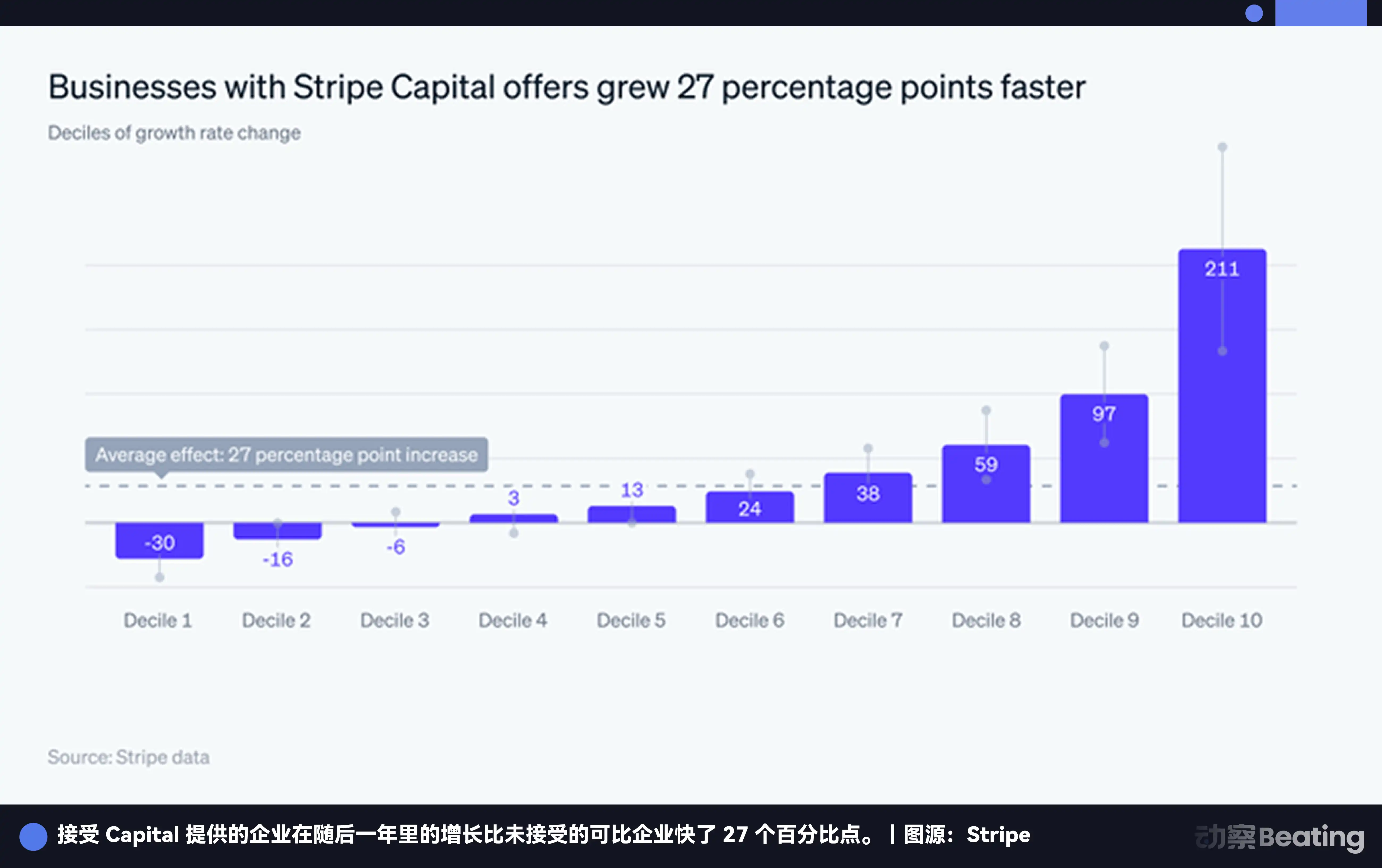
Stripe is transforming itself from just a payment tool into a business operating system. It not only helps you collect payments but also helps you with financing, issuing cards, financial management, and fraud prevention. It wants to become a company's financial brain, not just a payment terminal.
However, these are all issues in the world of human decision-making and human shopping. But what if decision-making and shopping become tasks for AI agents? What would this evolving infrastructure look like?
The Arrival of AI Agents: Who Will Be Their Wallet?
When AI agents become new consumer entities, the entire payment infrastructure needs to be redesigned, and this design authority will determine the next generation of business rules.
What is Agentic Commerce? Simply put, when AI is intelligent enough, it is no longer just a search tool but an agent that can be authorized to perform tasks on your behalf. You tell it, "Book me a window seat, best value flight to Shanghai next Tuesday," and it will compare prices, place the order, make the payment, all without your intervention.
We are on the eve of this new world's outbreak. Just like the mid-1990s internet, fundamental protocols like HTTP, HTML, DNS are taking shape amidst chaos, and no one knows which protocol will win, with AltaVista being there just like Google. It's the same now; no one knows who will become the "HTTP" of agentic commerce.
Stripe has divided the evolution of agentic commerce into five levels:
L1 is eliminating web forms; AI can help you automatically fill in those annoying registration, login, and payment forms;
L2 is descriptive search; you can tell AI in natural language what you want, and it will find and present results for you;
L3 is persistent memory; AI remembers all your preferences and history;
L4 is authorized delegation; you can authorize AI to autonomously make purchase decisions within a certain limit;
L5 is proactive prediction; AI can even arrange everything for you before you realize what you need.
Stripe believes we are currently on the edge of L1 and L2. Once we cross over to L3 and L4, the nature of business will be completely overturned. When thousands of AI agents transact on the internet on behalf of humans, they will need their wallet and their own payment protocols.
This is the future that Stripe is vying for. They have collaborated with OpenAI to develop the agentic commerce protocol, partnered with Microsoft to provide payment capabilities for its Copilot, and launched the Agentic Commerce Suite, allowing brands like Etsy and Coach to integrate once and sell to AI agents across multiple AI platforms. They have even introduced a feature called Machine Payments, enabling AI agents themselves to become a new type of paying customer, meaning not only do humans use AI to shop, but AI can also pay other AIs.
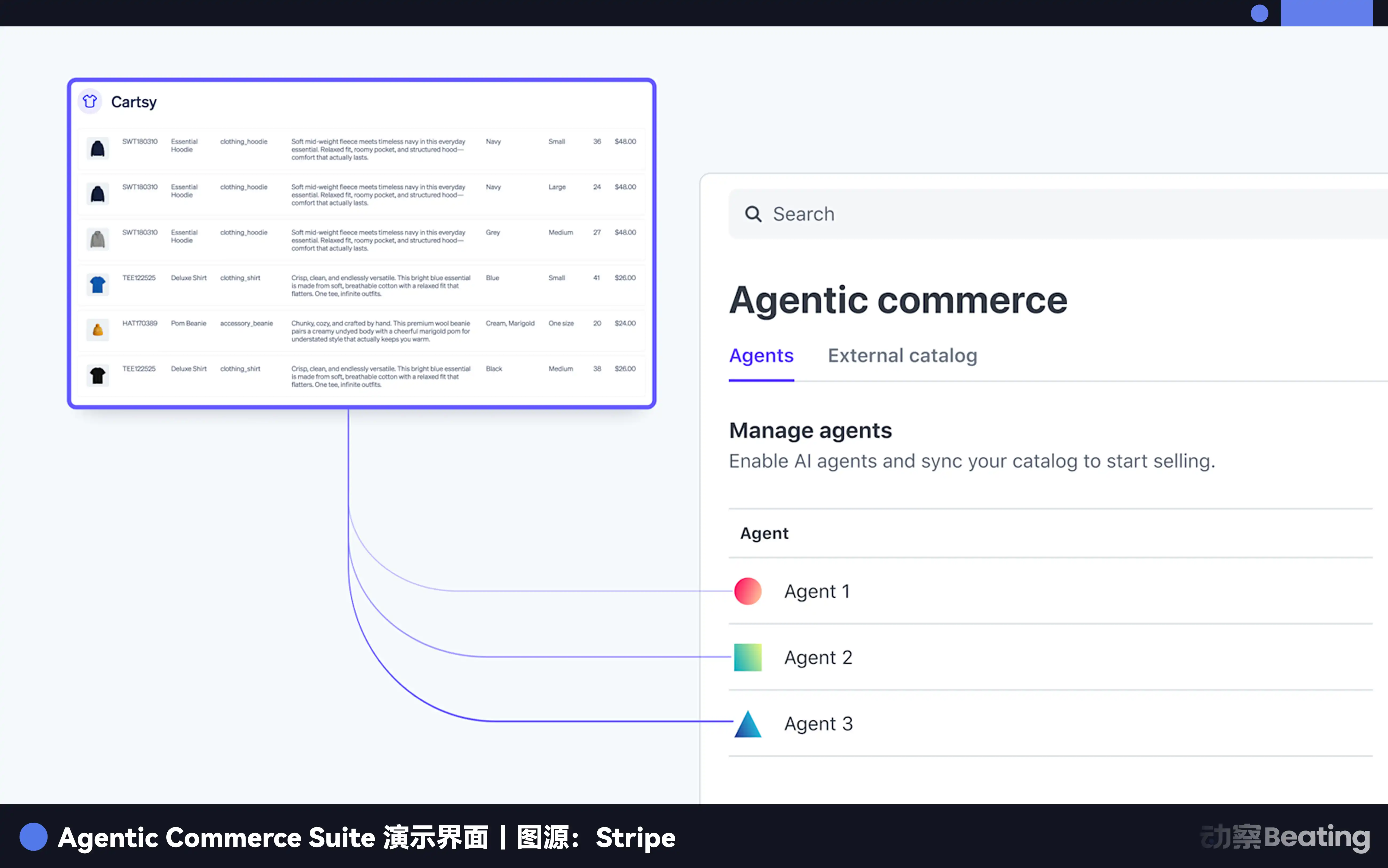
When AI agents become the new consumer, Stripe wants to be the one providing the wallet and payment protocol for them, a battlefield much larger than payment processing itself.
Technological barriers, whether in cross-border payments or AI agent wallets, are being systematically tackled by Stripe. But there is an older, more stubborn wall standing in front of all these possibilities.
The Final Enemy
A Republic of Permissions. This is the conclusion Stripe reaches at the end of its letter, quoting Nobel laureate and economic historian Joel Mokyr's theory from 2025, making a judgment rarely voiced by a commercial firm: what hinders all of this is not technology, but a system—comprised of regulators, committees, and courts—that, under the guise of "preventing bad things from happening," systematically suffocates "good things from happening."
Mokyr's core argument is that the Industrial Revolution happened in 18th-century Britain not just because there was coal and steam engines, but because the country's political and social culture at the time fostered an improvement mindset that encouraged innovation and commercial risk-taking. Throughout history, countless new technologies have failed not because the technology itself was lacking but because they were suffocated by non-market aggregators such as governments, guilds, and churches.
Stripe believes that today we live in a vast Republic of Permissions. It provides a critical list:
In AI drug discovery, while AI can now accomplish protein folding predictions that previously took years in a matter of weeks, the speed of bringing new drugs to market is still hindered by slow clinical trial processes, averaging over 10 years.
Entrepreneurs in Europe are constrained by the cumbersome provisions of the EU AI Act, where a small AI startup may need to invest significant time and money to meet compliance requirements rather than focus on product development.
Next-generation, safer, more efficient nuclear energy technologies are held back by rigid veto-based regulation, preventing deployment despite the increasing urgency of climate change.
Waymo's self-driving cars are being stymied by local regulations in San Francisco, impeding progress even though data shows they are safer than human drivers.
However, Stripe is not entirely pessimistic. It also provides examples of those thriving in the gaps:
France's Mistral AI and Italy's Bending Spoons have grown into world-class AI companies in Europe's stringent regulatory environment;
Rwanda's Zipline and the US's Varda have painstakingly sought permission inch by inch in the tightly regulated fields of drone delivery and space manufacturing, opening up new business models;
The US's Spring Health and Maven Clinic have used software and data to improve efficiency in the most conservative industry of healthcare, transforming the way mental health and women's health services are delivered.
This is not only Stripe's deepest concern but also the heaviest undertone of this letter. It likens the current AI transformation to the process of falling into a black hole. At the moment you cross the "event horizon," you feel nothing, but your future has undergone an irreversible change. Stripe believes that we are on the eve of a "different, and hopefully better singularity."
In the final words of this letter, Stripe offers no optimistic assurances or pessimistic predictions. It simply states that the market's sorting machine will not stop; it will only spin faster. Whether you become the winner selected by the machine or the redundant data ruthlessly discarded depends on how you respond now.
Emerging from the small village of Dromineer in Ireland with only 102 inhabitants, Stripe has transformed seven lines of code into a business empire that accounts for 1.6% of global GDP flow in just fifteen years. Its next step is to define the next generation of global business rules.
You may also like

From Mining Enterprise to Infrastructure Builder, Bitdeer Unpacks the Survival Logic behind BTC

How Can Agentic Commerce Empower AI to Start Making Money?

February Correction: Is the Crypto Market Bottoming Out?

Zuckerberg Retweets Stablecoin, Can Meta Win This "Comeback Game"?

Polymarket New Rule Release: How to Build a New Trading Bot

Bitwise: The Institutional Wave is Here, So Why is the Market Still Sleeping?

WEEX LALIGA Partnership 2026: Where Football Excellence Meets Crypto Innovation
WEEX becomes official crypto exchange partner of LALIGA in Hong Kong and Taiwan. Discover how this partnership brings together football excellence and trading discipline.

AI Apocalypse, a massive short squeeze

The "Second Truth" of the Luna Crash: Jane Street Exits Ahead of Plunge

Jane Street Market Manipulation, Stripe Considering Acquiring PayPal, What's the Overseas Crypto Community Talking About Today?

WEEX × LALIGA 2026: Trade Crypto, Take Your Shot & Win Official LALIGA Prizes
Unlock shoot attempts through futures trading, spot trading, or referrals. Turn match predictions into structured rewards with BTC, USDT, position airdrops, and LALIGA merchandise on WEEX.
a16z: Why Do AI Agents Need a Stablecoin for B2B Payments?

February 24th Market Key Intelligence, How Much Did You Miss?

Web4.0, perhaps the most needed narrative for cryptocurrency
Some Key News You Might Have Missed Over the Chinese New Year Holiday

Key Market Information Discrepancy on February 24th - A Must-Read! | Alpha Morning Report

$1,500,000 Salary Job: How to Achieve with $500 AI?



 App
App