
- Buy Crypto
- Markets
 Futures
- Spot
- Copy Trade
- Earn
- More
80% is Hype? Six Major Red Flags to See Stable's True Intent

Editor's Note: Recently, Stable completed two significant rounds of presale events in a short period of time. The initial allocation of 8.25 billion USD was quickly sold out, and the second round saw qualified subscriptions surpassing 11 billion USD, attracting high industry attention.
However, behind the impressive data, there are also backgrounds that need to be clarified. The project is driven by key figures from Tether, with USDT as the native asset forming a strong peg. The presale allocation is highly concentrated among early institutions and insiders. Moreover, from the enactment of the "GENIUS Act" to the accelerated project development, the timing between the two is overly tight.
This article attempts to present a more complete picture beyond the hype, addressing what infrastructure problems it is solving, who benefited in the early stages, where the risks lie, and why this issuance is worth careful scrutiny beyond the surface.
The following is the translation of the original text.
TL;DR: Overview
Stable project swept the field with a TVL of 8.25 billion USD in the first phase, completing the raise in just 20 minutes, and has recently launched the public testnet. However, behind this frenzy, there are some uncomfortable issues: risks brought by the high concentration of stablecoins, insider positioning in advance, and whether this project is actually solving payment issues or just creating a new batch of "bagholders." Below is an attempt at an honest interpretation:
What is the project?
A Layer 1 based on USDT as the native asset, backed by Tether insiders—but who is really benefiting?
Key Data:
Raised 28 million USD in seed funding, presale size of 8.25 billion USD (snatched up in 20 minutes—was it too fast?); the public testnet is live, but the mainnet is still weeks away from launch, and early insiders are already preparing to exit.
Core Narrative:
Stablecoins need a new payment rail, but the current design of Stable is more favorable to those who got in early, putting retail investors at a clear "disadvantageous" position.
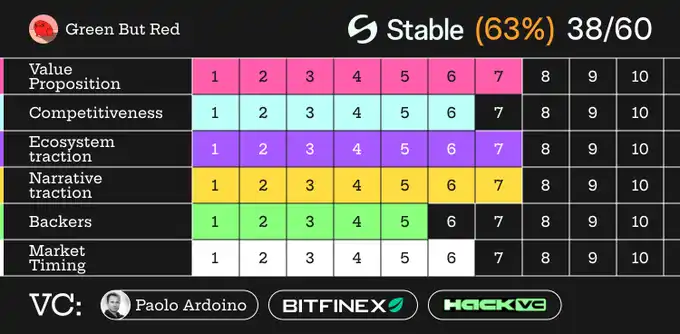
Value Proposition: 7/10
What problem is it actually solving:
Using USDT as gas does eliminate the hassle of dealing with two different tokens, which is a valid point. But there is a blunt question: Do users really care about this, or are they mainly chasing after the high yields of yield farming?
Honest Assessment:
It does indeed address a real issue (gas fees for stablecoin transfers), but on Solana / Polygon, a single $100,000 transfer has long been achievable for less than $1 in fees. Tether's USDT0 cross-chain mechanism can achieve a similar effect without needing to create a new L1 chain. The so-called "pain point" may not be as significant as marketing makes it out to be
Truly Valuable Aspect:
It seems more like a payment infrastructure for institutions rather than a retail-side payment innovation.
But the current structure is: Retail investors handle speculation, while institutions take away the value at the protocol layer.
Six Key Red Flags
Red Flag 1: Solving for the Sake of Solving; the Problem Isn't That Painful
USDT transfers are already very cheap, with fees generally less than $1 on @Solana. So why specifically launch a brand-new L1 chain just to further reduce fees by 10–20%?
Competitive Landscape: 6/10
Real Competitive Environment:
@Plasma ($XPL): Similar narrative, smaller funding scale, but with a different tokenomics design
@Solana + $USDT: USDT daily trading volume has already reached the $5 billion level, with low friction usage
@LayerZero_Core / $USDT0: Transferring USDT can be accomplished through existing cross-chain infrastructure, avoiding the need for a new chain
Why Stable isn't Indestructible:
First-mover advantage does exist, but can be replicated within 6 months
If alternative solutions are equally usable, sustained network effects are challenging to accumulate
Validator high centralization (only about thirty major validators) implies significant centralization risk
Red Flag 2: Suspicious Timing
《GENIUS Act》 passed (June 2025)
→ @Tether_to suddenly accelerates new L1 in August 2025
→ Pre-sale oversubscribed by 39x in October 2025
This series of timing events looks like a pre-planned coordinated move.
Growth and Hype: 7/10
$8.25 Billion Pre-sale: Taking a Reality Check
Sold out in 20 minutes (more like FOMO than organic demand), with a high probability of 95% of funds coming from whales and insiders with advance knowledge, leaving almost no FOMO stage for retail investors due to the rapid fill-up. Funds are locked until mainnet launch, preventing early exits.
What these phenomena actually indicate:
Institutional interest is indeed present, but funds and chips are highly concentrated. Early insiders are likely to sell at mainnet launch, with retail investors likely entering at the peak of excitement.
Public Testnet Activity (Average):
Discord subscribers 600+ (not impressive for a project focusing on a new L1), developer activity remains to be observed (only two weeks since testnet launch). Real applications will not be rolled out until after mainnet launch, with no actual on-chain transaction volume data to refer to.
Red Flag 3: Pre-sale Structure Design
Funds are locked in a vault until mainnet launch, only unlocking upon open claim.
This is a classic 'Unlock-Dump' structure:
Early depositors naturally become the most motivated sellers when they can claim.
Narrative and Story: 7/10
Why the Story Sounds Compelling:
A clear regulatory framework (《GENIUS Act》) creates a sense of urgency that "if you don't get in now, you'll miss out"
Endorsed by @Tether_to, it looks like receiving official institutional approval at a higher level
There is indeed a gap in payment infrastructure objectively
From a chronological perspective, everything seems to have naturally fallen into place
The loophole in this narrative:
"USDT as gas" is not a disruptive innovation but rather an incremental improvement. The adoption of stablecoins itself does not rely on creating a new L1 chain; the real beneficiaries are insiders of the protocol rather than regular users.
The story told to retail investors remains the same: "Hold stablecoins and earn additional yield," which has already been a proven classic trap in the previous cycle
Red Flag 4: The regulatory story seems a bit too "over-the-top"
The "GENIUS Act" has just been passed, and immediately, a perfectly timed and unbeatable narrative USDT L1 emerges? Overall, it feels more like a transaction that was already structured waiting for regulatory approval, conveniently wrapped in a layer of compliance.
Supporter Score: 5/10
The Real Beneficiaries:
@paoloardoino (Tether CEO): If Stable becomes the mainstream payment rail, he is the most direct beneficiary
@bitfinex: As a liquidity provider, they can continue to earn money through transaction fees
Franklin Templeton: Strategic investors laying out on the emerging infrastructure
Early seed round investors: Stuck in a position before the mainnet launch, waiting to offload at the peak of mainnet hype
Potential Casualties:
Buyers of pre-deposit reserves, latecomers to the mainnet, and regular users who think this is a "free payment" solution (they will pay the price elsewhere)
Red Flag 5: Conflict of Interest
Tether's CEO is advocating for a infrastructure with $USDT as the native token—The more USDT is used, the more he earns.
Such a clear conflict of interest, yet it has not been emphasized as a "major conflict" publicly.
Red Flag 6: Insider Pre-positioning
A $28 million seed round, most likely receiving a substantial allocation. The presale itself is filled with insider funds
Moment of mainnet launch → Insiders almost guaranteed to be able to offload chips to retail FOMO
Market Timing: 6/10
Why launch now?
The "GENIUS Act" provides a compliance umbrella, with the market sentiment towards stablecoins overall being positive. But all of this, timing-wise, seems a bit too "perfect"
Potential Red Flags:
Regulatory backlash (opposition to the "GENIUS Act" itself); Competing L1 stablecoins launching faster, stealing the narrative; Post mainnet launch, real trading volume falls short of expectations; Insider dumping causing a token price crash
A more candid explanation:
The pace of this issuance is: "We wait for regulatory clarity, then immediately rush into the market." This is either textbook-level execution, or a highly coordinated "carefully orchestrated" plan.
Conclusion
Final Score: 38/60 (63%)
Bull Case (Still Holding):
Global payment infrastructure is indeed very important; A network based on USDT as the native asset may well become an industry standard in the future; Pre-positioning in infrastructure can indeed capture long-term value; From the information disclosed so far, the mainnet's technical execution seems reasonably sound
Bear Case (Equally Valid):
Insiders have already heavily positioned themselves well before retail entry; The problem being solved has already been "mostly solved" by existing solutions; The tokenomics heavily favor early depositors but disadvantage latecomers buying on mainnet; If the "GENIUS Act" faces challenges, the project faces regulatory uncertainty
The Uncomfortable Truth:
This may indeed be a project that is "not bad" on the infrastructure front, but its distribution and issuance mechanism clearly heavily favor insiders: Early depositors are most incentivized to sell at the top of mainnet FOMO, while retail investors are usually left holding the bag when emotions are highest.
This is as classic a structure as it gets.
Conclusion:
Stable has a solid technical standpoint and indeed targets a real problem.
However, its choice of timing, pre-deposit mechanism, and internal positioning are all highly in line with that kind of—
“It looks like infrastructure upgrade but is essentially an early insider-friendly issuance” standard paradigm.
This doesn’t necessarily mean the project is bad,
it just means: the risk is extremely asymmetric.
Be sure to think about: which side of the timeline you are currently on.
This is not investment advice, but you can note one detail:
Institutional pre-deposits were filled in 20 minutes,
while on the retail side, people were still asking, “What is Stable?”.
The time difference between insiders and retail entry
is often where most losses occur.
You may also like

Crypto Price Prediction Today 18 February – XRP, Bitcoin, Ethereum
Key Takeaways XRP’s potential as a replacement for SWIFT is bolstered by regulatory approvals, potentially driving its price…

XRP Price Prediction: XRP is Outpacing Solana and Targeting Binance Coin Next – Should You Invest Now?
Key Takeaways XRP Ledger has moved into the sixth place by tokenized real-world asset value, surpassing Solana and…

New AI Predicts the Price of XRP, Dogecoin, and Solana By 2026
Key Takeaways ChatGPT anticipates significant price increases for XRP, Dogecoin, and Solana by the end of 2026. XRP…

Arthur Hayes Shares Two Scenarios for Bitcoin Price, Calling for a Major Crypto Rally
Key Takeaways Arthur Hayes predicts a significant crypto rally fueled by a $572 billion liquidity injection from the…

Bitcoin Price Prediction: Abu Dhabi Gov Funds Buy $1 Billion in BTC – What Do They Know?
Key Takeaways Abu Dhabi has revealed a $1 billion stake in Bitcoin through major ETF investments, signaling strong…

Bitcoin’s Divergence From Nasdaq Signals Dollar Liquidity Risk, Says Arthur Hayes
Key Takeaways Arthur Hayes highlights a concerning divergence between Bitcoin and the Nasdaq, pointing to a potential dollar…

Lagarde’s Possible Early Exit Could Alter Digital Euro Plans and Stablecoin Oversight
Key Takeaways Christine Lagarde’s potential departure as ECB president may disrupt the digital euro timeline and stablecoin policies.…
HYLQ Strategy Invests in Hyperliquid Quantum Solutions Pioneer qLABS, Acquires 18,333,334 qONE Tokens
Key Takeaways HYLQ Strategy Corp has made a strategic investment in qLABS, purchasing over 18 million qONE tokens…

WLFI Crypto Surges Toward $0.12 as Whale Purchase Precedes Trump-Linked Forum
Key Takeaways Whale accumulation has spurred a rally in WLFI crypto prices, reaching towards $0.12 ahead of a…
Cathie Wood Reverses Path with $6.9 Million Purchase in Coinbase Stock – Is ARK Strategizing a Rebound?
Key Takeaways ARK Invest acquires 41,453 shares of Coinbase, showing renewed interest post recent divestment. This acquisition by…
Crypto Lobby Establishes Working Group to Advocate for Prediction Market Regulatory Clarity
Key Takeaways The Digital Chamber announced the Prediction Markets Working Group to promote federal oversight of prediction markets.…

Peter Thiel Discreetly Withdraws from Ethereum Treasury Venture ETHZilla – A Cautionary Note for the DAT Model?
Key Takeaways Peter Thiel and Founders Fund have completely exited their position in ETHZilla. Thiel’s withdrawal raises questions…

Coin Center Advocates Protecting Crypto Developer Liability
Key Takeaways Coin Center is actively lobbying the U.S. Senate to safeguard crypto developer liability protections. The ongoing…

$150B in US Tax Refunds Could Catalyze Fresh Crypto Inflows, Historical Trends Indicate
Key Takeaways The IRS anticipates distributing approximately $150 billion in tax refunds to U.S. consumers by the end…

Oracle Error Leads DeFi Lender Moonwell to $1.8 Million in Bad Debt
Key Takeaways A critical oracle pricing glitch caused Moonwell to incur nearly $1.8 million in bad debt. The…
Crypto Price Prediction Today 18 February – XRP, Solana, Dogecoin
Key Takeaways XRP targets a $5 move, driven by its role as an alternative to SWIFT for cross-border…

China’s DeepSeek AI Predicts the Price of XRP, PEPE, and Shiba Inu By the End of 2026
Key Takeaways DeepSeek AI suggests significant potential price increases for XRP, PEPE, and Shiba Inu by 2026. XRP…

XRP Battles Key Support Amid Grayscale Sentiment Surge
Key Takeaways XRP has experienced a 29% price drop recently, creating a tense atmosphere among traders eyeing key…
Crypto Price Prediction Today 18 February – XRP, Bitcoin, Ethereum
Key Takeaways XRP’s potential as a replacement for SWIFT is bolstered by regulatory approvals, potentially driving its price…
XRP Price Prediction: XRP is Outpacing Solana and Targeting Binance Coin Next – Should You Invest Now?
Key Takeaways XRP Ledger has moved into the sixth place by tokenized real-world asset value, surpassing Solana and…
New AI Predicts the Price of XRP, Dogecoin, and Solana By 2026
Key Takeaways ChatGPT anticipates significant price increases for XRP, Dogecoin, and Solana by the end of 2026. XRP…
Arthur Hayes Shares Two Scenarios for Bitcoin Price, Calling for a Major Crypto Rally
Key Takeaways Arthur Hayes predicts a significant crypto rally fueled by a $572 billion liquidity injection from the…
Bitcoin Price Prediction: Abu Dhabi Gov Funds Buy $1 Billion in BTC – What Do They Know?
Key Takeaways Abu Dhabi has revealed a $1 billion stake in Bitcoin through major ETF investments, signaling strong…
Bitcoin’s Divergence From Nasdaq Signals Dollar Liquidity Risk, Says Arthur Hayes
Key Takeaways Arthur Hayes highlights a concerning divergence between Bitcoin and the Nasdaq, pointing to a potential dollar…


 App
App