
2-Hour Express to $80 Million Market Cap: How Can the New AI Token AGIXT Break Through?

Original Article Title: "2-Hour Express to $80M Market Cap, What Sets Apart the New AI Token AGIXT?"
Original Source: DeepTech TechFlow
Whenever the market feels dull, there always seems to be a new golden dog that catches everyone's eye.
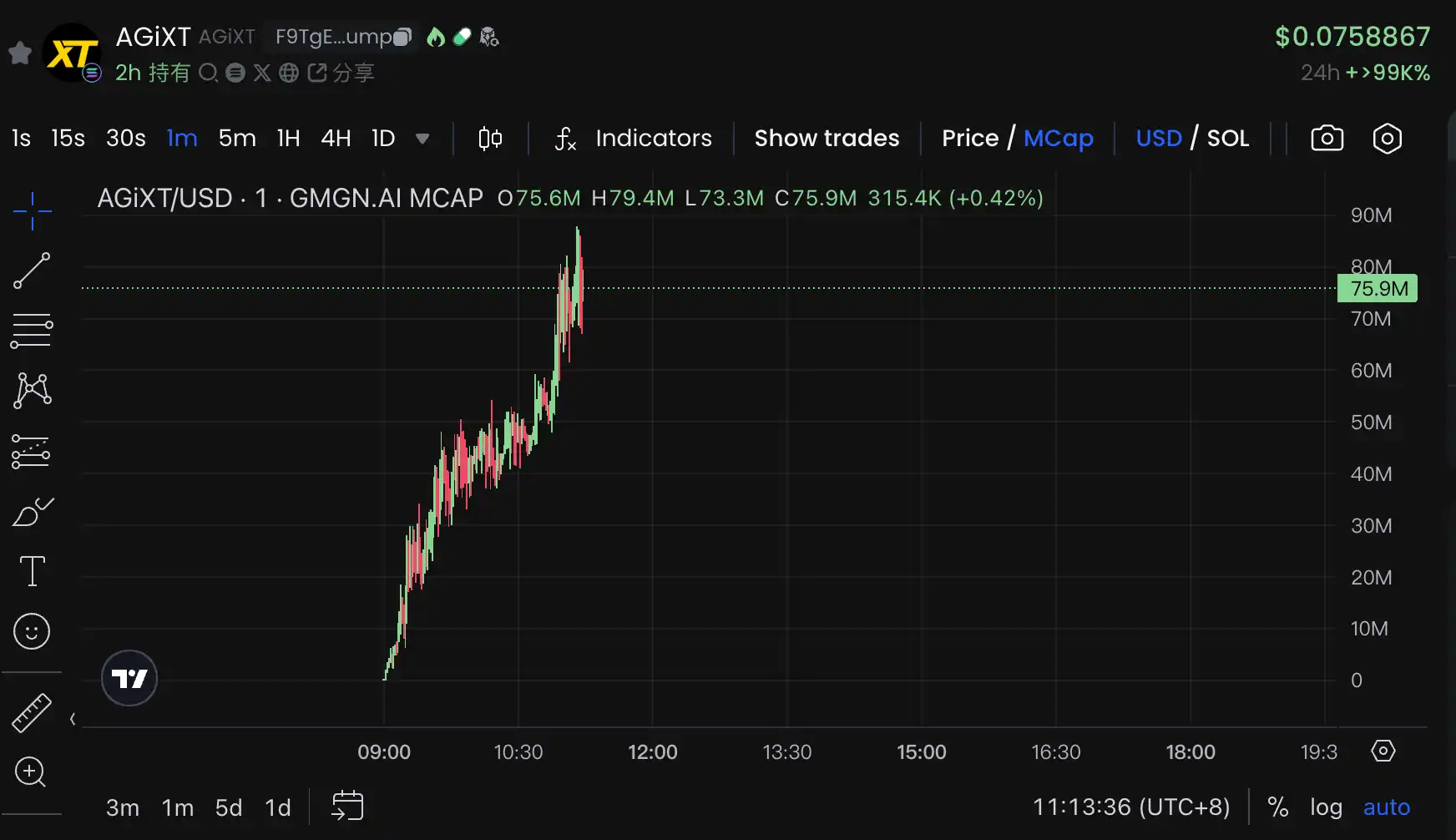
At 9 a.m. this morning, a new AI Agent token named $AGIXT appeared, and in less than a mere 2 hours, its market cap swiftly reached $80 million; even more dramatically, during this period, the token's trading volume reached 96 million, showcasing a long-lost market activity.
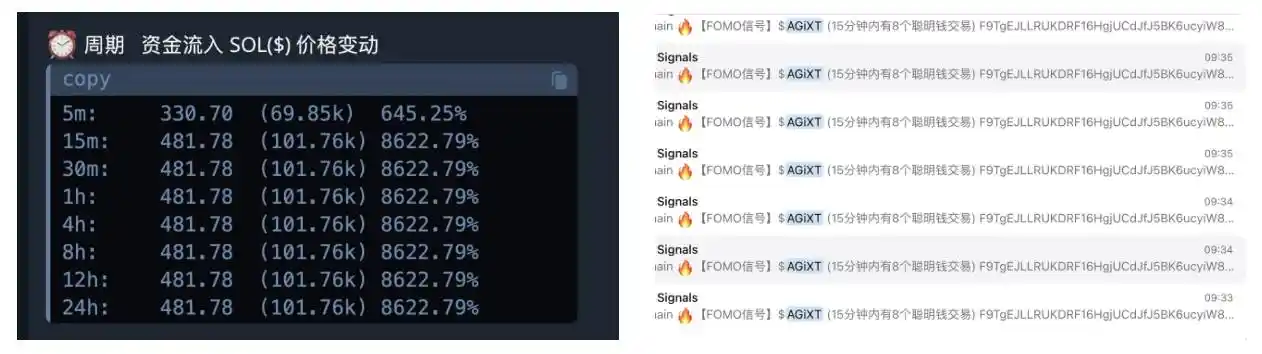
And as people belatedly caught on, contrasting with this was a significant amount of smart money swiftly buying into AGIXT within half an hour of the token launch, with on-chain data showing plenty of whales making single transactions of over 50 SOL.
What exactly is this AGIXT, and how does it differ from other AI Agent tokens? Our editors took a look at its Github and more information to quickly introduce you to AGIXT.
2700 Likes, an AI Automation Framework
Sometimes, the technical details of an AI Agent token are not actually what people care about; what people care about is whether there are any clues that make this project "look good."
Following this idea, the number of likes on Github has gradually become a marketing point for an AI Agent token—more likes indicate more developer approval, which also highlights the project's technical influence and strength.
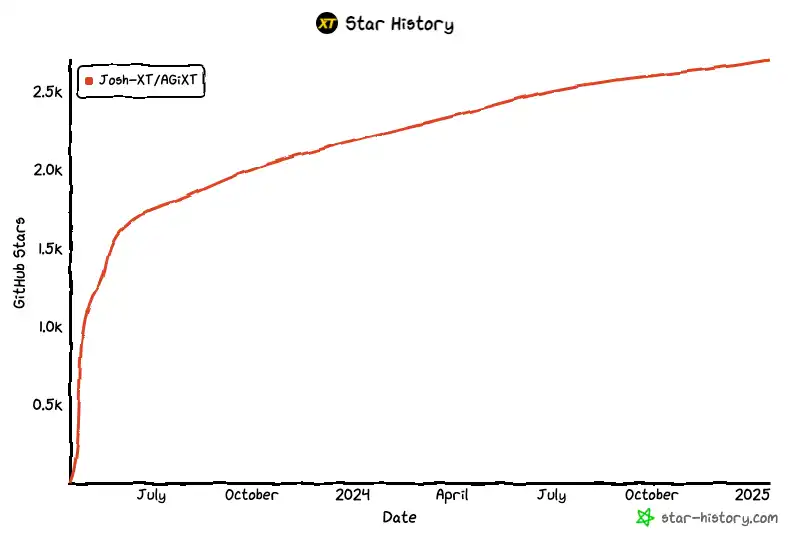
Browsing through AGIXT's code repository, you can find that the project's number of likes (Stars) has exceeded 2700, which indeed surpasses projects solely based on air-blown stories and random github creations.
More importantly, these likes were not recently inflated.
From the Star History below, it can be seen that the project started as early as last year, and since July 2023, the GitHub star count has shown a steady upward trend.
If it's just for show, then the setup has been too long; even before the entire AI Agent narrative began. Therefore, this looks more like a project done outside the circle, trying to tokenize in this wave of hype and then being discovered for its value.
However, what is this AGIXT all about?
Looking at the official description from the code repository, AGIXT is essentially an AI automation platform, simply put, it enables AI to automatically perform more complex tasks. Its main feature is the ability to simultaneously invoke multiple AI models (such as OpenAI, Claude, etc.) to collaborate, like having a team of AI assistants at your disposal.
While this might sound like developer speak, what can you actually do with this platform?
For end users, you can make natural language requests to tools built on this platform's API and receive actionable results. In plain language, it means having a conversation with AI in natural language and getting answers in various task scenarios.
This may sound similar to what popular frameworks are doing nowadays, but this project has a few enticing highlights:
1. Multi-Tasking Capability: It can handle not only simple conversations but also automate task planning, internet information searches, command execution, and even support voice interactions—think of it as a supercharged version of ChatGPT.
2. Decent Memory: The platform features an intelligent memory system that enables AI to maintain conversation context over the long term, avoiding "amnesia" scenarios.
3. High Extensibility: Through a plugin system, developers can easily add new functionalities to AGIXT.
4. Comprehensive Compatibility: It supports mainstream AI models, including OpenAI, Hugging Face, etc., allowing users to freely switch between different AI services as needed.
From a technical perspective, AGIXT's design is quite comprehensive, providing not only a Docker quick deployment solution but also equipped with an API interface for easy integration into other applications. This means it can run independently and also seamlessly integrate into other systems.
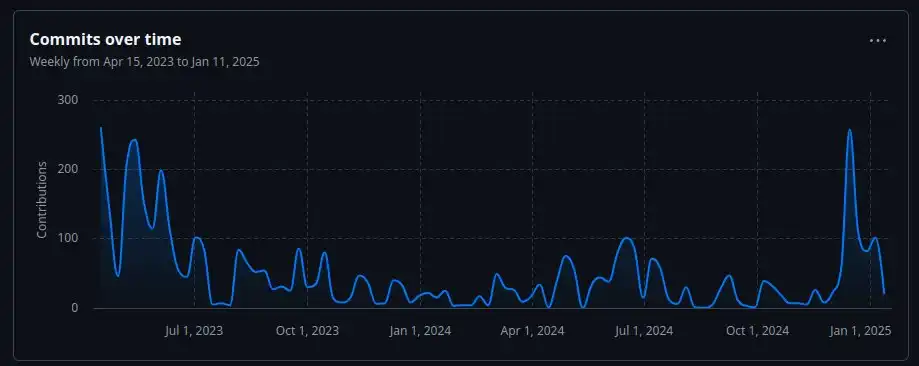
Moreover, the project's update frequency is impressive, with monthly updates over the past year, showing it's not just a token with no substance.
From a narrative standpoint, this looks more like a framework or platform-type project; it itself is not a standalone application, and other projects can leverage its capabilities to create more AI Agents.
However, the actual effect of using AGIXT as an agent still requires more use cases to validate; it can only be said that the existing information presented on the project's GitHub is good so far.
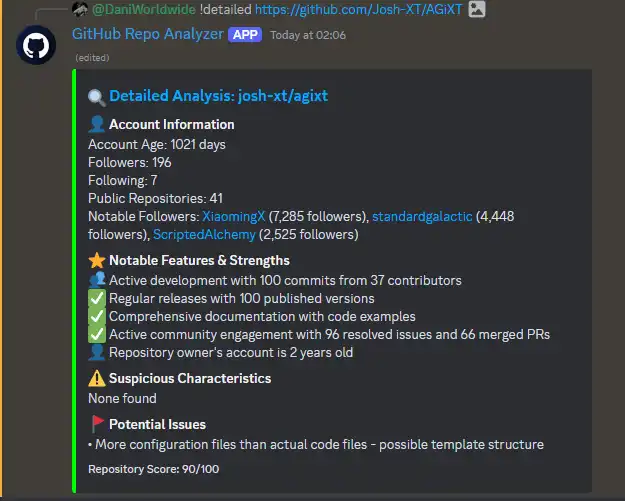
Not a Developer from the Crypto Community, but Focused on AGI Open-Source Contributions
According to associated information, the developer of the AGIXT project is @Josh_XT, a person passionate about continuous contributions to the AI open-source field, who made 8,000 code contributions on GitHub in the past year.
Some netizens have expressed (unconfirmed news) that this dev's level of contribution could rank in the top 2% of all developers on GitHub.
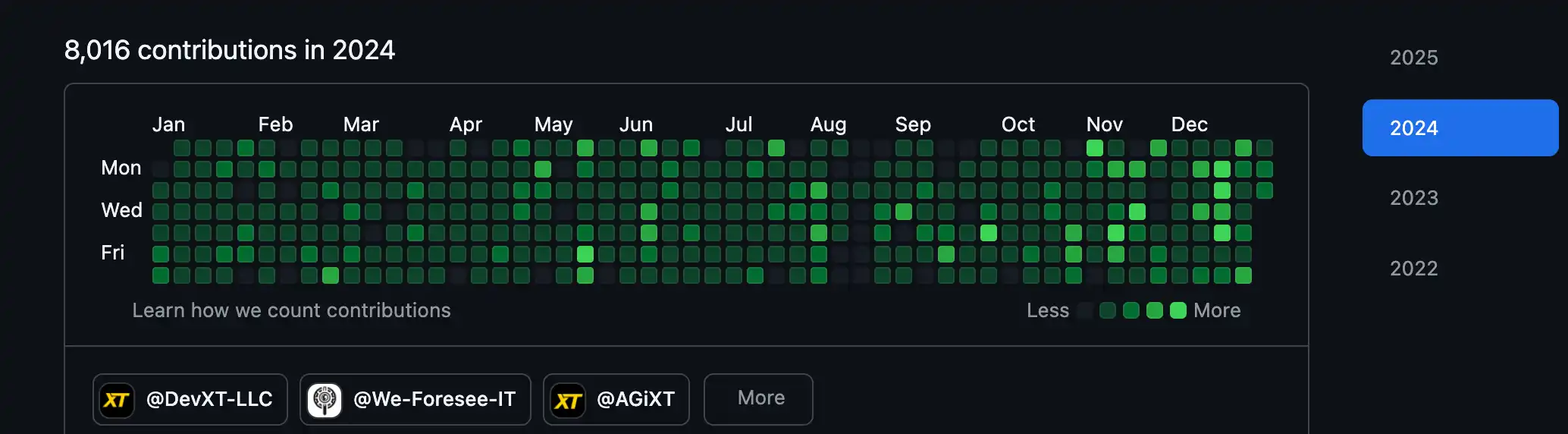
Three hours ago, Josh stated in a tweet that he has "not yet really delved into the cryptocurrency field," but he believes that crypto has indeed provided substantial support to the open-source community.
At the same time, Josh has also begun to attempt token locking for AGIXT.
Public data shows that he is using Streamflow Finance locking to lock 5% (about 22.5 million tokens) of the total 450 million AGIXT tokens for a two-year linear release. Starting from January 16, 2025, an automatic unlocking will occur every two weeks until January 28, 2027.
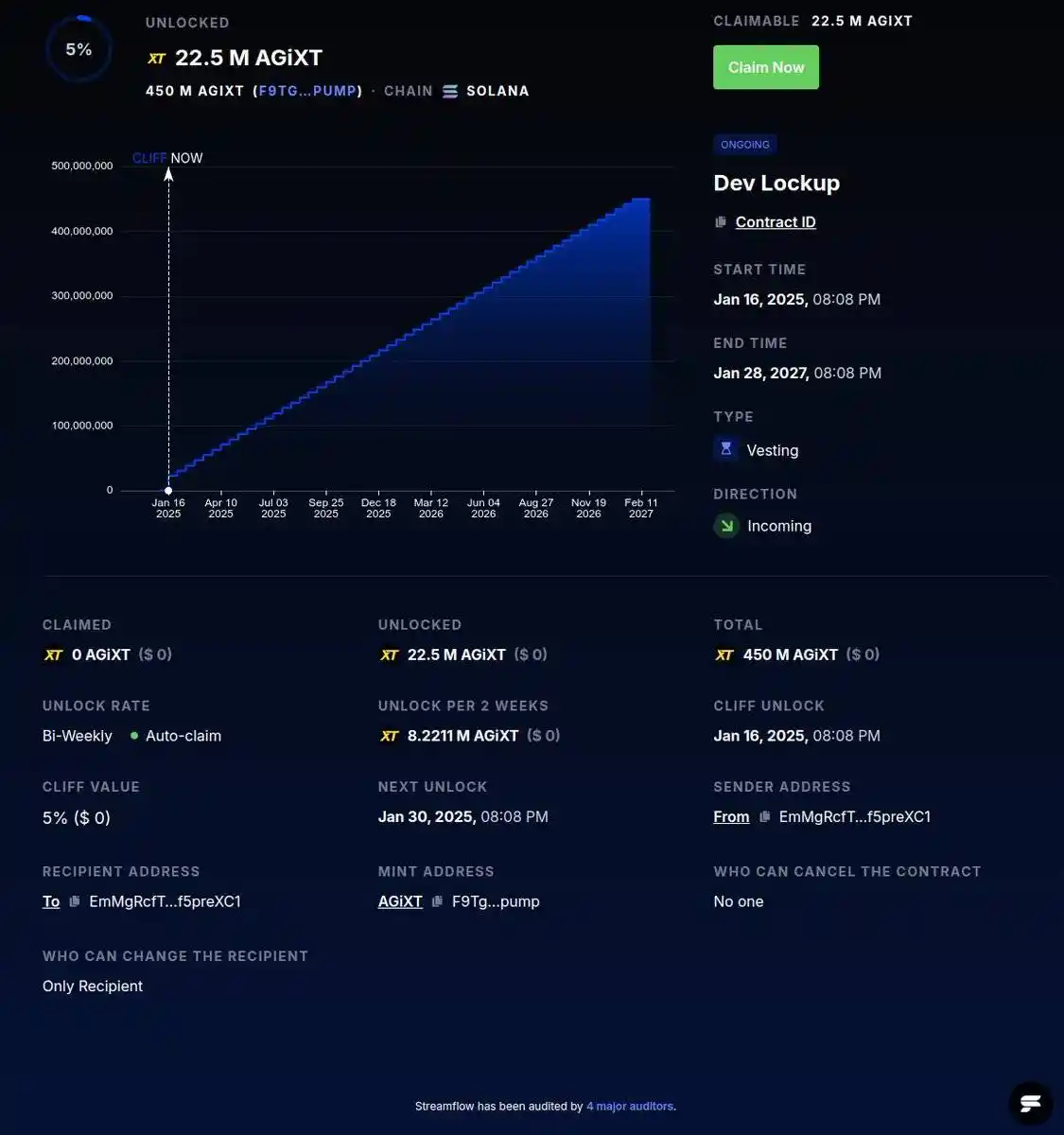
For more information about the project team, you can click here.
More Noteworthy Data
The combination of promising technology and skilled developers makes AGIXT appear somewhat "solid" among many speculative projects.
But does this constitute a reason to FOMO? Here are various pieces of information compiled by the editor. It might be helpful to look at more data before making a decision.
· Early-Stage Influencers Dumping Their Holdings
As the market capitalization of AGIXT rapidly rose above 50 million, more and more discussions could be seen on social media. However, at the same time, observant netizens discovered through data monitoring websites that some early-stage influencers were gradually selling off their holdings to realize profits.
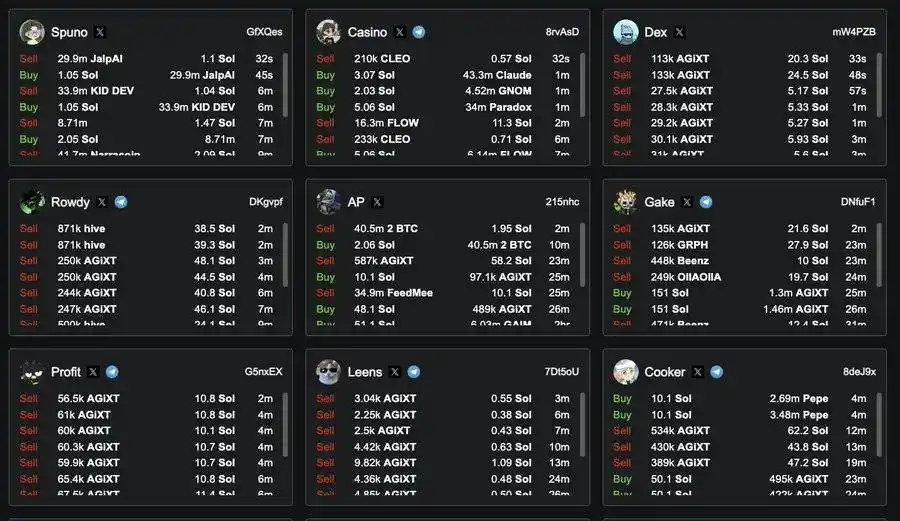
· Lock-up Suspicion
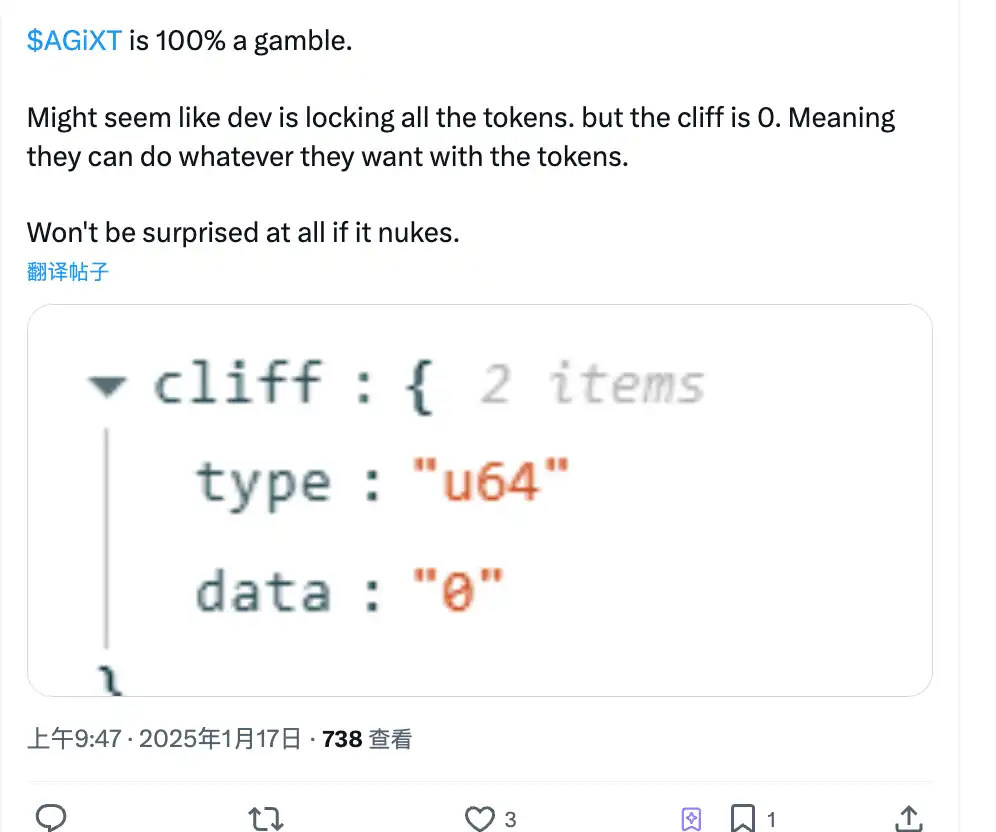
Some users have also pointed out that although the developers were conducting token lock-up, setting the cliff to 0 means that developers can start unlocking tokens from day one, with no mandatory initial lock-up period to protect investors.
This is a red flag, as there are concerns that developers may take advantage of this setting for improper conduct, and warnings have been issued about the potential for a price crash.
· Front-End Holding Too Centralized
Those who have invested in GMGN can use the "Chip Analysis" feature to see that the address HNFC...Sf4G holds 42.83% of the tokens.
Based on the total value shown in the graph of $2.2M, this address holds approximately 71.65M tokens, indicating a highly concentrated token distribution, with the largest holder holding nearly half of the total tokens, and the top few holders collectively controlling over 50% of the tokens.
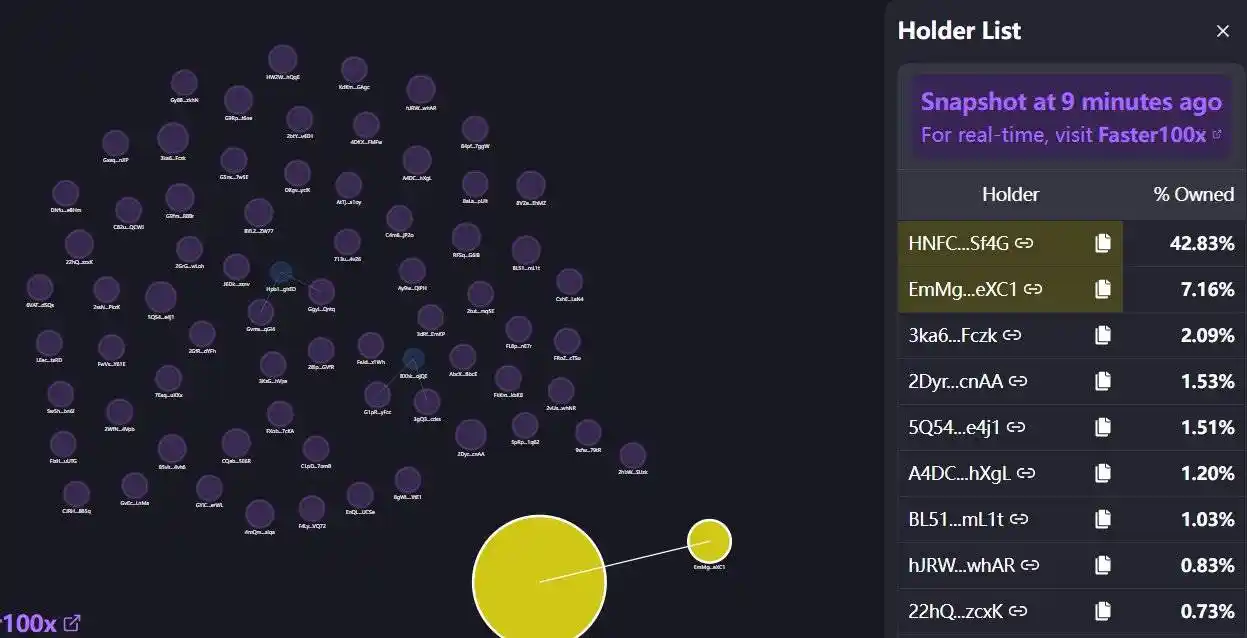
However, chip concentration does not necessarily mean a dump, it simply may indicate that the price influence of the top holders will be strengthened, and it will also be necessary to see whether the top holders have locked up or split their holdings.
Overall, AGIXT is an AI framework with solid code and a high level of developer expertise, but in the three hours since the token opened, the publicly available information is limited to this.
Whether it will be a one-day wonder or a rising star, in the fierce PVP game and with more information released, perhaps the answer will only be seen.
You may also like

Mastercard Launches Agent Pay for AI, Plans to Record AI Agent Payment Authorizations on Polygon
Mastercard launched Agent Pay for AI, a new payment protocol designed to help AI agents make small payments such as pay-per-use access to data and APIs. The system plans to record human-granted AI agent permissions on Polygon, focusing on verifiable authorization, identity, and payment controls.

Curve Deploys Llamalend v2 on Optimism With 250,000 OP Incentives
Curve launched Llamalend v2 on Optimism with 250,000 OP incentives from the Optimism Foundation. The upgrade expands Llamalend beyond its earlier crvUSD-focused model, adding broader collateral support, LlamaRisk market reviews, and the ability to use Curve LP tokens as collateral.

Raydium Old Liquidity Pool Reportedly Exploited, With $1.34 Million Moved to Ethereum and Tornado Cash
An old Raydium liquidity pool was reportedly exploited for around $1.34 million in USDC, RAY, and wSOL, with the stolen funds bridged to Ethereum and deposited into Tornado Cash. The incident highlights the tail risks of legacy DeFi pools, old contracts, and cross-chain fund laundering paths.

Kalshi Executive Challenges “SBF Backed AI Unicorns” Narrative, Says Leopold Aschenbrenner Was Key Figure
Kalshi executive John Wang questioned the “SBF backed AI unicorns” narrative, saying Leopold Aschenbrenner was the key figure behind major AI investment decisions.

Pantera Capital Partner: How Tokenization is Restructuring the Private Equity and Early Investment Ecosystem?

New York Proposes Stricter Stablecoin Issuer Rules Aligned With Federal GENIUS Act
NYDFS proposed stricter stablecoin issuer rules aligned with the GENIUS Act, covering reserves, custody, redemption timelines, audits, and capital buffers.
Every exchange is a "Universal Exchange."

The counterattack of traditional finance: Alliance chains are quietly reviving

CryptoQuant Says Bitcoin Profitable Supply Is Near 45% Pressure Zone as On-Chain Data Points to Market Repricing
CryptoQuant said Bitcoin’s profitable supply is nearing the 45% pressure zone, signaling rising market stress, unrealized losses, and a possible on-chain repricing phase.

Bitcoin Falls Below 200-Week Moving Average as On-Chain Data Shows Over Half of Supply in Loss
Bitcoin dropped below its 200-week moving average as on-chain data showed over 50% of circulating supply is now in loss, signaling rising market stress.

CFTC Reportedly Plans New Prediction Market Rules Focused on Manipulation Risk and Public Interest Review
The CFTC is reportedly preparing new prediction market rules focused on manipulation risk, public interest review, and retail trader protections.

Meet the new WEEX trial fund—your gateway to greater profits

WEEX Labs Lands at Dutch Blockchain Week: A Disruptive Crypto × AI Conversation Sets Sail in Amsterdam
SK Hynix Reportedly Plans U.S. ADR Listing as Early as August, With SEC Approval Possible in Late June
SK Hynix may pursue a U.S. ADR listing as early as August, with SEC approval reportedly possible in late June amid strong AI chip supply chain demand.

SpaceX vs Tesla vs xAI: Which Elon Musk Trade Has the Biggest Upside in 2026?
OpenAI Reveals It Has Confidentially Submitted an S-1 to the SEC, Keeping the Door Open for a Future IPO
On June 9, according to an OpenAI announcement, the company recently confidentially submitted a draft S-1 registration statement to the U.S. Securities and Exchange Commission (SEC), beginning the preliminary compliance process for a potential initial public offering. OpenAI said it chose to disclose this proactively because it expected the news might leak; however, the company has not yet set a specific listing timeline, and related arrangements may still take some time.
Latest research from 13 top universities including Cornell University: The current state, challenges, and misconceptions of the fusion of Crypto and AI
Deconstructing Anthropic: The Best AI Company, Possibly Also a Type of Organizational Invention
Mastercard Launches Agent Pay for AI, Plans to Record AI Agent Payment Authorizations on Polygon
Mastercard launched Agent Pay for AI, a new payment protocol designed to help AI agents make small payments such as pay-per-use access to data and APIs. The system plans to record human-granted AI agent permissions on Polygon, focusing on verifiable authorization, identity, and payment controls.
Curve Deploys Llamalend v2 on Optimism With 250,000 OP Incentives
Curve launched Llamalend v2 on Optimism with 250,000 OP incentives from the Optimism Foundation. The upgrade expands Llamalend beyond its earlier crvUSD-focused model, adding broader collateral support, LlamaRisk market reviews, and the ability to use Curve LP tokens as collateral.
Raydium Old Liquidity Pool Reportedly Exploited, With $1.34 Million Moved to Ethereum and Tornado Cash
An old Raydium liquidity pool was reportedly exploited for around $1.34 million in USDC, RAY, and wSOL, with the stolen funds bridged to Ethereum and deposited into Tornado Cash. The incident highlights the tail risks of legacy DeFi pools, old contracts, and cross-chain fund laundering paths.
Kalshi Executive Challenges “SBF Backed AI Unicorns” Narrative, Says Leopold Aschenbrenner Was Key Figure
Kalshi executive John Wang questioned the “SBF backed AI unicorns” narrative, saying Leopold Aschenbrenner was the key figure behind major AI investment decisions.
Pantera Capital Partner: How Tokenization is Restructuring the Private Equity and Early Investment Ecosystem?
New York Proposes Stricter Stablecoin Issuer Rules Aligned With Federal GENIUS Act
NYDFS proposed stricter stablecoin issuer rules aligned with the GENIUS Act, covering reserves, custody, redemption timelines, audits, and capital buffers.


