
What Are Prediction Markets? The Complete 2026 Guide


If you've checked the odds of a Fed rate cut or the likelihood of a government shutdown lately, you've probably landed on a prediction market platform like Polymarket or Kalshi. These aren't your average pollsters—they're markets where people put real money on the line.
Here's the thing about prediction markets: they're not some pundit's hot take on TV. They're crowdsourced probability machines. Anyone with a crypto wallet and an opinion can participate. And when money's at stake, people tend to be honest.
This guide covers:
- How prediction markets actually work
- The biggest platforms and which one fits your style
- How to trade event contracts profitably
- The risks that can wipe you out if you're not careful
Key Takeaways
- Prediction markets let you bet on real-world outcomes—elections, crypto prices, economic data—by trading contracts with other participants.
- Prices reflect crowd-sourced probabilities. A $0.65 contract price means the market sees a 65% chance of that event happening.
- Polymarket leads the space with $1B+ monthly volume, followed by regulated players like Kalshi.
- You can profit through information arbitrage, selling hype, statistical edges, or following smart money on-chain.
- Biggest risks: resolution disputes, insider trading, and low liquidity manipulation.
What Are Prediction Markets?
Think of prediction markets as financial exchanges for future events. Instead of buying stocks, you're buying contracts on whether something will happen—will the Fed cut rates? Will Bitcoin hit $100K? Will a specific bill pass Congress?
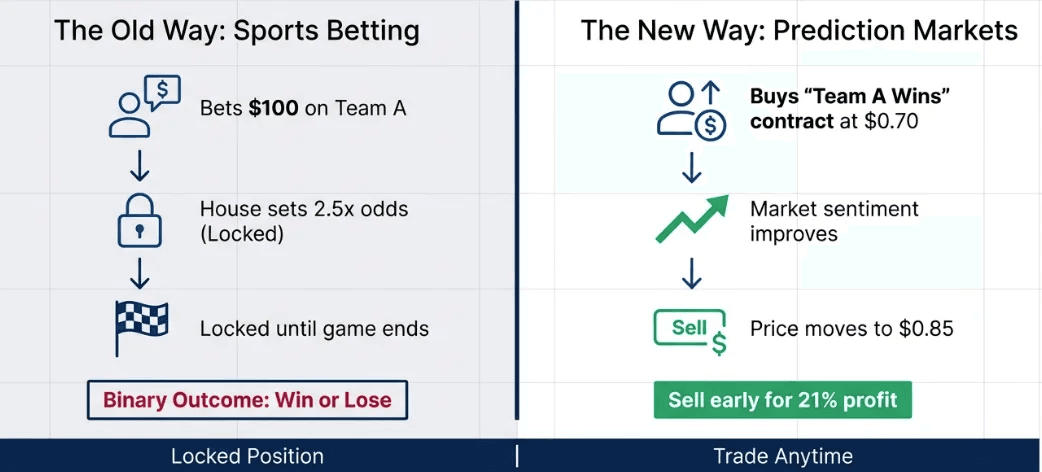
Here's the simple mechanic: you buy a YES contract at a certain price. If the event happens, you get $1 per contract. If not, it expires worthless. The price reflects the market's collective probability estimate.
How it's different from sports betting:
| Sports Betting | Prediction Markets | |
| Who sets the odds? | The bookmaker | The crowd (supply/demand) |
| Can odds change after you bet? | No, locked in | Yes, updates in real time |
| Can you exit early? | Usually no | Yes, anytime before resolution |
Why do prediction markets actually work? Because money creates honesty. Polls ask for opinions—people lie. Markets demand real capital—people tell the truth. That's why these platforms often beat professional pollsters at forecasting elections.
Pro tip: Use prediction market odds as a sanity check before big decisions. Planning to buy a house? Check Kalshi's inflation forecasts. Launching a product? See what Polymarket says about regulatory risk.
How Prediction Markets Actually Work
Let's walk through a real example so you can see the mechanics.
Scenario: The 2026 U.S. midterm elections. You want to bet on whether Democrats keep the Senate.
Step 1: Market opens
Event: "Will Democrats control the Senate after the 2026 midterms?"
Two outcomes: YES or NO. Contracts trade between $0.00 and $1.00.
Step 2: Do your homework
Polls show Democrats up 8 points in key swing states. But historical data says the party in power usually loses midterms. You weigh both.
Step 3: Place your trade
You buy 1,000 YES contracts at $0.55 ($550 total). If Democrats win, each contract pays $1.00—you get $1,000, netting $450 profit. If they lose, your contracts expire worthless—you lose $550.
Step 4: Market moves
A scandal breaks two weeks before the election. YES contracts drop to $0.40. You can sell immediately to cut your loss at $400 (down 27%), or hold and hope for a turnaround.
Step 5: Resolution
Election night. Democrats win. Your 1,000 contracts pay out $1,000. Total profit: $450. ROI: 82% over six months.
The beauty is that you can exit anytime. Prices update constantly as new information flows in—just like crypto trading.
Pro tip: Prediction markets are most profitable when you have information the crowd hasn't priced in yet. If you understand crypto regulation deeply and see a bill passing that others are sleeping on, you have an edge. Trade it.
The Biggest Prediction Market Platforms in 2026
1. Polymarket – The Crypto Leader
- Monthly volume: $1B+
- Currency: USDC (deposit crypto, trades settle in USDC)
- Best for: U.S. politics, crypto events, pop culture, celebrity drama
Why it's #1: No KYC, instant deposits, mobile-friendly. Most new users don't even realize it's a crypto-native DApp.
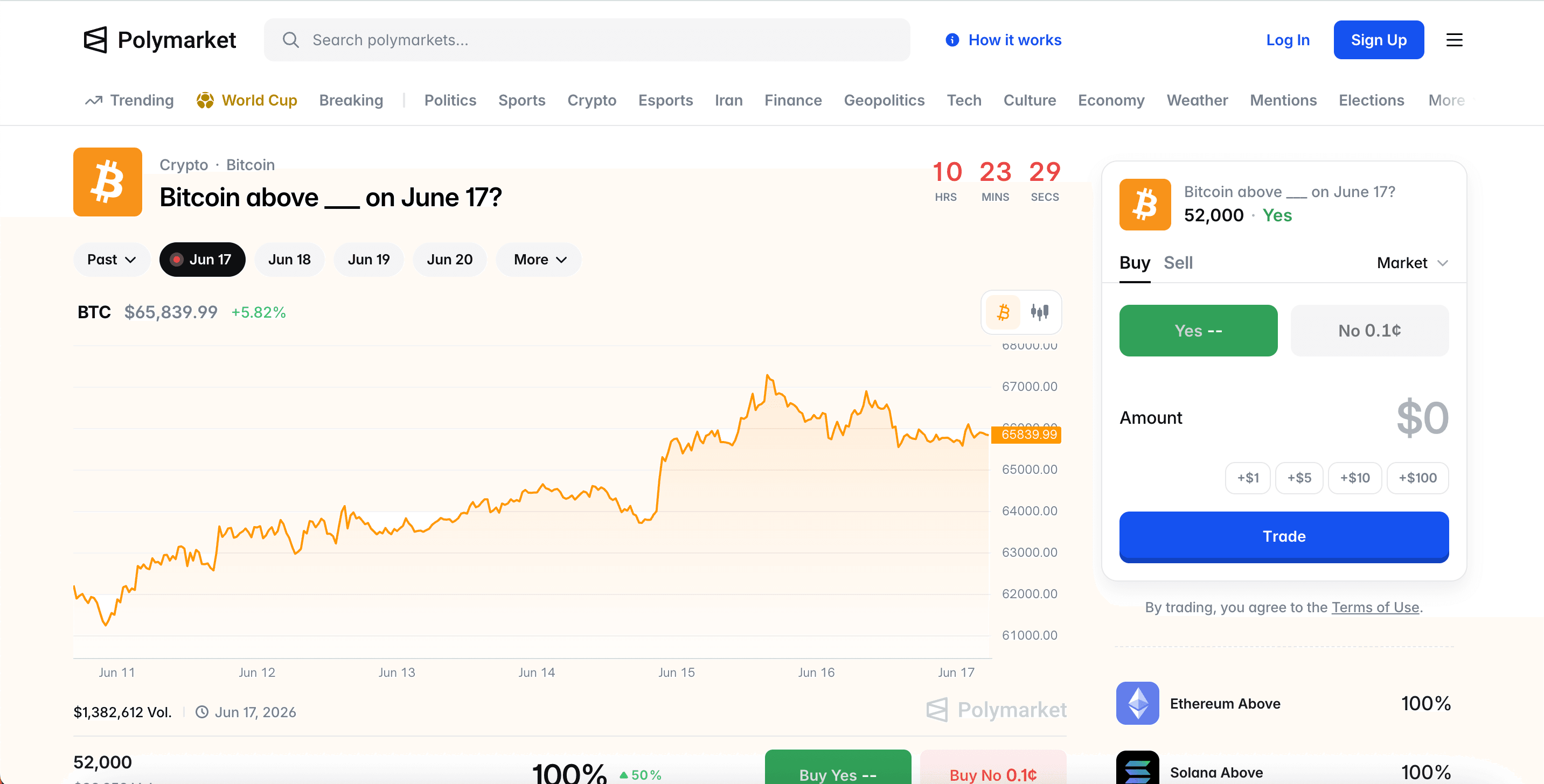
Most traded events:
- Presidential primaries
- Bitcoin price targets
- Celebrity scandals
2. Kalshi – The Regulated Contender
- Monthly volume: $85M
- Currency: USD (crypto accepted for deposits)
- Known for: First legal prediction market in the U.S.
- Catch: Lower liquidity than Polymarket, fewer event categories
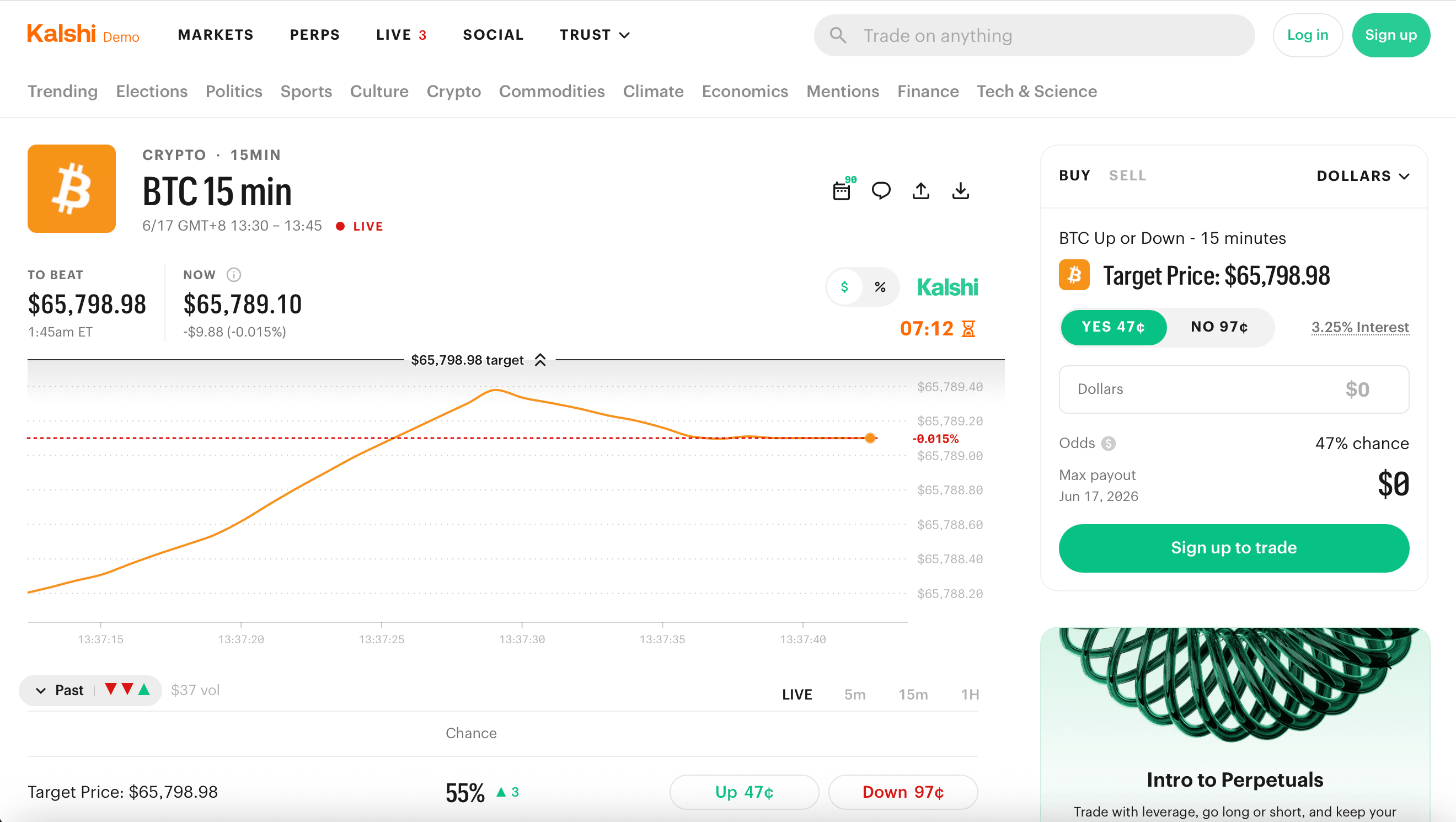
Most traded events:
- Fed interest rate decisions
- Inflation reports
- Congressional bill outcomes
- Weather events
3 Biggest Risks to Know in Prediction Market Trading
Risk 1: Resolution Disputes
What happens when the outcome isn't crystal clear?
Real example: Polymarket hosted "Will Elon Musk step down as Twitter CEO by Dec 31, 2024?" Elon announced Linda Yaccarino as CEO in May 2023—but he stayed on as executive chairman and kept tweeting. Did he "step down"? Traders were split 50/50.
Polymarket resolved it as YES. Some traders lost money on a technicality.
Most markets resolve via oracles (Polymarket uses UMA protocol). Oracles can be gamed or misinterpreted. Always trade markets with clear, unambiguous resolution criteria. Avoid vague events like "Will Bitcoin be widely adopted by 2030?"—what counts as "widely adopted"?
Risk 2: Insider Trading
Prediction markets are largely unregulated, which makes insider trading a real threat.
Real example: In 2024, someone bet $700K on "Will Sam Bankman-Fried be convicted?"—YES contracts, 48 hours before the jury verdict. They knew something. They walked away with $1.2M.
What to watch for: Sudden whale bids on low-liquidity markets with no news to justify the move. If "Will FDA approve Drug X?" spikes from $0.30 to $0.80 on $200K volume with zero headlines, someone probably knows something. Do your own research before following.
Risk 3: Low Liquidity
Small markets are easy to manipulate.
Example: Market: "Will Bitcoin hit $100K by June 2026?" Total liquidity: $50K. You buy $30K of YES contracts at $0.55, price spikes to $0.72 because you just ate half the order book. You sell immediately at $0.72, booking a quick 31% gain. Price crashes back to $0.55 after you exit.
You just manipulated the market. Is it illegal? In most regulated jurisdictions, yes—but enforcement is still catching up to the technology.
Final Thoughts
Prediction markets are evolving into serious forecasting tools—not gambling parlors. Use them to gauge probabilities on elections, Fed moves, and crypto outcomes. Treat them as information markets, stick to high-liquidity platforms, and only trade when you have an edge. They won't replace traditional forecasting overnight, but for traders who spot mispriced contracts, the opportunity is real.
Beyond speculation, they also offer a practical hedging function. Heavy on crypto? Hedge regulatory risk with event contracts. In real estate? Inflation markets can serve as a macro hedge. Smart traders use prediction markets not just to bet—but to protect positions and exploit information asymmetries.
FAQ
Q: Is it illegal to use Polymarket?
Polymarket operates in a legal gray zone that varies heavily by location. Federally in the U.S., it is a legal, licensed derivatives exchange regulated by the Commodity Futures Trading Commission.
Q: What's the difference between prediction markets and sports betting?
Sports betting pits you against the bookmaker, who sets the odds. Prediction markets are peer-to-peer—the crowd sets prices through supply and demand. You can also exit positions early in prediction markets, which sports betting typically doesn't allow.
Q: Can I lose more than I invest?
No. Unlike leveraged trading, your maximum loss is the amount you pay for contracts. If you buy $1,000 worth of YES contracts and the event doesn't happen, you lose $1,000—nothing more.
Q: Are prediction markets legal?
It depends on your jurisdiction. In the U.S., Kalshi is regulated and legal. Polymarket operates in a gray area—it's accessible but not formally regulated. Always check your local laws before participating.
Disclaimer: This content is provided for general informational and educational purposes only and should not be considered financial, investment, legal, or tax advice. Nothing in this article constitutes an offer, recommendation, solicitation, or invitation to buy, sell, or trade any crypto asset or use any specific service. Crypto assets are highly volatile and involve risk, including the potential loss of capital. WEEX services may not be available in all regions and are subject to applicable laws, regulations, and user eligibility requirements. Please carefully assess risks and confirm local requirements before making any financial decisions.
You may also like

How to Buy Cryptocurrency on WEEX Exchange 2026: Full Guide
Prediction Market Apps 2026: How Prediction Markets Work? Are They Safe and Legal?
Is Polymarket Legal in India in 2026? Key Legal Updates on Prediction Markets
14 Best Prediction Market Apps in 2026: The Ultimate Guide to Crypto-Native and Regulated Platforms
Can Politicians Rig Election Prediction Markets? The Dark Side of Election Prediction Markets
2026 US Election Odds: Who Leads Right Now on Polymarket and Kalshi?
What Is a Crypto Prediction Market? Key Opportunities in the Prediction Market Sector
Plot twist in the AI race—the next big flex is actually physical infra?
How to Profit on Prediction Market: A Beginner's Guide to Prediction Market
Decentralized Prediction Market: A Beginner's Guide for WEEX Users
Kalshi Prediction Market Explained: How It Works and Who Can Use It
What Is WXT Used For? A Beginner's Guide to WEEX Token Utility
Top Prediction Market Websites in 2026: Which Platform Is Best for You?
How to Start Spot Trading on WEEX: No Leverage, No Liquidation Risk
What Is a Prediction Market Platform? How It Works and Key Risks
Can You Make Money on Prediction Markets? Risks and Strategies
Is a Prediction Market Just Gambling? How It Works and Key Risks
What Are the Most Popular Prediction Market Platforms in 2026?
How to Buy Cryptocurrency on WEEX Exchange 2026: Full Guide
Prediction Market Apps 2026: How Prediction Markets Work? Are They Safe and Legal?
Is Polymarket Legal in India in 2026? Key Legal Updates on Prediction Markets
14 Best Prediction Market Apps in 2026: The Ultimate Guide to Crypto-Native and Regulated Platforms
Can Politicians Rig Election Prediction Markets? The Dark Side of Election Prediction Markets
2026 US Election Odds: Who Leads Right Now on Polymarket and Kalshi?
Contents
Popular coins


