
Why Silver is More Volatile Than Gold and How to Trade Silver in 2026? Full Guide for Beginners


Gold and silver have long been the twin pillars of precious metals investing, offering shelter during economic uncertainty and a hedge against inflation. Yet anyone who has watched both markets knows they don't move the same way. Silver's price swings are visibly sharper, its rallies more explosive, and its corrections more punishing.
This isn't random. It's structural. Understanding why silver behaves differently from gold is the key to deciding whether silver belongs in your portfolio—and how to trade it without getting burned.
Key Takeaways
- Silver is 2–3 times more volatile than gold due to its smaller market size, lower liquidity, and dual role as both a monetary metal and an industrial commodity .
- Industrial demand drives the difference: Over 50% of silver consumption comes from solar panels, electronics, EVs, and 5G infrastructure, making it highly sensitive to economic cycles .
- Gold is a stability play—central bank reserves, deep liquidity, and limited industrial use keep its price more measured .
- The silver market is roughly one-tenth the size of gold's, meaning moderate capital flows can trigger outsized price moves .
- Tokenized silver products like XAG on WEEX offer 24/7 trading, leverage, and zero-fee promotions, bringing precious metals into the crypto ecosystem .
The Core Question: Why Is Silver More Volatile Than Gold?
The answer to the million-dollar question—"why is silver more volatile than gold?"—comes down to three interrelated factors: market structure, demand composition, and supply dynamics.
Silver isn't just "gold's cheaper cousin." It's a fundamentally different asset with a different risk-reward profile.
Market Size and Liquidity: The Structural Disadvantage
The silver market is significantly smaller than gold's—estimated at roughly one-sixth to one-tenth the size . Daily trading volumes for gold are 5 to 10 times higher than for silver, with tighter bid-ask spreads and deeper order books .
This matters because:
- A $100 million inflow into gold barely moves the needle.
- The same inflow into silver can trigger a 3–5% price swing.
- The market's smaller float means large institutional trades or leveraged positions have an amplified effect on price .
For traders, this creates opportunity—and risk. The same thin liquidity that allows silver to surge also leaves it vulnerable to sharp corrections.
Silver's Dual Nature: Monetary Metal + Industrial Commodity
This is the most critical distinction between silver and gold.
Gold's demand is predominantly driven by:
- Investment and wealth preservation
- Jewellery
- Central bank reserves
Silver, by contrast, has two distinct sources of demand :
- Monetary and Investment Demand
Like gold, silver responds to:
- U.S. dollar strength
- Interest rate expectations
- Geopolitical risk
- Inflation sentiment
- Industrial Demand (50–60% of total consumption)
This is where silver's volatility originates. Key industrial applications include:
- Solar photovoltaics
- Electronics and semiconductors
- Electric vehicles
- 5G infrastructure
- Medical devices
Why This Dual Nature Amplifies Price Swings
When the economy is strong and industrial activity accelerates, demand for silver can rise rapidly, often pushing prices higher and allowing silver to outperform gold .
When growth slows or recession risks increase, industrial demand weakens, causing silver prices to fall sharply—even if safe-haven buying provides some support .
In some environments, investment and industrial demand reinforce each other (inflation coupled with strong clean-energy investment). In others, they move in opposite directions, creating sharp swings and sudden reversals.
Gold, by comparison, has limited industrial use. Its stronger safe-haven profile generally results in lower volatility .
Supply Constraints: The Inelasticity Factor
Silver's supply side adds another layer of volatility.
Most Silver Is a Byproduct
Approximately 70% of silver production comes as a byproduct of mining other metals—copper, lead, and zinc . This means:
- Higher silver prices don't automatically trigger increased production.
- Mining decisions are driven by base metal economics, not silver alone.
- Supply cannot respond quickly to spikes in demand .
Persistent Deficits
The silver market has recorded multi-year supply deficits, including a 210.5 million ounce shortfall in 2024—the fourth consecutive annual deficit . Projections for 2025 suggest another sizeable deficit of roughly 187.6 million ounces.
In a smaller market, these imbalances translate into sharper price adjustments than those typically seen in gold.
Limited Scrap Recycling
While scrap recycling is an important supply source, recovery from products like electronics and solar panels is technically complex or uneconomic . This limited elasticity on both primary and secondary supply channels keeps deficits from self-correcting.
Historical Volatility Comparison
The numbers tell a clear story:
| Metric | Gold | Silver |
| Annualized Volatility | ~14–16% | ~25–30% |
| Daily Price Moves | ~2–3% | ~4–6% (can exceed 10%) |
| Market Size | ~$15T+ | ~$1.5–2T |
| Industrial Demand Share | ~10% | ~50–60% |
Silver's volatility is typically 1.5 to 3 times that of gold. In extreme scenarios—such as the 2011 or 2021 silver runs—volatility can exceed 40% annualized .
For investors, this means:
- Silver is a high-beta play on precious metals. It outperforms in bull markets and underperforms in corrections.
- Gold serves as a portfolio stabilizer. It offers predictable downside protection.
Speculative Activity and Leverage
Silver attracts a higher proportion of short-term traders and speculators than gold.
Why Silver Draws Speculators
- Lower price per ounce: More accessible to retail investors.
- Higher leverage potential: Futures and perpetual contracts allow amplified exposure.
- Meme-stock-like behavior: Silver's price can be heavily influenced by sentiment-driven moves .
The Leverage Effect
In futures and perpetual markets:
- Small moves in silver can trigger large gains or losses.
- Margin calls and forced liquidations can exacerbate price swings.
- Funding rates fluctuate as traders rebalance long and short positions .
Changes in exchange margin requirements—such as CME's adjustments in late 2025—can force leveraged traders to reduce exposure, accelerating corrections .
Why Trade Silver on WEEX
For those looking to trade silver with flexibility and leverage, WEEX offers tokenized silver products that bridge traditional precious metals and the crypto ecosystem.
What WEEX Offers
WEEX has listed tokenized silver products including:
- XAG: A digital derivative tracking silver's spot price, with 1 XAG representing 1 troy ounce of silver .
- Tokenized gold products: PAXG (Paxos Gold) and XAUT (Tether Gold), backed 1:1 by physical gold .
Key features of WEEX:
- 24/7 trading: Unlike traditional markets, WEEX allows trading anytime .
- Leverage up to 400×: Amplify returns (and risks) .
- Zero-fee promotions: Campaigns offering 0% maker/taker fees on silver and gold pairs .
- USDT margining: No separate brokerage account or bank deposit required .
How to Trade Silver on WEEX: Step-by-Step Guide
- Step 1: Go to WEEX official website and Sign up.
- Step 2: Deposit USDT from your wallet or buy crypto via fiat or "Quick Buy".
- Step 3: Go to the futures section and select SILVERXAG/USDT.
- Step 4: Set leverage (up to 400×). Start low—silver is volatile. Set Stop Loss (SL) or Take Profit (TP).
- Step 5: Enter contract size and confirm your order.
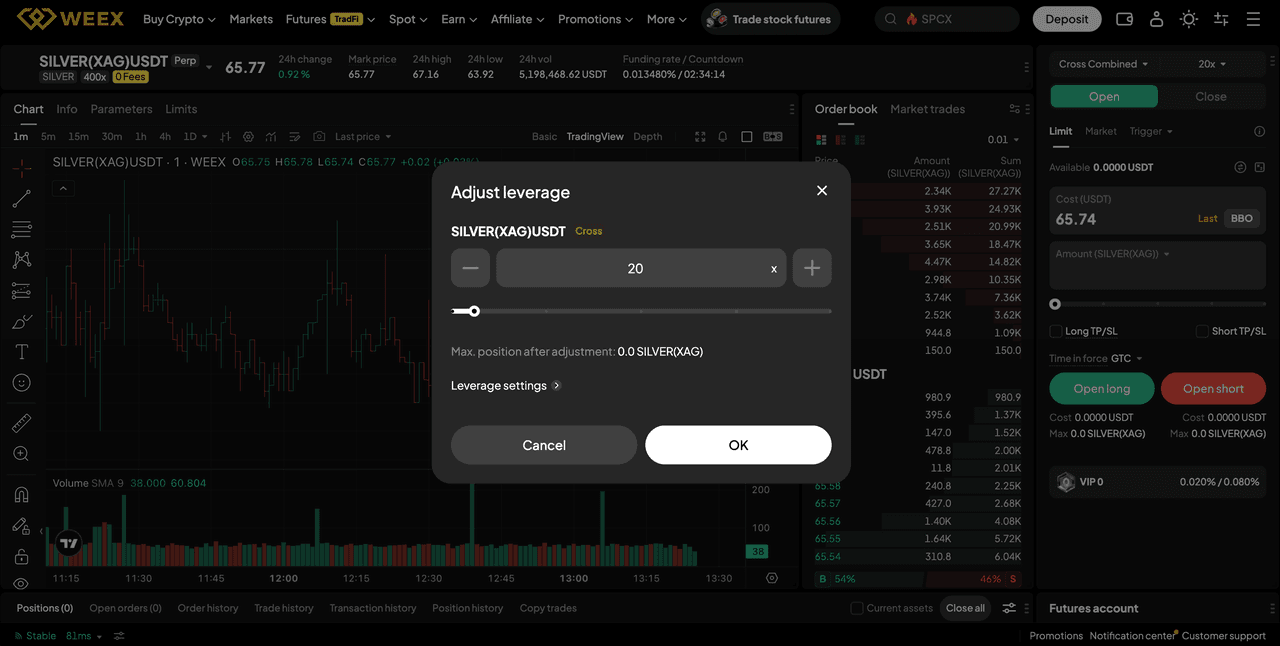
Pro Tip: Take advantage of WEEX's zero-fee campaigns when available. These promotions reduce transaction friction and can significantly improve short-term trading margins .
Silver Risk Management: The Volatility Tradeoff
Silver's volatility creates opportunities—but it also demands discipline.
Key Risks to Monitor
- Economic cycle sensitivity: Silver's industrial demand makes it vulnerable to slowdowns.
- Leverage amplification: High leverage can lead to liquidation cascades during volatile conditions.
- Funding rate fluctuations: Holding positions through settlement windows can add unexpected costs .
- Liquidity constraints: Weekend and holiday trading may see wider spreads .
Final Thoughts
Silver's reputation as gold's "volatile cousin" is well-earned. Its smaller market, lower liquidity, and dual role as both a monetary metal and industrial commodity make it a higher-risk, higher-reward asset than gold. For investors, the choice is clear: gold offers stability and preservation, while silver delivers growth potential and trading opportunities.
The right answer depends on your goals and risk tolerance. For those comfortable with the swings—and equipped with the right tools—silver can be a powerful addition to any portfolio. Many investors hold both, using gold for defense and silver for offense.
Ready to trade silver? Sign up on WEEX Now and Start Trading!
FAQ
Q1: Why is silver more volatile than gold?
Silver's smaller market, heavy industrial demand (solar, EVs, electronics), and higher speculative activity make it 2–3 times more volatile than gold.
Q2: How much more volatile is silver compared to gold?
Silver is 1.5 to 3 times more volatile. Annualized volatility: 25–30% for silver vs. 14–16% for gold.
Q3: Is silver a better investment than gold?
Gold offers stability and preservation. Silver offers higher growth potential but carries more risk. Many investors hold both.
Q4: Can I trade silver 24/7 on WEEX?
Yes. WEEX offers tokenized silver (XAG) with 24/7 trading, USDT margining, and leverage up to 400×.
Q5: What are the risks of trading silver with leverage?
Leverage amplifies losses as well as gains. A 5% silver move can wipe out a 20× position. Use stop-losses and start with conservative leverage.
Disclaimer: This content is provided for general informational and educational purposes only and should not be considered financial, investment, legal, or tax advice. Nothing in this article constitutes an offer, recommendation, solicitation, or invitation to buy, sell, or trade any crypto asset or use any specific service. Crypto assets are highly volatile and involve risk, including the potential loss of capital. WEEX services may not be available in all regions and are subject to applicable laws, regulations, and user eligibility requirements. Please carefully assess risks and confirm local requirements before making any financial decisions.
You may also like

How to Buy Cryptocurrency on WEEX Exchange 2026: Full Guide
Prediction Market Apps 2026: How Prediction Markets Work? Are They Safe and Legal?
Is Polymarket Legal in India in 2026? Key Legal Updates on Prediction Markets
14 Best Prediction Market Apps in 2026: The Ultimate Guide to Crypto-Native and Regulated Platforms
Can Politicians Rig Election Prediction Markets? The Dark Side of Election Prediction Markets
2026 US Election Odds: Who Leads Right Now on Polymarket and Kalshi?
What Is a Crypto Prediction Market? Key Opportunities in the Prediction Market Sector
Plot twist in the AI race—the next big flex is actually physical infra?
How to Profit on Prediction Market: A Beginner's Guide to Prediction Market
Decentralized Prediction Market: A Beginner's Guide for WEEX Users
Kalshi Prediction Market Explained: How It Works and Who Can Use It
What Is WXT Used For? A Beginner's Guide to WEEX Token Utility
Top Prediction Market Websites in 2026: Which Platform Is Best for You?
How to Start Spot Trading on WEEX: No Leverage, No Liquidation Risk
What Is a Prediction Market Platform? How It Works and Key Risks
Can You Make Money on Prediction Markets? Risks and Strategies
Is a Prediction Market Just Gambling? How It Works and Key Risks
What Are the Most Popular Prediction Market Platforms in 2026?
How to Buy Cryptocurrency on WEEX Exchange 2026: Full Guide
Prediction Market Apps 2026: How Prediction Markets Work? Are They Safe and Legal?
Is Polymarket Legal in India in 2026? Key Legal Updates on Prediction Markets
14 Best Prediction Market Apps in 2026: The Ultimate Guide to Crypto-Native and Regulated Platforms
Can Politicians Rig Election Prediction Markets? The Dark Side of Election Prediction Markets
2026 US Election Odds: Who Leads Right Now on Polymarket and Kalshi?
Contents
Popular coins


