
How Crypto Market Reacts to SpaceX IPO: Prediction Markets, Tokenized Stocks, and RWA Trends Reveal





When SpaceX went public on June 16, 2026, it made Wall Street history—and quietly triggered a crypto market chain reaction. Priced at $135, the stock surged past $173, closing with a $2.1T market cap.
Blockchain platforms saw record activity: Hyperliquid moved $1.2B daily volume on SpaceX perps, while Polymarket traders accurately forecasted the $2T–$2.5T valuation range. Traders without traditional access found faster, 24/7 alternatives to bet on SpaceX.
Instead of draining crypto liquidity, the IPO boosted RWA adoption and tokenized securities. Bitcoin rose 2%, and total crypto market cap climbed 1.7%. The message is clear: blockchain and prediction markets like Polymarket are evolving into serious financial infrastructure—not just speculation.
How SpaceX IPO Changed the Game
SpaceX raised roughly $75 billion through its IPO, instantly ranking it among America's largest publicly traded corporations. It now stands alongside Nvidia, Alphabet, Apple, Microsoft, and Amazon in market capitalization.
Institutional demand was staggering. Reports suggest that orders exceeded $350 billion before trading even commenced—a clear signal that investor appetite for space-related assets remains insatiable.
Yet for all the fanfare on Nasdaq, the more intriguing action was unfolding on decentralized exchanges and prediction platforms.
How Crypto Markets Found Their Own Way to Trade SpaceX
Long before traditional investors could buy SpaceX shares through their brokers, crypto traders had already been pricing the company using alternative instruments.
Blockchain platforms rolled out several products designed to mirror SpaceX exposure:
- Tokenized stocks: digital representations of SpaceX shares
- Synthetic assets: derivative products that track stock performance
- Futures: contracts with leverage
- Prediction markets: binary bets on valuation outcomes
Instead of waiting for NYSE or Nasdaq opening bells, traders turned to WEEX Exchange, which offers 24/7 trading, no KYC requirements, and USDT-based settlement for tokenized stocks and stock futures.
Perpetual Futures Steal the Spotlight
The standout performer was Hyperliquid, a decentralized derivatives exchange that offered synthetic SpaceX perpetual futures.
Trading volumes were eye-popping:
- Over 7 million SpaceX perpetual contracts changed hands
- Daily volume exceeded $1.2 billion
- Pre-IPO pricing ranged from roughly $153 to $180
What made this remarkable was how closely these decentralized prices matched SpaceX's eventual Nasdaq debut. In many ways, blockchain-based derivatives provided price discovery that rivaled traditional exchanges—a milestone that didn't go unnoticed by institutional observers.
For those keeping track of crypto market trends, this was a clear signal that decentralized finance is maturing beyond niche speculation.
Tokenized Stocks: The New Frontier
Perpetual futures weren't the only game in town. Tokenized stock offerings drew massive participation from retail and institutional players alike.
Solana-Based Tokenized Shares
Backpack Securities and Sunrise introduced SPCX, a tokenized SpaceX stock built on Solana. Eligible holders can eventually convert these digital assets into actual company shares, creating a direct bridge between traditional finance and blockchain infrastructure.
This development speaks directly to the growing RWA trends that are reshaping how investors think about asset ownership. Stocks, bonds, and even real estate are increasingly finding their way onto distributed ledgers.
How Prediction Markets Get Involved in SpaceX IPO
This is where things get particularly interesting for fans of prediction markets and platforms like Polymarket.
Leading up to and during the IPO, Polymarket hosted contracts asking traders to forecast SpaceX's post-debut valuation. The market assigned roughly a 78% probability that the company would close between $2 trillion and $2.5 trillion on its first trading day.
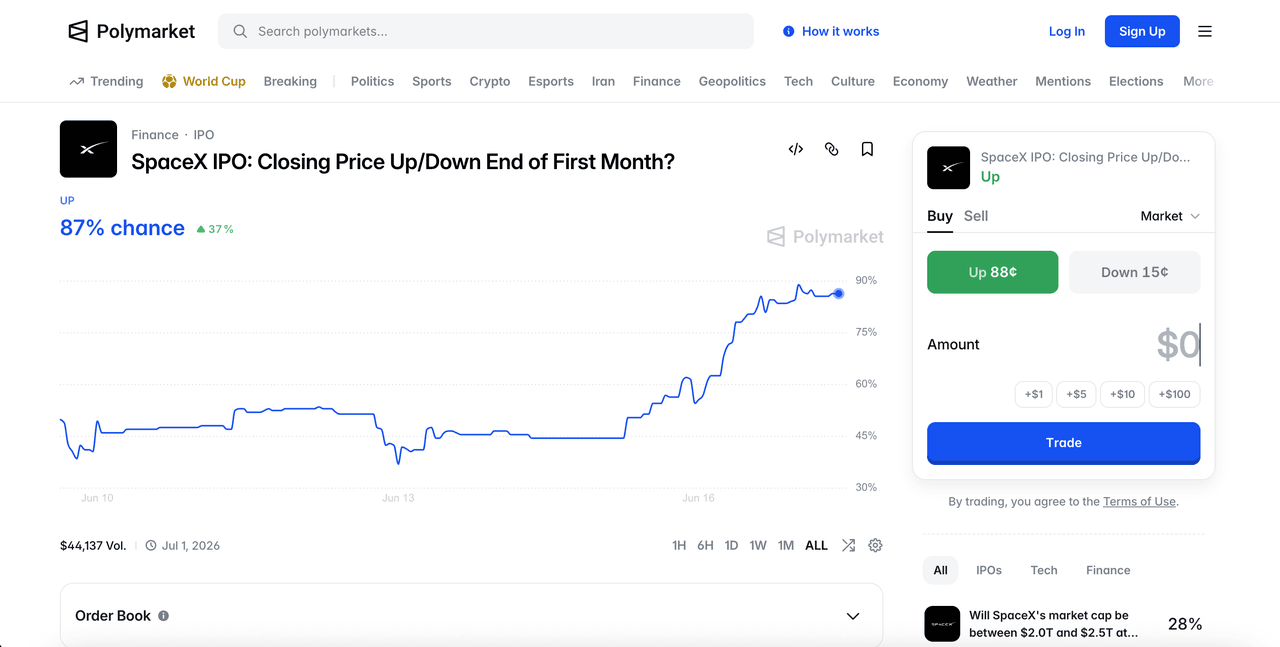
These forecasting platforms added an entirely new layer of price discovery beyond traditional equity analysis. Instead of relying solely on Wall Street analysts, traders could express their views directly through decentralized betting markets.
For anyone following Polymarket activity, the SpaceX IPO offered a textbook case study in how prediction markets can complement—and sometimes even lead—conventional financial forecasting.
RWA Trends: The Bigger Picture
For investors looking beyond the immediate IPO hype, the most significant takeaway may be the accelerating adoption of Real-World Assets on blockchain networks.
RWA refers to traditional financial products—stocks, bonds, treasury bills, real estate, commodities—represented on distributed ledgers. SpaceX has become one of the clearest demonstrations yet that demand for tokenized assets is genuine and growing.
Instead of viewing blockchain only as a cryptocurrency playground, investors increasingly see it as infrastructure capable of modernizing legacy finance.
Many analysts believe future IPOs from companies like OpenAI, Anthropic, or Stripe could generate similar—or even larger—tokenized markets. The infrastructure is now in place, and the appetite is clearly there.
Risks to Know About SpaceX IPO
It would be irresponsible to ignore the challenges. Morningstar estimated a fair value for SpaceX significantly below the IPO price, suggesting that some investors may have paid a premium for hype. Regulatory scrutiny is also intensifying.
Policymakers have raised questions about:
- Investor protection mechanisms in tokenized markets
- Corporate governance standards for digital securities
- Valuation methodology across decentralized platforms
- Overall market integrity and transparency
Tokenized stocks still face regulatory uncertainty across multiple jurisdictions. As adoption grows, clearer rules will likely emerge—but in the meantime, investors should proceed with appropriate caution.
Conclusion
The SpaceX IPO wasn't just a milestone for traditional finance—it became a landmark event for blockchain markets as well. From perpetual futures to tokenized stocks and prediction markets, the IPO showed how decentralized finance is evolving beyond crypto into a broader financial ecosystem. WEEX, with 24/7 trading, no KYC, and USDT-settled tokenized stocks and futures, are lowering barriers and redefining market access.
Rather than weakening digital assets, the IPO strengthened confidence in blockchain infrastructure and reinforced growing RWA trends. As more private tech giants go public, tokenized assets and blockchain trading platforms will play an increasingly vital role in global investing.
Ready to trade? Sign up on WEEX Now and Start Trading!
FAQ
- How did the SpaceX IPO affect the crypto market?
The IPO generated massive interest in blockchain-based investment products, including tokenized stocks, perpetual futures, and prediction markets. Rather than reducing crypto liquidity, it created additional trading opportunities and attracted new participants to the ecosystem.
- What role did prediction markets like Polymarket play during the SpaceX IPO?
Polymarket hosted valuation prediction contracts that allowed traders to bet on SpaceX's post-debut market cap. The market accurately forecasted a $2 trillion–$2.5 trillion close, demonstrating how prediction markets can complement traditional financial analysis.
- Why didn't Bitcoin drop during the SpaceX IPO?
Many expected a sell-off as institutions raised capital for the IPO. However, Bitcoin actually gained roughly 2%, suggesting that today's crypto market has deeper liquidity and broader participation than in previous cycles.
- What are tokenized stocks and how do they work?
Tokenized stocks are blockchain-based digital assets that represent ownership or economic exposure to publicly traded shares. They allow investors to trade traditional stocks on crypto platforms, often with greater flexibility and 24/7 access.
- What are RWA trends and why do they matter?
Real-World Assets (RWAs) bring traditional financial instruments like stocks, bonds, and real estate onto blockchain networks. This expands crypto's use cases beyond digital currencies and opens new investment opportunities for both retail and institutional investors.
- Where can I trade SpaceX-related crypto products?
Several platforms offer SpaceX exposure, including Hyperliquid (perpetual futures), Binance (tokenized campaigns), and Backpack Securities (Solana-based SPCX tokens). Always conduct your own research before trading.
- What risks should I consider with tokenized stocks?
Tokenized stocks face regulatory uncertainty across jurisdictions, potential valuation discrepancies, and governance challenges. Investors should carefully evaluate platform credibility and legal frameworks before participating.
- Will future IPOs generate similar crypto market activity?
Likely yes. Companies like OpenAI, Anthropic, and Stripe could generate significant tokenized trading activity, especially as blockchain infrastructure and regulatory clarity continue to improve.
You may also like

How to Buy Cryptocurrency on WEEX Exchange 2026: Full Guide
Prediction Market Apps 2026: How Prediction Markets Work? Are They Safe and Legal?
Is Polymarket Legal in India in 2026? Key Legal Updates on Prediction Markets
14 Best Prediction Market Apps in 2026: The Ultimate Guide to Crypto-Native and Regulated Platforms
Can Politicians Rig Election Prediction Markets? The Dark Side of Election Prediction Markets
2026 US Election Odds: Who Leads Right Now on Polymarket and Kalshi?
What Is a Crypto Prediction Market? Key Opportunities in the Prediction Market Sector
Plot twist in the AI race—the next big flex is actually physical infra?
How to Profit on Prediction Market: A Beginner's Guide to Prediction Market
Decentralized Prediction Market: A Beginner's Guide for WEEX Users
Kalshi Prediction Market Explained: How It Works and Who Can Use It
What Is WXT Used For? A Beginner's Guide to WEEX Token Utility
Top Prediction Market Websites in 2026: Which Platform Is Best for You?
How to Start Spot Trading on WEEX: No Leverage, No Liquidation Risk
What Is a Prediction Market Platform? How It Works and Key Risks
Can You Make Money on Prediction Markets? Risks and Strategies
Is a Prediction Market Just Gambling? How It Works and Key Risks
What Are the Most Popular Prediction Market Platforms in 2026?
How to Buy Cryptocurrency on WEEX Exchange 2026: Full Guide
Prediction Market Apps 2026: How Prediction Markets Work? Are They Safe and Legal?
Is Polymarket Legal in India in 2026? Key Legal Updates on Prediction Markets
14 Best Prediction Market Apps in 2026: The Ultimate Guide to Crypto-Native and Regulated Platforms
Can Politicians Rig Election Prediction Markets? The Dark Side of Election Prediction Markets
2026 US Election Odds: Who Leads Right Now on Polymarket and Kalshi?
Contents
Popular coins


